US Retail Sales Preview: Dollar set to jump above low barrier of expectations, three scenarios
- Economists project US Retail Sales to have dropped in March after bouncing in February.
- Bank of America's downbeat projections – based on its credit card data – have further lowered expectations.
- The US Dollar has room to bounce on a better outcome, yet the trend remains down.

A second "Goldilocks Friday" in a row? The "not too hot, not too cold" Nonfarm Payrolls report from Good Friday has been buoying stocks throughout the week. Another moderately positive release coming now could do the same. For the US Dollar, it means relief – but only temporarily.
Here is a preview of the US Retail Sales report for March 2023, due out on April 14 at 12:30 GMT.
Not too hot, nor too cold – that is what stock traders have received from the labor figures, which showed moderation in job gains and wage growth. Retail sales may provide a similar treat, by marginally beating low expectations.
The economic calendar is pointing to a drop of 0.4% in headline retail sales, repeating last month's decline. The ex-autos core measure is also predicted to fall, by 0.3%, after a slide of 0.1% in February. Only the Retail Sales Control Group carries a more upbeat forecast for a rise of 0.6% after 0.5%.
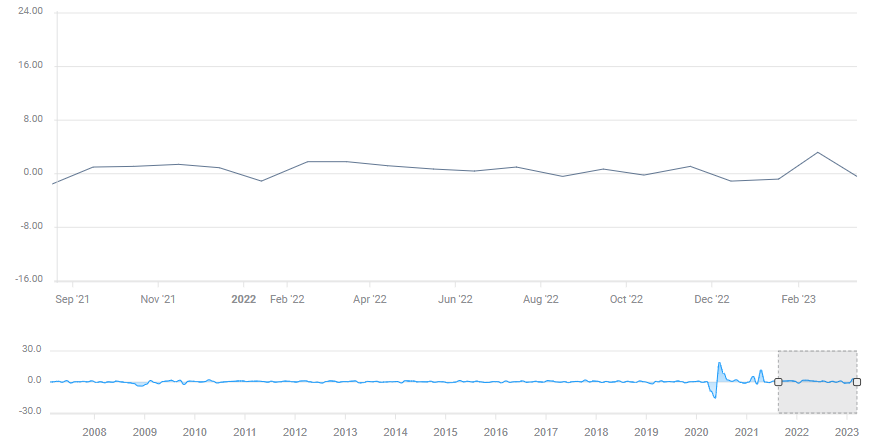
Source: FXStreet
The relentless American consumer has a relatively low bar to pass, which may even be lower. Why? Bank of America, one of the country's top financial institutions, has access to the usage of credit card data. It looks downbeat.
BofA project a below-consensus fall of 1.0% in sales excluding autos and a fall of 0.5% in the Control Group. Its publication on April 12 came after the consensus numbers in the calendar were produced – but have been widely circulated in the financial media. Therefore, real expectations are lower – a lower hurdle to surpass.
Three scenarios for retail sales and their impact on the US Dollar and stocks
If the various Retail Sales figures exceed the low estimates and decline only moderately, it would be the perfect Goldilocks scenario for stocks. On the one hand, America is still growing – consumption is 70% of the economy – but on the other hand, the Federal Reserve (Fed) is in less of a rush to raise rates.
For the US Dollar, it means a boost after several days under pressure. Nevertheless, any such upswing would probably be a "dead-cat bounce" – the Greenback falls in such Goldilocks scenarios. Investors are calm and seek riskier assets abroad.
Another scenario is that Bank of America not only pointed in the correct direction but was too optimistic. If sales declined more than expected, it would weigh on stocks and hurt the US Dollar. If the data is considerably adverse, the Greenback would later bounce and benefit from safe-haven flows.
A third potential outcome – albeit less likely – is a substantial beat of expectations. If sales jumped last month, we could see stocks sink and the US Dollar rising on expectations for more significant rate hikes. Once again, such a scenario is less likely, especially amid the banking crisis.
Final thoughts
The US retail sales report is highly important and will determine the closing moves of the week. I expect a small beat of the downbeat estimates, resulting in an ephemeral increase for the US Dollar, and an extension of the gradual gains in stocks.
Author

Yohay Elam
FXStreet
Yohay is in Forex since 2008 when he founded Forex Crunch, a blog crafted in his free time that turned into a fully-fledged currency website later sold to Finixio.

















