US purchasing managers’ index plunges to decade low

The US factory sector showed its weakest outlook in over 10 years as the China trade war slammed exports and employment.
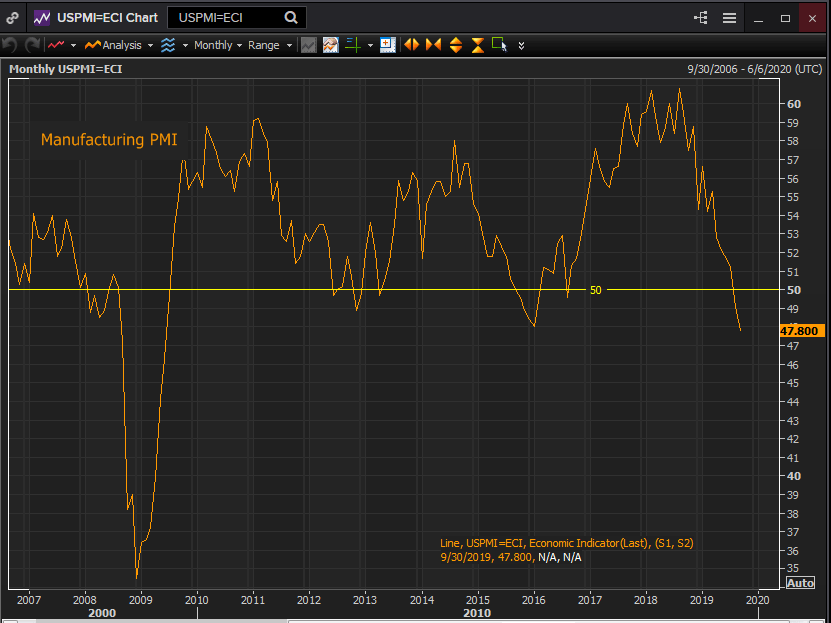
The purchasing managers’ index from the Institute for Supply Management (ISM) turned in a 47.8 score for September, the lowest this gauge has been since June 2009. It was the second month below the 50 demarcation between expansion and contraction. The consensus estimate had been for a rise to 50.1 from August’s 49.1.
Reuters
New orders rose marginally to 47.3 in September from August’s post-recession low of 47.2 but the new export orders index sank to 41.0 from 43.3. Imports came in at 48.1, up 2.1 from August.
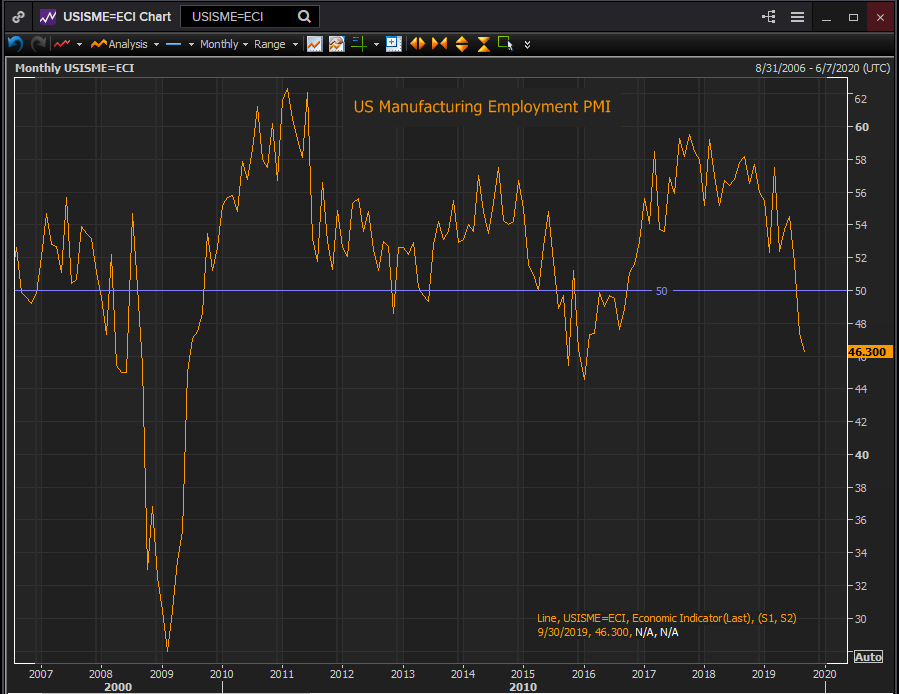
Employment fell to its lowest level since January 2016 at 46.3, also its second month of contraction.
Reuters
The indexes for production, supplier deliveries and inventories declined though the price index rose 3.7 points to 49.7.
Manufacturing work had been one of the achievements of the last two years which saw the largest additions to factory payrolls in a generation.
“Global trade remains the most significant issue, as demonstrated by the contraction in new export orders that began in July 2019. Overall, sentiment this month remains cautious regarding near-term growth,” wrote Timothy Fiore the chair of the ISM Business Survey Commitment in the accompanying statement.
Markets responded swiftly to the negative report. The Dow shed over 250 points after the release and in the early afternoon was off 276 points from Monday’s close.
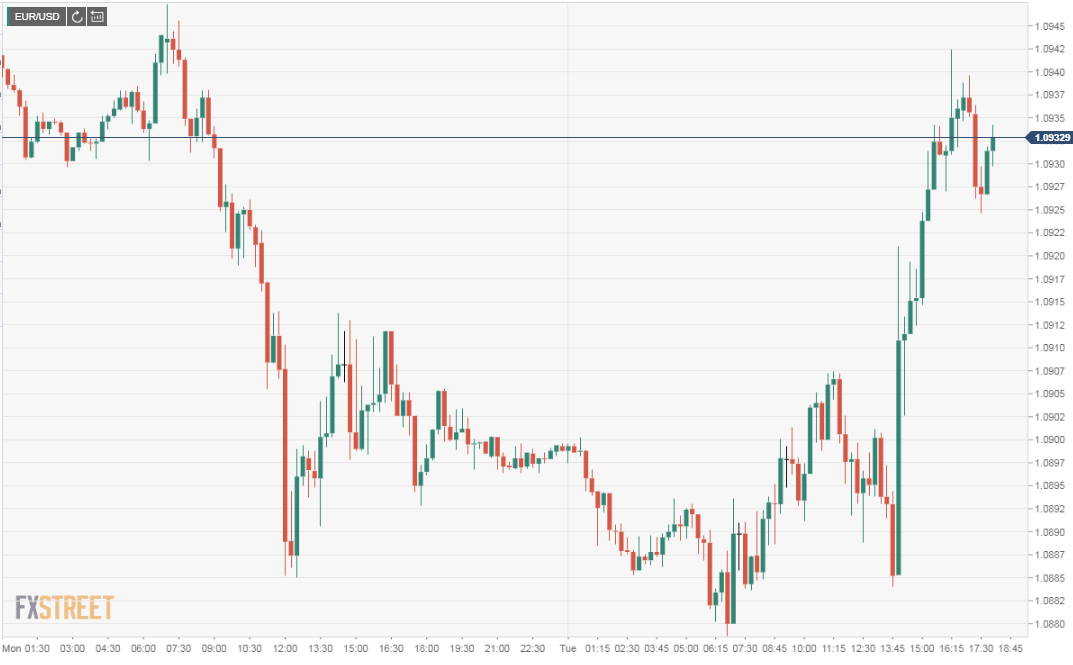
The dollar lost about 40 points against the euro from 1.0885 in the first 30 minutes after the release and continued lower throughout the morning pausing at 1.0935 just after the London close. The US currency dropped a little under a figure versus the yen slipping from 108.40 before the release to 107.66 (1:15 pm EDT).
Short term yields dropped sharply with the 2-year generic Treasury falling 7 basis points to 1.55%. The 10-year generic lost 3 points to 1.64%. The spread between these two benchmark Treasuries widened 1 point to 9 points.
The 10-year Treasury yield has lost 26 points in the last two weeks since reaching 1.90% on September 13th. The 2-year yields has dipped 25 points in the same period from 1.80%.

Reuters
This report and the ISM Services release on Thursday will likely reignite speculation about a Federal Reserve rate cut at the October 29-30 FOMC following 0.25% cuts at the July and September meetings.
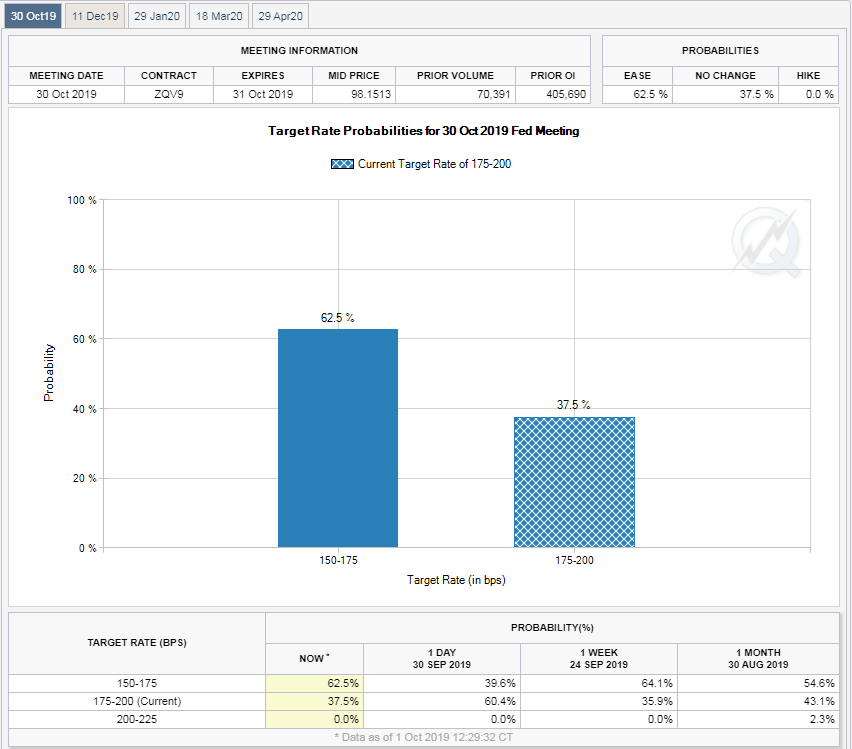
As of this writing the fed funds futures rate the chance of a 0.25% cut at this month’s meeting at 62.5% with 37.5% odds for a hold at the current target range of 1.75%-2.00%.
CME Group
The deepening contraction in the manufacturing sector is the latest indication that the almost two year old trade war with China has reached a critical stage for the manufacturing sector and by implication for the overall economy. Factories are often considered a leading indicator for the entire economy by virtue of the longer lead times needed for increases in manufacturing output.
Manufacturing sentiment and the PMI index rose sharply after the November 2016 election reaching a 14 year high at 60.8 in August 2018. The 12 month average that month was the highest since October 2004.
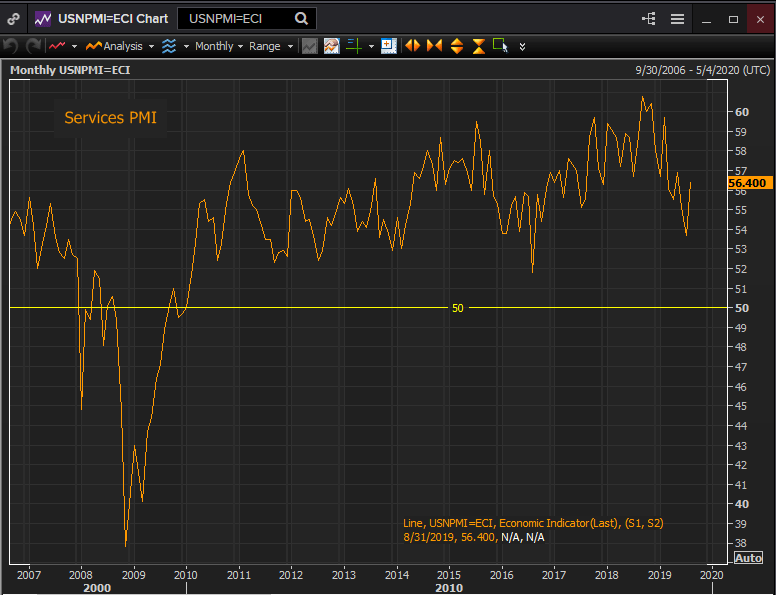
Sentiment in the much larger service sector which is between 85% and 90% of US economic activity has remained expansive though moving lower. It registered 56.4 in August up from 53.7 the prior month and is expected to come at 55.1 when the September figure is reported on Thursday October 3rd at 10:00 am EDT, 14:00 GMT.
Reuters
Author

Joseph Trevisani
FXStreet
Joseph Trevisani began his thirty-year career in the financial markets at Credit Suisse in New York and Singapore where he worked for 12 years as an interbank currency trader and trading desk manager.