US Payrolls day is here


Asian equity markets concluded Friday's session on a predominantly positive note, mirroring the broad-based gains observed across US markets. Japan's Nikkei 225 added 0.7%, a move bolstered by US President Donald Trump putting pen to paper and signing an executive order implementing a trade agreement with Japan. This deal includes a hefty US$550 billion investment pledge from Japan, with the majority of imports subject to tariffs of 15%.
- The S&P 500 ended Thursday up by 0.8% to 6,502, the Nasdaq 100 rose 0.9% to 23,633, and the Dow Jones Industrial Average rallied 0.8% to 45,621.
- The policy-sensitive US two-year Treasury yield fell three basis points (bps) to its lowest level in approximately one year.
- In the FX space, trading was relatively subdued, with a similar picture across commodities, as Spot Gold versus the US dollar (XAU/USD) consolidated around its all-time highs of US$3,578.
US jobs report on deck
The upcoming August US employment report will drive today’s market sentiment. As I mentioned in a previous note, estimates suggest that the economy added 75,000, reflecting another subdued print, down from 73,000 in the previous month. The unemployment rate is forecast to have increased to 4.3%, from 4.2%, and wages are expected to have remained steady at 0.3% MM, though eased to 3.7% (from 3.9%) YY. Revisions will be key here as well!
I have included a screenshot of the LSEG economic monitor below, providing the maximum and minimum forecasts for the above-noted data.

LSEG data
In the run-up to today’s all-important jobs report, coupled with a soft July JOLTS print – which, outside of 7.10 million in late 2024, highlighted the weakest jobs backdrop since the COVID pandemic at 7.18 million – Thursday’s August ADP private payroll data revealed that 54,000 jobs were added in August. This fell short of estimates of 65,000 and marked a substantial deceleration from July’s 104,000 gain. Initial jobless claims also jumped to their highest level since June at 237,000.
Additionally, while business activity expanded in the service sector, according to the August ISM services PMI print, the employment sub-component contracted further. This lines up with comments from ADP Chief Economist Nela Richardson, who stated that job growth faces ‘strong headwinds from uncertainty’, including rising consumer worries, labour shortages, and AI-related disruptions.
150 basis points of easing for the Fed in 2026?
The convergence of these noted data has heightened expectations for a faster pace of policy easing by the US Federal Reserve (Fed). A whopping 150 bps of easing is now priced in for 2026, with 60 bps worth of cuts implied for the end of this year and September’s meeting all but fully priced in. While I agree that the job market is beginning to show signs of strain, is 150 bps a little far-fetched, given that inflation is still persistently above the Fed’s 2.0% target? Is this a case of the market getting ahead of itself here? Stubbornly higher inflation will obviously dent market expectations of faster cuts, while naturally disinflation will have an opposite effect.
As you can see from the USD Index chart below, the price has continued to range between support at 97.72 and resistance from 98.58. If today’s jobs data comes in weaker-than-expected, investors will likely continue to price in faster cuts in 2026 and USD downside is likely on the table, which could see a breakout below the said consolidation, with scope to refresh year-to-date lows. Alternatively, a strong report could prompt a USD breakout higher, targeting highs of 100.26 – set when the July payrolls data were released – followed by resistance coming in at 100.54.
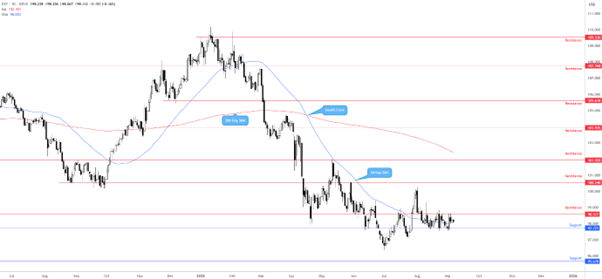
Charts created using Trading View
Author
Aaron Hill
FP Markets
After completing his Bachelor’s degree in English and Creative Writing in the UK, and subsequently spending a handful of years teaching English as a foreign language teacher around Asia, Aaron was introduced to financial trading,

















