US output drops at fastest rate in a decade


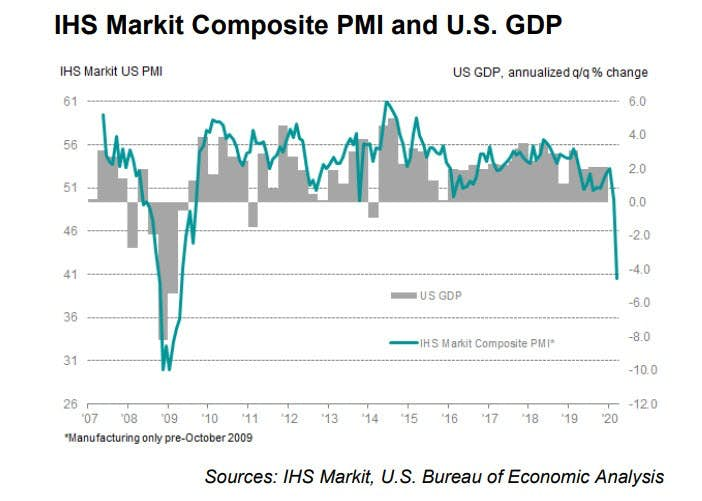
The US in caught in an enormous economic downturn that will be the worst in history.
Markit reports US Output Drops at Fastest Rate For Over a Decade
Key Findings
Flash U.S. Composite Output Index at 40.5 (49.6 in February). New series low.
Flash U.S. Services Business Activity Index at 39.1 (49.4 in February). New series low.
Flash U.S. Manufacturing PMI at 49.2 (50.7 in February). 127-month low.
Flash U.S. Manufacturing Output Index at 47.6 (50.7 in February). 127-month low.
U.S. private sector firms indicated a marked contraction in overall business activity in March following the escalation of the coronavirus disease 2019 (COVID-19) outbreak. The overall decline was the steepest recorded since comparable survey data were available in October 2009, and reflected widespread falls in activity.
Companies also reported the first contraction of new business since data collection began. The marked decrease in new orders stemmed from sharp falls in client demand following the outbreak of COVID-19, according to panel members. Lower customer demand was also reflected in falling new export orders, with key export partners shutting down or limiting the size of their orders.
Manufacturers and service providers both noted a drop in total new business, with the latter once again seeing the sharper rate of decline. Firms meanwhile reduced their workforce numbers at the fastest pace since December 2009 in March. The decline in employment partly stemmed from a sharp fall in the level of outstanding business, with a number of businesses noting that customers were putting orders on hold until further notice due to COVID-19.
March data also indicated a weakening of inflationary pressures, as both average input prices and output charges fell at U.S. private sector firms. The decline in selling prices was the fastest in the ten-and-a-half year series history, as manufacturers and service providers both cut their prices to boost sales.
Chris Williamson, Markit Chief Business Economist
“The survey underscores how the US is likely already in a recession that will inevitably deepen further. The March PMI is roughly indicative of GDP falling at an annualised rate approaching 5%, but the increasing number of virus-fighting lockdowns and closures mean the second quarter will likely see a far steeper rate of decline.”
5% is amazingly optimistic.
Note that Goldman Projects a Catastrophic GDP Decline Worse than Great Depression.
Goldman Sachs economists forecast a historically sharp and swift recession, with second-quarter GDP sinking a stunning 24% after a 6% decline in the first quarter.
Goldman expects a huge third-quarter rebound as does Morgan Stanley. I don't.
The Huge Fear: How Do I Pay the Bills?
Please note the Huge Fear: The Huge Fear: How Do I Pay the Bills?
That fear will linger a long, long time.
It is nearly crazy to project a fast rebound from this disaster.
Largest Collapse in Eurozone Business Activity Ever
Also note the Largest Collapse in Eurozone Business Activity Ever
This is not a 911 replay, nor is it anything the Fed or central banks can fix.
Nothing is Working Now: What's Next for America?
The US, EU, and China are in recession now. The only questions are how deep and for how long.
For a 20-point discussion of what I believe will happen.
Author
Mike “Mish” Shedlock's
Sitka Pacific Capital Management,Llc

















