US Midterms: Can Wall Street rally despite AI debt and credit risks?


Political uncertainty may be coming to an end, but the real question for investors is whether the technology sector can sustain its enormous spending commitments.
The US midterm elections are arriving at an interesting moment for financial markets. Technology stocks have come under pressure, investors are questioning the amount of money being spent on artificial intelligence, and the bond market is beginning to reflect concerns that were largely ignored during the earlier stages of the AI boom.
At the same time, there are reasons to expect a recovery. A reduction in political uncertainty, historically favorable year-end seasonality and the possibility of institutional investors rebuilding their equity exposure could provide some support for US stocks.
This leaves the market in a rather unusual position. The same environment that could produce a strong rally in the S&P 500 and Nasdaq may also be exposing deeper financial weaknesses beneath the surface.
To understand what might happen next, investors need to look beyond the election itself.
Why a political setback for Trump might actually help Wall Street
At first glance, a Democratic victory in the midterm elections might seem negative for US equities. A stronger Democratic presence in Congress could lead to greater scrutiny of large technology companies, tougher discussions around AI regulation and more obstacles for certain investment projects.
But there is another side to the argument.
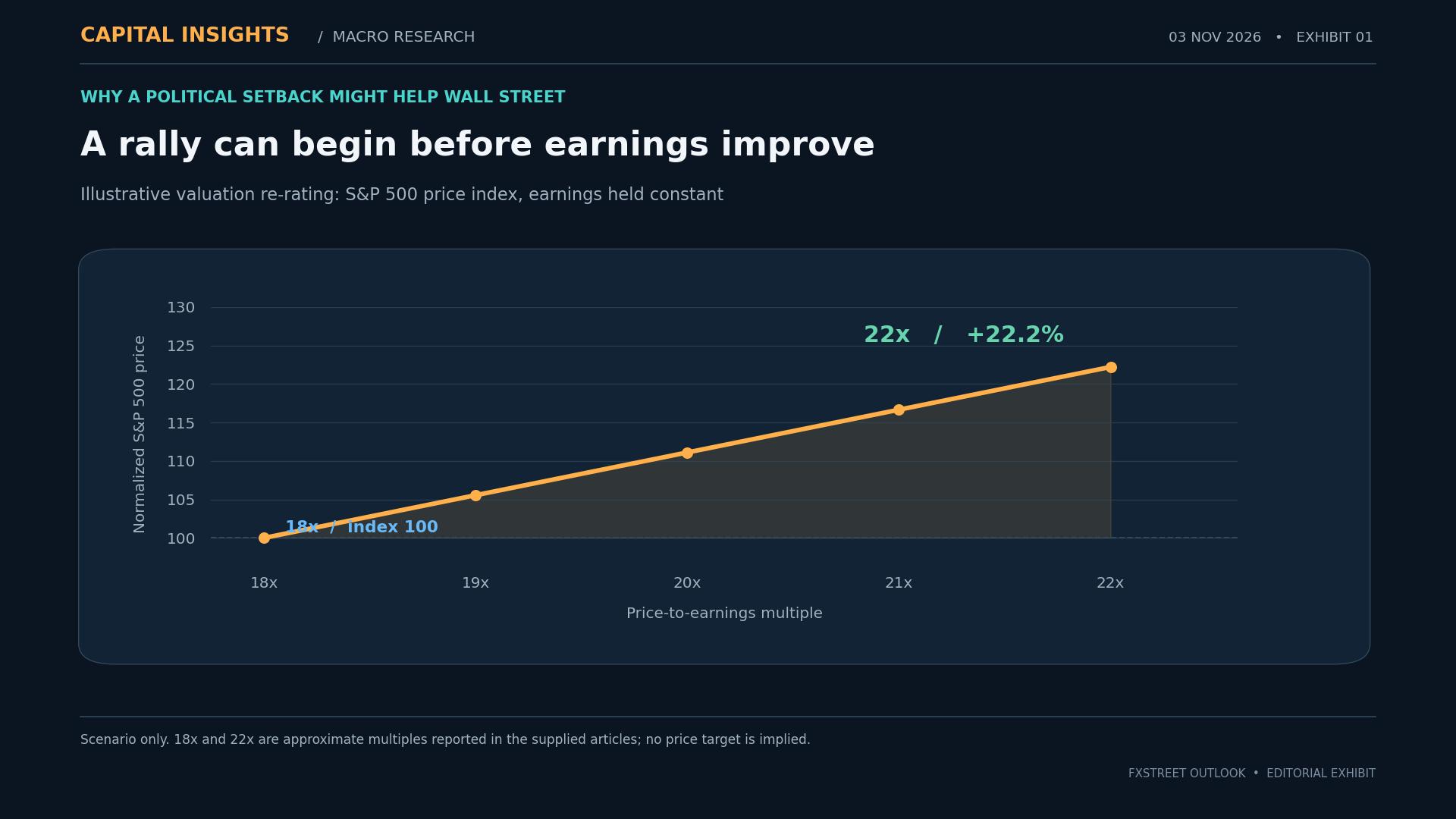
One of the factors weighing on US equity valuations has been political uncertainty. Trade disputes, geopolitical tensions and unexpected policy announcements make it more difficult for businesses and investors to plan ahead.
If the election results in a divided government, the administration could face greater difficulty introducing major policy changes. While political gridlock is not always good for the economy, greater predictability can sometimes be welcomed by financial markets.
This matters because stock prices depend on more than corporate earnings.
Investors also decide how much they are willing to pay for those earnings. When uncertainty increases, valuation multiples can contract even when companies continue reporting healthy profits. If political risks begin to fade, those multiples could recover without requiring a substantial improvement in earnings.
That creates an interesting possibility: US equities could rally after the election, not necessarily because the economic outlook has improved, but because investors are becoming more comfortable with the risks they are taking.
However, that does not mean every sector would benefit equally.
The AI industry faces a much bigger question than the election
The recent pressure on technology stocks has brought attention back to something that deserves more discussion: the economics behind artificial intelligence.
For several years, investors have focused on the potential of AI to transform productivity, generate new revenue streams and support long-term economic growth.
Those expectations are not unreasonable. AI may eventually become one of the most important technological developments of this generation.
The difficult part is determining whether the companies financing this transformation will earn enough money to justify their spending.
Major technology companies are investing enormous amounts in data centers, computing infrastructure, semiconductors and energy capacity. These investments are being made today, while a significant portion of the expected financial returns may not arrive until much later.
Meanwhile, competition between AI providers continues to increase.
As more models enter the market, pricing pressure could intensify. Companies may face a situation in which the cost of developing and operating advanced AI systems remains high while customers become less willing to pay premium prices.
This creates a potential problem for profitability.
The technology itself can be successful without every company investing in it becoming financially successful.
We have seen similar situations during earlier technological transformations. New industries can change the world while investors still lose money by paying too much for the companies involved.
The difference today is the sheer scale of the investment commitments.
The credit market may reveal problems before the stock market does
One area that deserves particular attention is the financing behind AI infrastructure.
Building large data centers requires substantial upfront capital. Some companies can finance these projects through existing cash flows, while others depend more heavily on borrowing and external investors.
That distinction becomes increasingly important when financing conditions tighten.
Imagine a company committing billions of dollars to develop new infrastructure. Its business plan assumes that demand for computing capacity will continue growing and that the completed facilities will generate sufficient revenue to cover operating expenses and financial obligations.
But what happens if demand develops more slowly than expected?
The company may still have to meet its debt payments, even if revenue falls short of its original projections.
The same problem could emerge if regulations, electricity costs or local opposition delay the construction of new facilities.
Financial commitments do not necessarily disappear simply because a project is postponed.
This is where the bond market becomes particularly important.
When investors become less confident about a company's ability to repay its obligations, they generally demand higher yields to compensate for the additional risk. That can be reflected in wider corporate credit spreads and higher credit default swap premiums.
For companies already operating with substantial financial commitments, rising borrowing costs can gradually become a serious problem.
There is also a broader economic consequence.
If AI infrastructure absorbs an increasingly large amount of available financing, other businesses could face more expensive access to capital. The benefits of AI-related investment might then be accompanied by tighter financial conditions elsewhere in the economy.
This is why I believe the discussion around artificial intelligence should move beyond stock valuations alone.
The more important question is whether the expected returns on these investments can support the financing structures being built around them.
Why falling Treasury yields are not always good news for the Nasdaq
The relationship between US Treasury yields and technology stocks is another area where investors need to be careful.
Normally, declining bond yields are considered supportive for growth stocks. Lower discount rates increase the present value of expected future earnings, which can make companies with strong long-term growth prospects more attractive.
But the reason behind falling yields matters.
If Treasury yields decline because inflation is cooling and the Federal Reserve has more room to ease monetary policy, that could be constructive for equities.
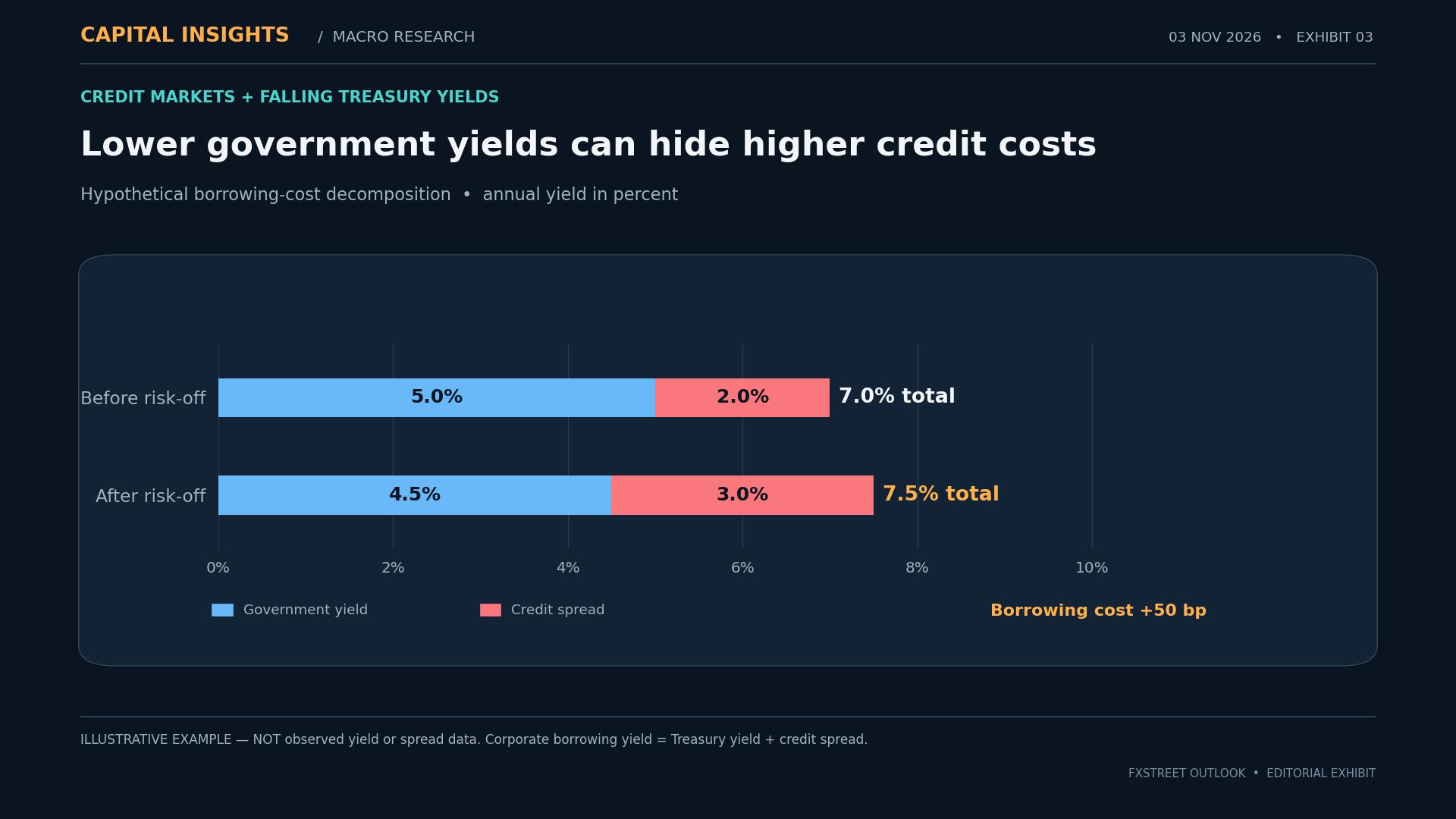
If yields decline because investors are worried about economic growth, deteriorating credit conditions or financial instability, the interpretation becomes very different.
In that case, lower yields may reflect demand for safe government bonds rather than improving financial conditions for businesses.
A company facing weaker earnings expectations and wider credit spreads may not benefit much from a decline in Treasury yields if its own borrowing costs remain elevated.
This distinction is especially relevant for the Nasdaq because its performance is heavily influenced by companies whose valuations depend on expectations of future growth.
A decline in the 10-year Treasury yield should therefore not automatically be interpreted as a bullish signal.
Investors need to understand whether the bond market is pricing lower inflation, weaker growth or increasing financial stress.
Those are three very different environments.
Gold and the Dollar provide another piece of the puzzle
The recent weakness in gold also shows how complicated the current market environment has become.
Gold is often considered a safe-haven asset, particularly during periods of political uncertainty or geopolitical tension.
Yet even when investors are concerned about the economy, gold can struggle if the US dollar strengthens and real interest rates remain elevated.
Unlike bonds, gold does not provide interest income. Higher real yields can therefore increase the opportunity cost of holding it.
A stronger dollar can create additional pressure.
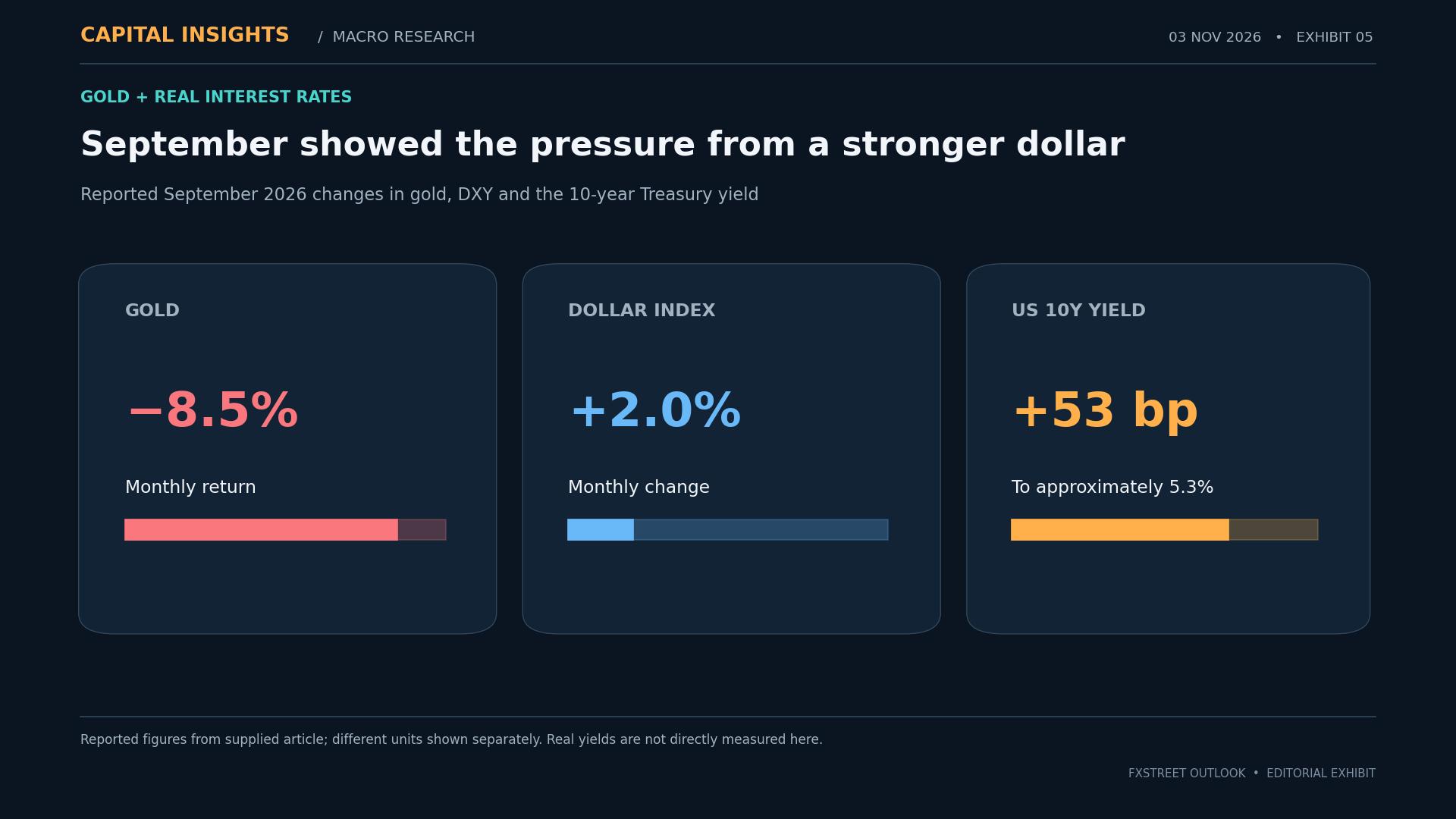
This is particularly important around the US midterm elections. Historical tendencies may suggest that gold often performs well following these events, but the election result alone does not determine its direction.
The subsequent movement in the dollar and real Treasury yields could be much more important.
A sustained recovery in gold would become more convincing if the dollar weakened alongside declining real yields.
Conversely, persistent dollar strength and high real yields could limit any recovery, regardless of the political outcome.
The $4,000 area also remains an important reference point following the recent correction. Whether gold can recover and maintain that level may help indicate whether buyers are regaining control or whether the market remains vulnerable to further selling.
There is another complication.
During periods of severe financial stress, investors sometimes sell liquid assets to raise cash or meet margin requirements. Gold can experience selling pressure during those episodes even when demand for protection is rising.
In other words, a market selloff does not guarantee an immediate rally in gold.
The Iran conflict adds another layer of uncertainty
Geopolitical developments remain an additional source of volatility, particularly through the energy market.
The conflict involving Iran has already shown how quickly oil prices can react to headlines about potential negotiations, military developments or possible escalation.
This matters for more than energy companies.
Higher oil prices can increase inflationary pressure through transportation, production and consumer costs. If that pressure becomes persistent, it could complicate the Federal Reserve's ability to lower interest rates.
Higher inflation expectations may also influence Treasury yields and the dollar, creating further consequences for equities and gold.
A decline in oil prices could have the opposite effect by easing some of the pressure on inflation.
However, geopolitical de-escalation could also reduce demand for safe-haven assets.
The reaction across financial markets is therefore unlikely to be straightforward.
For investors, the important issue is not simply whether oil rises or falls, but how those movements affect inflation expectations, monetary policy and broader risk sentiment.
Could US equities still experience a strong year-end rally?
Despite these concerns, a recovery in US equities remains possible.
The recent correction has already reduced some of the enthusiasm surrounding technology stocks, while institutional investors have reportedly cut their equity exposure.
If political uncertainty declines and investors begin rebuilding positions, that buying activity could support a meaningful rebound.
Seasonality may offer another advantage. November and December have historically been favorable periods for US equities, although seasonal patterns provide no guarantee of future performance.
But I would separate a short-term rally from a genuine improvement in market fundamentals.
An equity recovery driven mainly by positioning, short covering or higher valuation multiples can occur even while underlying economic risks remain unresolved.
A more sustainable recovery would ideally be accompanied by stable or improving credit conditions, healthier corporate cash flows and greater confidence in the returns generated by AI investments.
The behavior of the bond market could be especially useful in making that distinction.
If equities rise while corporate credit spreads continue widening, investors should question whether the optimism in stocks is being confirmed by the companies' financing conditions.
On the other hand, a recovery accompanied by stabilizing credit spreads, improving market breadth and healthier earnings expectations would provide stronger evidence that financial conditions are genuinely improving.
What matters after the election
The US midterms may determine the initial direction of the market, but their longer-term importance will depend on what happens afterward.
A Democratic victory could reduce certain forms of political uncertainty while increasing concerns about technology regulation. A stronger-than-expected Republican result could initially support sectors that investors associate with the administration's policies.
Neither outcome automatically resolves the financial questions surrounding artificial intelligence.
For the Nasdaq, the next major test may be whether technology companies can maintain earnings growth while financing an increasingly expensive infrastructure expansion.
For the broader S&P 500, the question is whether improving sentiment and market participation can offset weakness in the technology sector.
For gold, the direction of the dollar and real interest rates may be more important than the political composition of Congress.
And across all three markets, the development of credit conditions could provide an important indication of whether financial stress is easing or spreading.
My base case is not that the election must produce either a lasting rally or a market crash. Both a short-term recovery and continued medium-term financial pressure are plausible.
The distinction matters.
Markets can recover before the underlying problems have been solved, just as they can decline before those problems become visible in official economic data.
The coming weeks may therefore tell us much more than who controls Congress.
They could reveal whether investors are simply returning to risk after a period of uncertainty, or whether the financial foundations of the AI investment boom are beginning to face a more serious test.
Author