US Michigan Consumer Sentiment April Preview: Happiness is on the way
- Sentiment forecast to reach pandemic high of 89.6 in April.
- Consumer outlook has regained just half of its lockdown collapse.
- Payrolls, relief payments and consumer spending point to improved confidence.
- Retail Sales rocket in March on stimulus payments, GDP rises to 8.3%.
- Currency markets are unlikely to trade on consumer sentiment after sales figures.

Money may not be able to buy happiness, but it goes a long way to boosting consumer sentiment.
Nonfarm Payrolls had a banner month in March, adding almost one million jobs. Most American families received $1400 in government cash and judging by the Retail Sales numbers they rushed out and spent every penny.
Any one of these developments would have boosted consumer confidence. Three in one month may be just the shock needed to convince households that the pandemic has truly been replaced by a booming economic recovery.
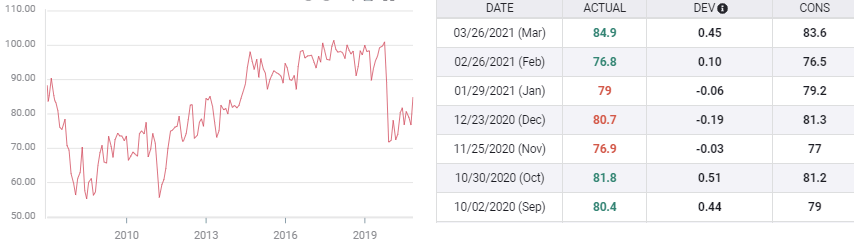
The Michigan Consumer Sentiment Index is forecast to climb to 89.6 in April from March's 84.9, which was the highest of the pandemic. Attitudes have recovered about half of last year’s plunge from 101 in February to 71.8 in April.
Michigan Consumer Sentiment
Nonfarm Payrolls
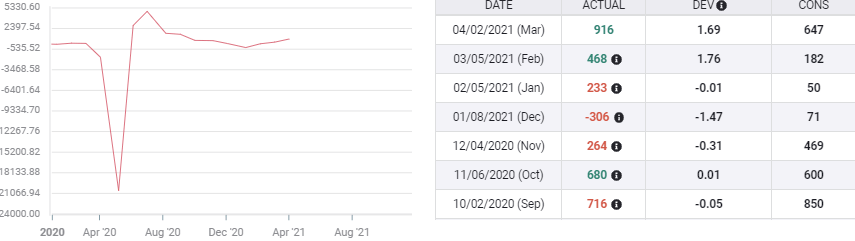
American firms hired 916,000 people in March, the most since last August. Revisions to the January and February totals added another 156,000 jobs, bringing the first quarter sum to 1.617 million. Payrolls doubled each month, January 233,000, February 468,000 and the above 916,000 in March.
Each month was also far stronger than the consensus estimates of 50,000 for January,182,000 in February and 647,000 for March. In total the labor market performance for the quarter was 46% better than analysts thought it would be.
Nonfarm Payrolls
Retail Sales, COVID-19 relief and GDP
The January COVID-19 stipend of $600 for most individuals generated an astonishing 7.6% surge in Retail Sales.
Except for the fall and recovery around the March and April lockdowns it had been the largest single month burst of spending in a generation.
Now it is the second highest.
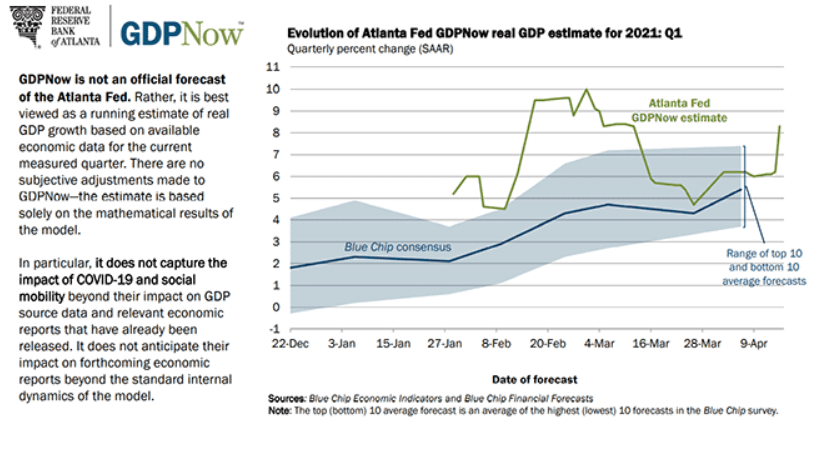
March’s award of $1400 in household stimulus payments sent Retail Sales soaring 9.8%, near to doubling the 5.9% forecast. The Control Group category, which informs the government's gross domestic product (GDP) calculation, rose 6.9%. This prompted a 2.3% increase in the Q1 Atlanta Fed GDPNow model to 8.3%.
Retail Sales are a better measure of Consumer Sentiment than anything short of the index itself. If Americans are celebrating in the the stores and malls it is an excellent bet that the job market and vaccination rates have finally broken consumers from their pandemic funk.
Conclusion
Employment is the most important economic fact for consumer sentiment, Retail Sales are its most blatant expression.
The March sentiment figures only partially reflect the rapidly improving labor market as the survey is done in the early part of the month.
A similar delay would involve the stimulus payments which began to be received mid-month and the enjoyment of the retail spending binge.
All three events will be fully reflected in the April sentiment numbers. American consumer optimism is set to flower.
Author

Joseph Trevisani
FXStreet
Joseph Trevisani began his thirty-year career in the financial markets at Credit Suisse in New York and Singapore where he worked for 12 years as an interbank currency trader and trading desk manager.
















