US Manufacturing PMI Rebounds to 16 Month High in July: Employment trails general improvement
- Overall index of 54.2 at its best level since March 2019.
- New order index rises to 61.5 from 56.4 in June, soaring from April’s 27.5.
- Employment lags at 44.3 with 12 straight months of contraction.
- Market response favorable, equities and dollar gain, Treasury yields stable.

Sentiment and activity in the US manufacturing sector improved more than forecast in July with the forward looking new orders index at its highest level in two years, though the employment gauge trailed the general optimism.
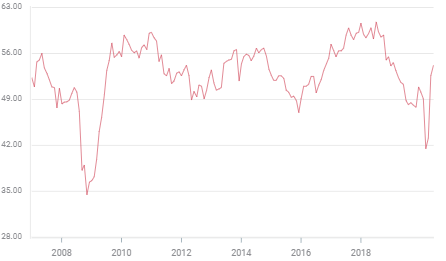
The purchasing managers index (PMI) from the Institute for Supply Management (ISM) climbed to 54.2 last month from 52.6 in June. It was better than the 53.6 estimate despite the conviction among some analysts that the summer surge in Covid cases would derail the recovery in a factory sector hard-hit by the pandemic closures and the trade war with China.
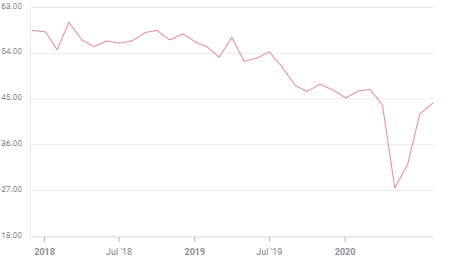
Employment edged higher to 44.3 from 42.1 in June missing the 48.1 prediction by a wide margin. The new orders index reached 61.5 in July its highest reading in 22 months. It has more than doubled in three months from its April shutdown low of 27.5. Prices improved to 53.2 from 51.3 in June. “Sentiment was generally optimistic” among manufacturers according to the ISM survey.
Manufacturing PMI
Recovery slowdown expected
The nearly complete shutdown of the US economy in March and April plunged economic activity and especially the manufacturing industry to a nadir not touched since the financial crisis of a decade ago.
Recovery began with the partial reopening of some states in late April and has continued despite the large increase in positive Covid tests in several of the largest and most economically important US states like Texas, Florida and California.
Though hospitalizations and fatalities in the affected states have trailed the spring outbreak by wide margins and have not come close to overwhelming the public health systems the impact on consumer traffic and business failures seems to have driven initial unemployment claims higher in the last two weeks.
Non-farm and manufacturing payrolls
Manufacturing is about 15% of US GDP but it is considered a leading indicator for the overall economy because of the longer lead time for production and the higher skill levels of its employees.
Employment is a trailing indicator. Companies normally wait until they are sure a new employee is justified before hiring and incurring the additional payroll costs.
The limited improvement of the manufacturing employment index in July could be the inherent delay in personnel decisions or it might be evidence that higher Covid cases are exacting extra caution from businesses.
Manufacturing employment PMI
Economists have taken the second view and the consensus forecast for July’s non-farm payrolls is just 1.65 million, barely one-third of June's record 4.8 million hires. With 22.16 million lost jobs in March and April and only 7.499 recalled in the following two months, the July estimate would be a sharp deceleration in the pace of recovery.
Sector variation
The ISM survey noted that 13 industrial categories including primary metal, wood products, electrical equipment, appliances and components had reported growth in July.
Producers of transportation equipment, machinery and metal fabrication reported contraction. In the ISM indexes readings above 50 denote expansion and scores below, contraction
Market response and conclusion
Equities rose with the Dow adding 0.89% to 26,664 and the S&P 500 climbing to 3294, up 0.72%. The dollar was higher by small amounts against all of the majors except the Canadian dollar continuing Friday’s reversal of two weeks of USD losses. Treasuries yields were unchanged in percent with minimal point movement. The 10-year return was 0.553% and the 2-year 0.111% at the equity close at 4:00 pm EDT.
While the overall tone of the report was positive the employment index showed reluctance to hire.
It may be that manufacturing industries are, for logical reasons, more cautious about hiring than the far larger service sector. Friday’s payrolls will tell us if the survey accurately represents factory employment decisions and if that caution carries over to service industries.
Author

Joseph Trevisani
FXStreet
Joseph Trevisani began his thirty-year career in the financial markets at Credit Suisse in New York and Singapore where he worked for 12 years as an interbank currency trader and trading desk manager.
















