US Manufacturing PMI February Preview: IS this what is meant by going viral?
- Sentiment expected to remain positive despite China.
- Business investment was unexpectedly strong in January.
- Equity losses and the Fed on the near term horizon.

The Institute for Supply Management (ISM) will issue its purchasing managers’ index (PMI) for the manufacturing sector in January on Monday, March 2nd at 15:00 GMT, 10:00 EDT.
Forecast
The purchasing managers’ index is expected to slip to 50.5 in February from 50.9 in January and 47.8 in December. The prices paid index is predicted to fall to 51.5 from 53.3. The new orders index is predicted to drop to 49.8 in February from 52 in January. Employment will be unchanged at 46.6.
US manufacturing and the economy
Manufacturing PMI
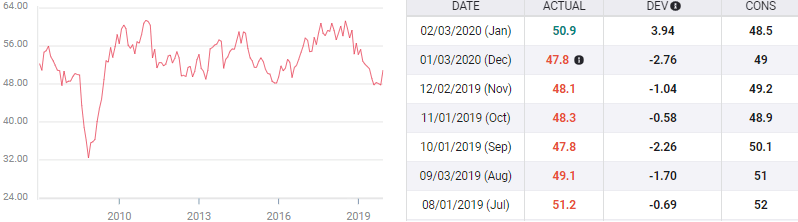
The unexpected jump into expansion for the manufacturing sector in January at 50.9 in the purchasing managers’ index after five months in contraction was due as much to optimism from the completed US-China trade deal as from any large boost to business, though new orders did claim 52 after the same five months below 50 as the overall index.
Manufacturing has been in a slow-motion decline for almost two years as the trade dispute sapped first outlook then orders and eventually employment. The descent did not reflect the general US economy which grew 2.3% for the year on a quarterly average and continued to produce large numbers of new jobs, albeit not in the factory sector.
Unemployment has remained near half-century lows and wages are near their best levels in a decade. Consumer sentiment has climbed to the higher reaches of its post-recession range not surprisingly considering the labor market and is at levels seen only twice before.
Business investment
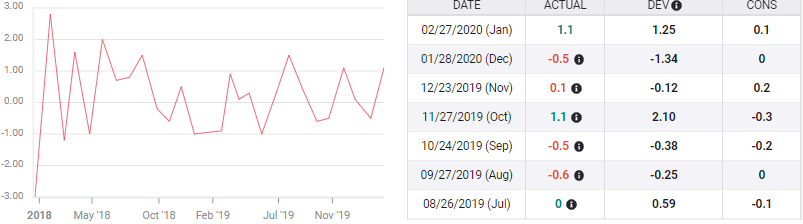
Planning and investment in the business community suffered the greatest impact from the US-China trade argument. The non-defense capital goods category of durable goods, the well-known analog for business investment, reversed in the second half of 2019, posting a small negative monthly average.
Non-Defense Capital Goods
FXStreet
Analysts had expected any rebound to be delayed until orders and purchases began to flow from China. The wholly unanticipated surge of spending, up 1.1% in January on a median projection for a 0.1% gain, indicated that business planners were confident in the pending benefits of the trade deal.
Equities and the Fed
While the actual effect of the virus on the Chinese economy and by extension around the globe is unknown, the fearful crushing of equity markets in the most rapid correction in history dominated headlines last week. American stocks are down about 12% without any appreciable change in the US economic situation.
Federal Reserve Chairman Jerome Powell said that the bank is ready to reduce the fed funds rate if necessary to maintain the country’s longest expansion.
Yields on US Treasuries have already fallen to record lows as investors around the world sought the safety of the US economy and financial markets.
“The fundamentals of the U.S. economy remain strong,” Powell noted in a four-sentence statement on Friday. “However, the Coronavirus poses evolving risks to economic activity. The Federal Reserve is closely monitoring developments and their implications for the economic outlook. We will use our tools and act as appropriate to support the economy.”
Conclusion
The extent of the Coronavirus on the economy of China is unknown although the assumption that it will be large is rife in the markets.
Business investment is a long term project with spending and return horizons to several years. The health crisis in China is logically expected to put a serious dent in the immediate performance of her promises under the US-China trade accord.
Will the acknowledged future benefits of the trade deal be sufficient to maintain a positive outlook in the manufacturing sector as the near damage from the partial shuttering of the Chinese economy is accounted? Despite the fears clearly evident in markets, business planners are likely to take a more constructive and long-term approach.
Author

Joseph Trevisani
FXStreet
Joseph Trevisani began his thirty-year career in the financial markets at Credit Suisse in New York and Singapore where he worked for 12 years as an interbank currency trader and trading desk manager.