US June Durable Goods: More than meets the eye
- Two of three Durable Goods categories miss forecasts by wide margins.
- Business spending remains strong, on par with the last year.
- Substantial upward revisions for May continue the corrective trend.
- Markets on hold for Wednesday’s Federal Reserve meeting.

New orders for long-lasting consumer goods were slower than forecast in June but large positive revisions to the May results kept market focus on the robust US economic recovery.
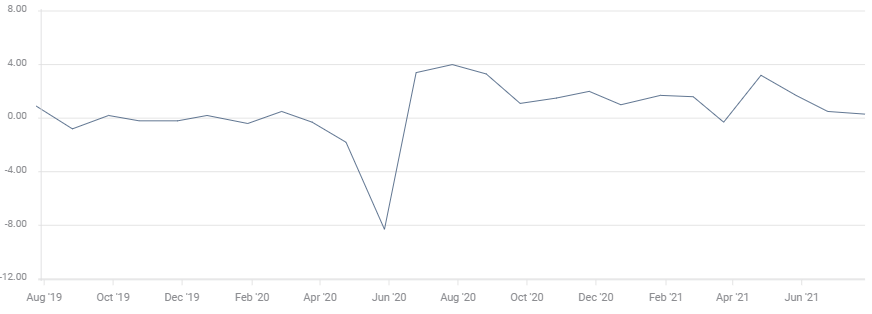
Durable Goods placements rose 0.8% last month, less than half the 2.1% prediction but the May result was revised to 3.2% from its original 2.3%. Orders excluding the transportation sector added 0.3% on a 0.8% forecast. May’s orders were adjusted to 0.5% from 0.3%.
Durable Goods
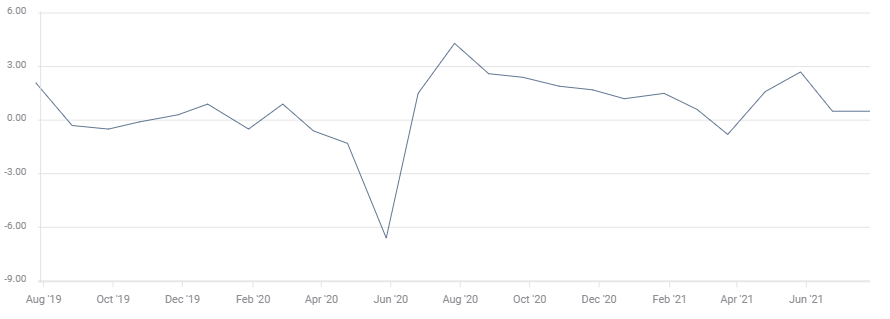
Nondefense Capital Goods orders, the business investment proxy, climbed 0.5%, slightly under the 0.7% estimate, but here also there was a substantial revision to the May figures, bringing it to 0.5% from -0.1%.
Pandemic revisions
Revisions to Durable Goods results are standard practice as it takes time for some of the information to reach the Census Bureau.
However, the lockdowns and dislocations of the past 18 months have been particularly hard on economic reporting. There has been a pronounced tendency for initial results to underestimate the final figures for consumer and business activity.
In all three major categories, Durable Goods Orders, Orders ex transport and Nondefense Capital Goods, every revision of the past twelve months, except one has been positive. That is 35 of 36 monthly figures were adjusted higher at the second issue. The sole exception was neutral, unchanged at the revision. That does not mean the final numbers were positive, just that they improved between the first and second.
In comparison, of the 36 revisions in 2019, 13 were positive and 23 were negative.
It seems the pandemic has made even statisticians pessimistic.
Business spending
Business investment spending has been one of the drivers of the US economy ever since the lockdown collapse bottomed out last spring.
Nondefense Capital Goods Orders, which are often used to limn the business investment quotient of gross domestic product, have averaged a 1.4% monthly increase over the past year. This investment has continued even as manufacturers have contended with broad shortages of labor and supplies which have hampered production.
Nondefense Capital Goods
Market response
Responses to the Durable Goods results were limited with the Fed meeting on Wednesday dominating market considerations.
Equities were slightly lower, with the S&P 500 losing 0.47%, the Dow shedding 0.24% and the NASDAQ taking the largest hit,1.2% related to China’s crackdown on some of its largest tech firms.
Treasury yields fell due to the expected continuation of the Fed’s easy money policy and the lack of new information on the prospects for a tapering of the bond program.
The dollar was mixed, gaining against the euro, sterling, Australian, New Zealand and Canadian dollars but falling versus the Japanese yen and Swiss Franc.
-637630313228398112.png)
-637630313448499336.png)
-637630313549652629.png)
Conclusion
The consumption side of the US economy continues to thrive even as the strong demand for goods and services collides with a limited supply of products and labor.
Federal Reserve insistence that inflation is temporary has little bearing on the reality of consumer prices that are expected to have the highest gains in a generation this year.
Durable Goods Orders are of a piece with the demand resurgence that is fueling inflation.
Author

Joseph Trevisani
FXStreet
Joseph Trevisani began his thirty-year career in the financial markets at Credit Suisse in New York and Singapore where he worked for 12 years as an interbank currency trader and trading desk manager.


![How Wall Street rigs the game [Video]](https://editorial.fxsstatic.com/images/i/market-chaos-01.jpg)