US January Durable Goods and Q4 GDP Preview: Consumers worry but they spend
- January Retail Sales were much stronger than forecast, Goods may follow.
- November and December Durable Goods Orders were revised higher.
- Fourth quarter GDP expected to be little changed at 4.1%.
- Markets unlikely to stir as goods restate Retail Sales data.

There are two American consumers abroad in the land. One is depressed by the pandemic, the endless restrictions and the dismal labor market. The second cashes government stimulus check and spends every penny. The first answers satisfaction surveys with appropriate caution and pessimism, the second behaves as if the recovery is already here.
Which customer went to the stores and auto malls in January?
Durable Goods Orders are forecast to rise 1.1% in January after a 0.5% increase in December. Orders ex Transportation are expected to slip to 0.7% from 1.1%. Nondefense Capital Goods Orders, the business investment proxy, are projected to gain 0.6% in January following December's 0.7% addition.
Retail Sales
Overall Retail Sales climbed a remarkable 5.3% in January pulverizing the 1.1% forecast and reversing two months of decline. Except for the two months of lockdown recovery in May and June, January's surge was the largest since October 2001 and the second most dramatic in three decades.
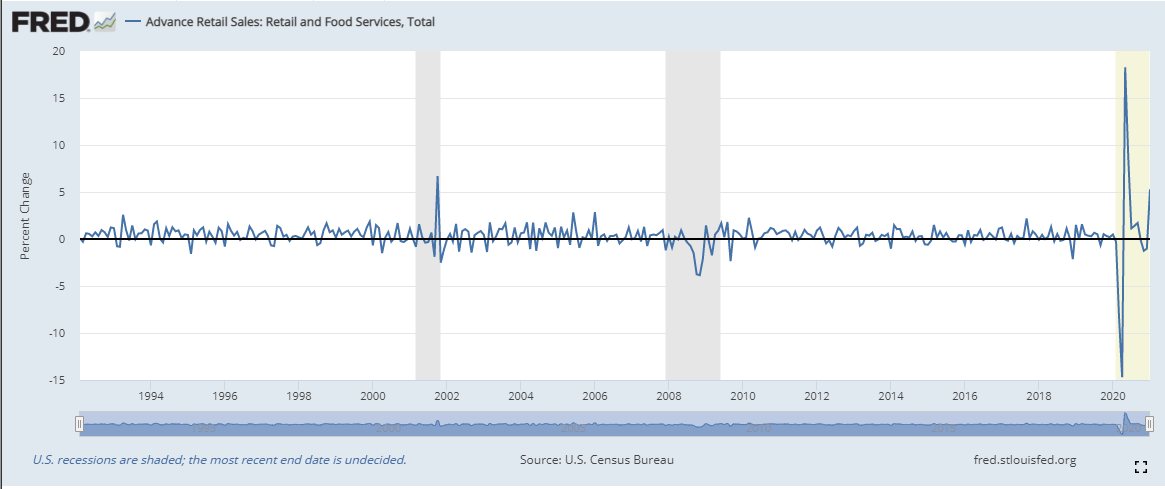
Analysts have given credit to the Trump administration's $600 award but the magnitude of the gain makes it likely that more of family finances than just the December stimulus was utilized.
Durable Goods
Durable Goods are manufactured items designed to last more than three years in normal use. These items, running the consumer and business gamut from fountain pens and scarves to computers, commercial airliners and nuclear power plants, are a sub-set of overall retail spending. The business portion of these sales are known by the Census Bureau as Nondefense Capital Goods.
Retail Sales dropped 1.4% in November and 1% in December and both were revised lower.
Durable Goods remained positive at 1.2% in November, revised from 0.9% and 0.5%% in December, revised from 0.2%. Nondefense purchases were 0.8% in November, revised from 0.4% and 0.7% revised from 0.6%.
Durable Goods

FXStreet
Consumer Confidence
The two main US consumer satisfaction surveys from the University of Michigan and the Conference Board diverged in February.
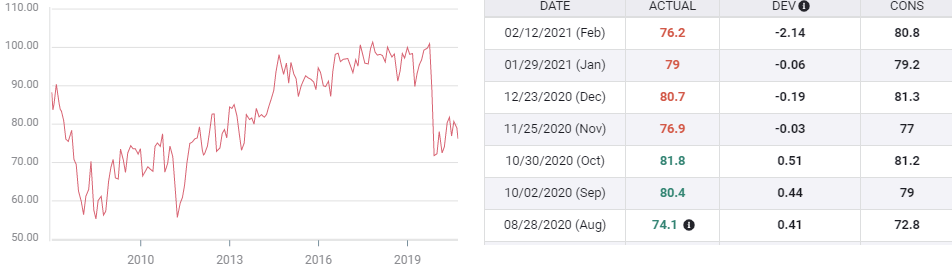
Michigan reported a drop in sentiment to 76.2 from 79, missing its 80.8 forecast. It was the lowest reading since August. The majority of the decline was in the expectations index which fell to 69.8 from 74 while the current conditions index edged down to 86.2 from 86.7.
Michigan Consumer Sentiment
The Conference Board Consumer Confidence Index rose to 91.3 from 88.9, beating its consensus estimate of 90. Its Present Situation Index climbed to 92 from 85.5 but its Expectations Index fell to 90.8 from 91.2.
Gross Domestic Product
Fourth quarter GDP is forecast to rise to 4.1% annualized from 4%.
It is relatively rare for the first and second revisions of the Bureau of Economic Analysis' (BEA) Gross Domestic Product (GDP) calculation, called preliminary and final, the initial release is called advanced, to have a substantial adjustment. The majority of pertinent data is already incorporated in that first figure and the pending revisions are normally small.
For instance even though the December Retail Sales Control Group was revised lower on February 17 to -2.4% from -1.9%, that is probably not enough to derange the original calculation. Likewise, the only major piece of data still missing , the December international trade balance which will only make the final version, is almost never far enough from its BEA estimate to affect the final GDP number.
Conclusion
Retail Sales were far stronger that forecast in January and odds are that some portion of that spending went into Durable Goods.
But even if goods are notably better than expectation it will have little or no market impact. From an economic point of view, Durable Goods orders are a restatement of previous information.
Fed Chairman Jerome Powell's dovish assessment of the US economy and the need for long-term policy support in Congressional testimony was far more relevant in keeping the dollar on the defensive.
Author

Joseph Trevisani
FXStreet
Joseph Trevisani began his thirty-year career in the financial markets at Credit Suisse in New York and Singapore where he worked for 12 years as an interbank currency trader and trading desk manager.
















