US Initial Jobless Claims: The pandemic still controls risk perception
- Claims expected to fall to 1.3 million from 1.508 million.
- Continuing claims to dip below 20 million for the first time since April.
- Total filed claims approaching 50 million in 14 weeks.
- Non-farm payrolls forecast to add 3 million in June.
- Dollar trading remains tied to risk perception though pandemic premium has vanished.

The gradual decline in initial jobless claims from their peak three months ago, 78% to last week, is a statistic that looks best in narrow focus. In historical context it is a continuing disaster.
Labor market statistics
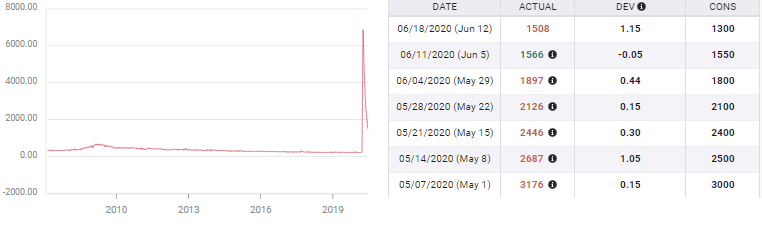
Initial claims are forecast to fall to 1.3 million in the June 19 week from 1.508 million. They had been predicted to drop to 1.3 million last week as well.
Claims have decreased every week since their peak of 6.867 million on March 27 the second week of the pandemic accounting. Though the improvement is real the benefit is illusory. In the third month of the pandemic there are still 5.6 times as many people filing for unemployment payments as there were in the month before the layoffs began.
Initial jobless claims
Continuing claims are projected to fall to 19.968 million in the June 12 week from 20.544 million previously. It would be the first drop below 20 million in two months and a 19.8% decline from the May 8 high of 24.912 million.
Non-farm payrolls are expected to gain 3 million jobs in June after May’s unexpected addition of 2.508 million. Payrolls lost 26.687 million positions in April and before the May report the consensus estimate had been for another 8 million losses. If accurate it would bring rehires to just over 25% of the April
Purchasing managers' indexes
Business sentiment surveys offer modest optimism that the recovery from the April depths is permanent.
The IHS Markit purchasing managers’ index for June registered 49.6 in manufacturing and 46.7 in services. It was a solid improvement over the 39.8 and 37.5 readings in May and marginally better than the forecasts of 48 in manufacturing and 46.5 in services.
In May the Institute for Supply Management (ISM) manufacturing index rose to 43.1 in May from 41.5 and the services score climbed to 45.4 from 41.8.
ISM manufacturing PMI
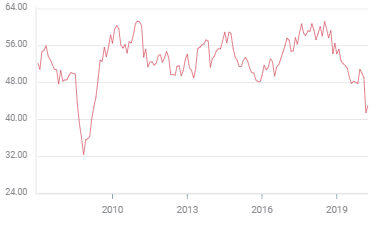
However all four scores from both surveys remain below the 50 division between expansion and contraction.
The employment gauges were the weakest of the ISM set: in manufacturing 32.1 in May from 27.5, missing the 35 forecast; in services 31.8 from 30 in April but below the 35.8 prediction.
Retail sales
The US consumer was far more active in May than anticipated. Retail sales soared 17.7%, well beyond the 8% prediction. Sales ex-autos rose 12.4% versus a 5.5% estimate and the control group, which enters the government’s GDP calculation, climbed 11%, more than doubling the 4.7% prediction. The May increases were the largest on record as were the April declines.
Most important for the economy sales reversed the April collapse of 14.7% providing businesses with immediate cash flow after weeks of empty tills.
Conclusion and markets
As encouraging as the May retail sales figures are and the recovery in consumption is expected to be seconded by the May durable goods orders set for Thursday release, unemployment is still rising.
The total initial claims for May of approximately 9.2 million was 3.6 times the 2.508 million rehires. If the June claims continue at their current pace there will still be twice as many layoffs as returned workers.
Equities and the dollar have incorporated a relatively quick US recovery into price levels. The Dow and S&P 500, even with Wednesday’s early losses were down 9.89% and 4.44% respectively year-to-date, (10:27 am EDT) far less than their March lows.
Markets have not though, moved from their pandemic susceptibility. Wednesday’s news reports of rising virus case in the US was the source of the equity losses and the dollar’s mild strength.
Unemployment claims will show a gradually improving labor market but their impact on markets will remain minor compared to the viral headlines.
Author

Joseph Trevisani
FXStreet
Joseph Trevisani began his thirty-year career in the financial markets at Credit Suisse in New York and Singapore where he worked for 12 years as an interbank currency trader and trading desk manager.