Gold hedges policy credibility, not inflation, as macro risks evolve


Gold’s strength at the start of 2026 cannot be explained by inflation dynamics alone. Consumer prices have stabilized, headline CPI surprises have faded, and yet gold continues to trade near historic highs. This disconnect is not a market anomaly. It is a signal that gold is performing a different macro function.
The current gold cycle is not about purchasing power erosion. It is about balance sheet risk, policy credibility, and the growing need for neutral reserves in a fragmented global system.
Markets are no longer pricing gold as a reactionary hedge. They are pricing it as a structural anchor.
Inflation has stepped back, Gold has not
Inflation was the dominant narrative of the previous cycle. Gold responded mechanically to CPI surprises, real yield swings, and aggressive monetary tightening. That regime is fading.
Recent inflation data in both the United States and Europe confirm a disinflationary stabilization rather than renewed pressure. Policy rates are high but static. Forward guidance has shifted from urgency to patience.
Yet gold has not retreated. Instead, it has consolidated above previous breakout zones, absorbing profit taking without structural damage. This behavior suggests that the market is no longer trading gold against inflation prints, but against something deeper.
The balance sheet problem is the real catalyst
The defining macro stress of 2026 is not inflation. It is balance sheet fragility.
Public debt levels across developed economies remain elevated. Fiscal discipline is constrained by political cycles. Central banks are caught between credibility and flexibility, unable to tighten further and reluctant to ease too quickly.
Gold thrives in this environment not because prices are rising, but because confidence is thinning.
When policy tools lose asymmetry and fiscal space narrows, gold becomes a balance sheet hedge. It protects against policy error, not price instability.
This explains why gold can remain bid even as inflation expectations flatten.
A market that absorbs pullbacks is not speculative
The Renko structure reinforces this macro interpretation.
After pushing to new highs near the 4500 area, gold entered a corrective phase that remained orderly and controlled. Pullbacks have respected higher structural supports, while momentum oscillators have reset without triggering trend failure.
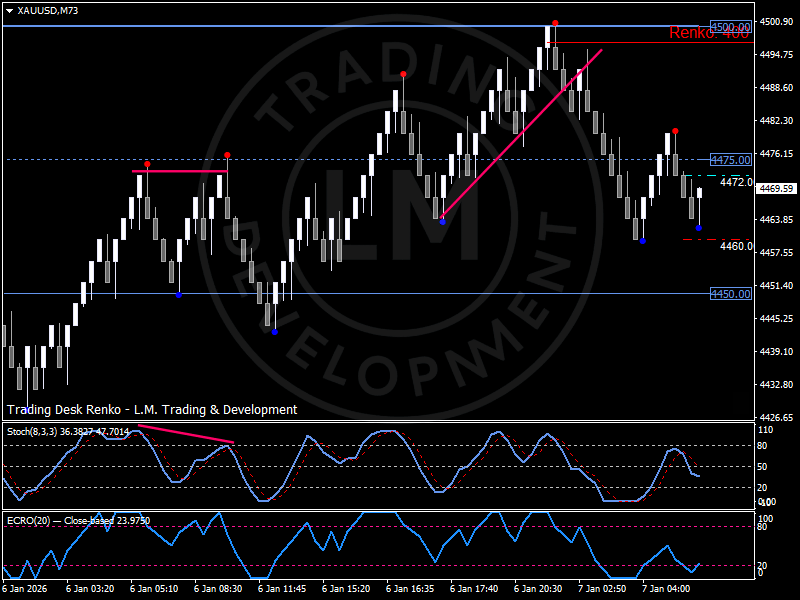
This is not the behavior of a crowded speculative rally. It is the signature of institutional positioning.
Gold is not being chased. It is being accumulated on weakness.
The market is signaling acceptance of higher price levels rather than exhaustion.
Real yields are no longer the dominant reference
One of the most telling features of this cycle is the weakening correlation between gold and real yields.
In previous regimes, rising real yields would have pressured gold decisively. In the current environment, that relationship has loosened. Gold remains resilient even when real yields fail to decline meaningfully.
This confirms that the market is no longer anchoring gold valuation exclusively to monetary variables. Instead, it is pricing systemic uncertainty, geopolitical fragmentation, and long term policy constraints.
Gold is responding to the quality of balance sheets, not the level of interest rates.
Why this matters going into 2026
Gold’s current role has implications beyond short term price action.
As markets move deeper into 2026, the distinction between growth assets and protection assets is becoming clearer. Copper reflects confidence in long term industrial demand. Gold reflects the need for systemic insurance.
This divergence does not indicate excess or imbalance. It reflects a market that is allocating capital according to function rather than narrative.
Gold is not signaling panic. It is signaling prudence.
Conclusion
Gold’s resilience in a stabilizing inflation environment marks a structural shift in how the metal is priced. The market is no longer using gold as a pure inflation hedge. It is using it as a balance sheet hedge in a world where policy credibility is increasingly questioned.
This explains why gold can consolidate near record highs without speculative excess and why pullbacks continue to attract demand.
Understanding this transition is essential for navigating commodities in 2026. Gold is not reacting to yesterday’s risks. It is positioning for tomorrow’s constraints.
Author
Luca Mattei
LM Trading & Development
Luca Mattei is a market analyst focusing on FX, metals, and macroeconomic trends. He develops trading tools for retail and professional traders, coding indicators and EAs for MT4/MT5 and strategies in Pine Script for TradingView.

















