US initial jobless claims rise but continuing claims and overall unemployment drops
- Initial claims add 2.1 million lowest in 10 weeks.
- Continuing claims fall 3.86 million in previous week.
- All states have at least partially reopened their economics.
- Almost 41 million jobless claims have been filed in two-and-a-half months.
- Nearly 8 million people are collecting benefits through coronavirus relief bill, the CARES Act.
- Dollar loses ground as risk-premium abates.

Filings for first time jobless benefits dropped to 2.1 million last week, the lowest number of new claimants since the pandemic crashed into the American economy in late March.
Almost 41 million people have applied for unemployment insurance in the last 10 weeks as states have fought the public health crisis by closing businesses and ordering social restrictions that have produced a massive wave of unemployment.
Continuing claims
Continuing claims, the number of individuals receiving benefits for at least two weeks, fell 3.86 million to 21.052 million, for the first decrease since claims began their rise on March 26.
Continuing claims
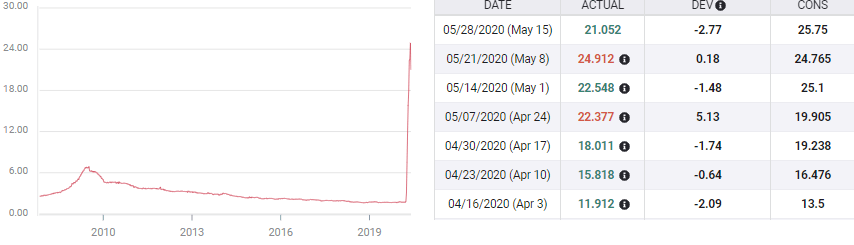
The drop in continuing claims in the week of May 15, 2.446 million new claims were filed that week, is the first evidence that the reopening of many state economies that started with Georgia on April 26 has started to pull people back to work, removing them from the benefits list.
This week’s claims suggest both new layoffs and that states are having success working through the backlog of previously filed requests created by the tidal wave of claims. Unemployment insurance is administered by the states though the national program of 26 benefit weeks is a joint state and Federal endeavor.
Reopened states
All 50 states have rescinded their stay-at-home orders and many have permitted reopening of what their governments considered nonessential businesses, including restaurants and retail stores, though in many cases with capacity restrictions.
So far there has been no evidence in the states opened the longest, Georgia, Florida and Texas of the much discussed second wave of virus cases and no appreciable rise in hospitalizations or fatalities.
Non-farm payrolls
Despite the apparent turnaround in the continuing claims statistics, the unemployment rate and non-farm payrolls for May, reported on June 5, are expected to show a second month of huge losses.
The unemployment rate is forecast to jump to 19.8% from 14.7% in April.
Unemployment rate
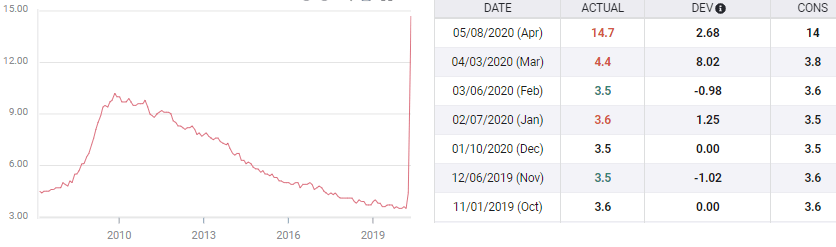
Labor Department rules require that for an individual to be counted as unemployed they must have sought work in the month prior to the survey. Many of the people who were laid off in March and April considered their furloughs temporary, as did their employers, did not look for a new positions and hence were not counted in the unemployment rate.
With the shutdowns now stretching into their third month some portion of these folks have begun to look for new work and thus joined the official employment rate.
Non-farm payrolls are forecast to fall 7.45 million in May after dropping 20.5 million in April.
US dollar
The dollar had litlle initial reaction to the jobless figures. But in the context of the general retreat of risk-aversion pricing, the lower initial claims number and the surprise drop in continuing claims reinforced the pullback in the US currency. The greenback closed lower against all of the majors except the Canadian dollar where it gained 11 points, having lost more than two-and-a-half big figures this week.
CARES ACT
The Federal relief bill, the CARES Act*, created unemployment benefits for self-employed, contract employees and other freelance, temporary or gig workers who were not eligible for traditional insurance because they are not listed on a firm’s payroll.
The Pandemic Unemployment Assistance program enacted as part of the $2.2 trillion relief bill passed in March is paying benefits to 7.8million American according to the Labor Department.
*Coronavirus Aid, Relief and Economic Security Act
Author

Joseph Trevisani
FXStreet
Joseph Trevisani began his thirty-year career in the financial markets at Credit Suisse in New York and Singapore where he worked for 12 years as an interbank currency trader and trading desk manager.