US labour market: Gradual cooling continues


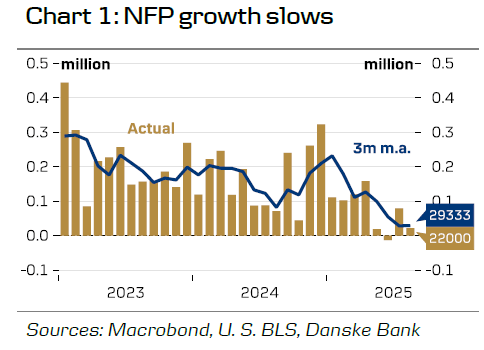
The labour market has cooled towards late summer, yet underlying resilience persists as recent trends appear to be supply-driven. In August, nonfarm payrolls (NFP) rose by 22k (cons: 75k), while downward revisions erased 21k jobs from the prior two months. This extended the weakening trend seen in the surprising July jobs report, which featured significant downward revisions and marked the weakest three-month-average for job creation since the pandemic (chart 1).
The unemployment rate edged up to 4.3% (prior: 4.2%), driven partly by an unexpected expansion in the domestic labour force. Over the past six months, the domestic labour force expanded by 1.4m, offsetting a decline of 1.0m foreign-born workers due to stricter immigration policies. However, we expect the rise in domestic labour supply to be short-lived, as demographic constraints suggest the recent boost driven by economic uncertainty should be temporary. Fed Chair Powell has recently noted that the break-even unemployment rate - the level at which labour supply and demand are balanced - has shifted lower, potentially nearing zero when accounting for reduced labour inflows. This shift helps to explain the discrepancies in various labour market indicators. Importantly, a supply-driven slowdown in employment growth does not warrant similar policy easing from the Fed as a demand-driven slowdown would.
The July JOLTs report reinforced the cooling labour market narrative, though largely due to reduced hiring rather than widespread layoffs. Job openings declined slightly to 7.18m (prior: 7.36m), marking the first time since April 2021 that the ratio of job openings to job seekers dropped below 1.0. At the same time, hiring remained steady at 5.3m, while involuntary layoffs and WARN notifications for mass layoffs stayed at historically modest levels. Overall, firms seem to be refraining from aggressive cost-cutting measures, underscoring underlying stability.
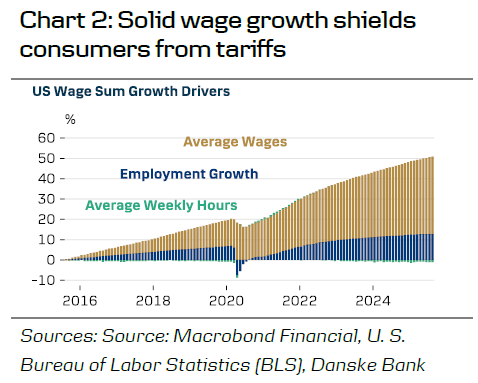
Despite signs of moderation, wage growth remains robust. With an annualised pace of 4.4%, wage sum growth, driven by rising nominal wages (chart 2), continues to shield consumers from cost pressures and support demand. Importantly, the labour income share remains historically low (chart 3), enabling firms to absorb higher wages without straining profit margins.
Looking towards 2026, expansionary fiscal policy is likely to support the labour market, reducing the risk of a sharp collapse. While headline figures suggest significant weakening, underlying dynamics indicate supply constraints as the primary driver. As a result, we do not think the Fed is under pressure to cut interest rates aggressively.
We do expect the Fed to resume rate cuts from September, but progress only gradually with one cut per quarter. In comparison, markets have almost fully priced in 25bp cuts for all three of the remaining meetings this year.
Author
Danske Research Team
Danske Bank A/S
Research is part of Danske Bank Markets and operate as Danske Bank's research department. The department monitors financial markets and economic trends of relevance to Danske Bank Markets and its clients.

















