US government runs fourth-largest budget deficit in history

Despite all the talk about DOGE and cost-cutting earlier this year, the federal government spent more in fiscal 2025 than it did the previous year and set a new spending record.
However, thanks to an influx of tariff revenue, the fiscal 2025 budget deficit was slightly smaller – if you can call a $1.78 trillion deficit “small.”
That compares to a $1.82 trillion deficit in fiscal 2024.
It was the fourth-largest deficit in history. The only deficits bigger than the last two years occurred during the pandemic era in 2020 and 2021.
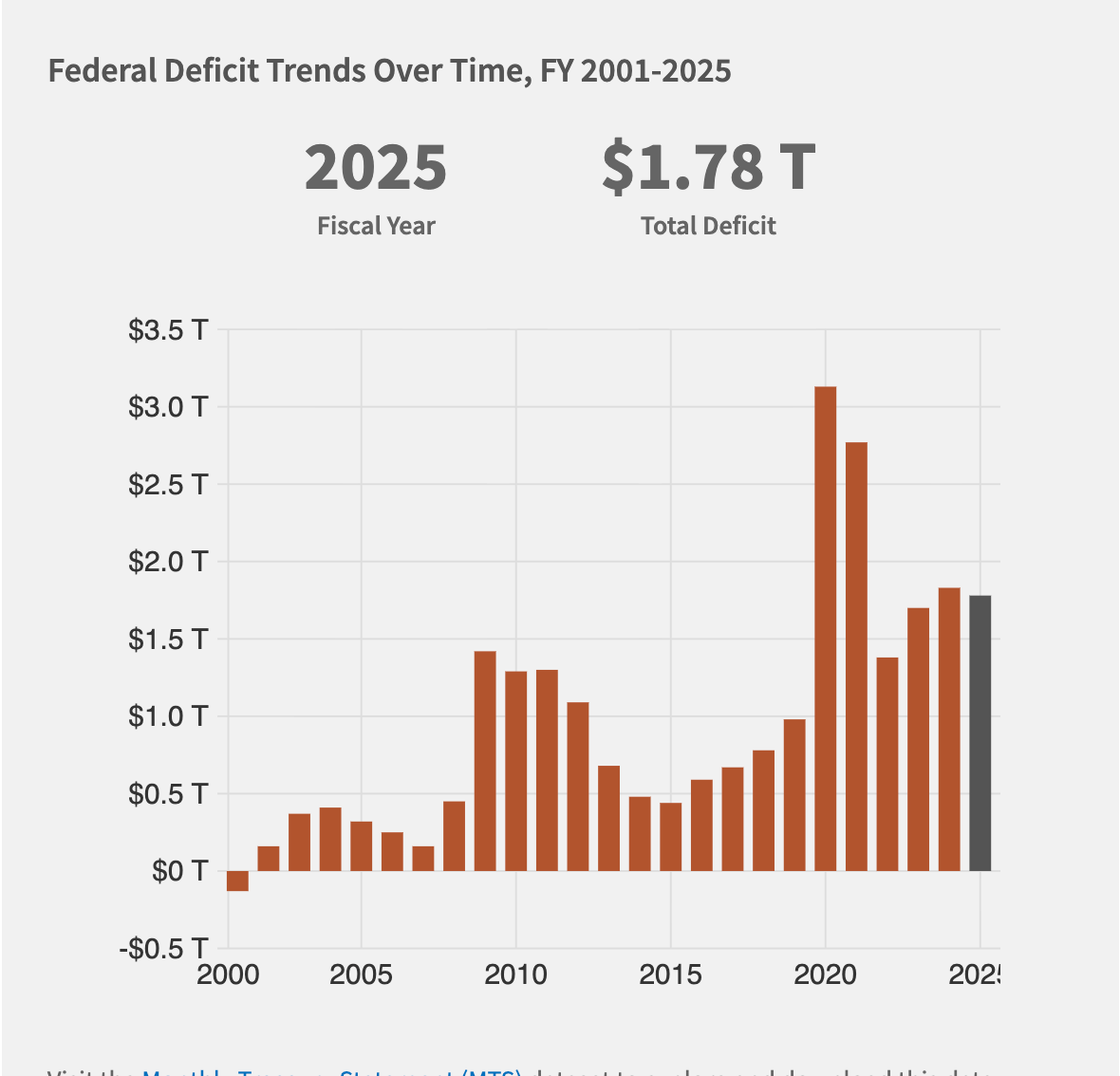
Treasury Department officials estimate the budget deficit-to-GDP ratio dropped slightly to 5.9 percent. It typically runs around 3 percent.
It was the first time the deficit to GDP ratio had been below 6 percent since 2022, prompting Treasury Secretary Scott Bessent to declare “we’re on our way.”
However, these numbers are nothing to brag about.
Breaking down the deficit numbers
The U.S. government took in $5.2 trillion in fiscal 2025. That was 6.4 percent higher than 2024.
A surge in tariff revenue helped boost overall receipts. The U.S. collected $202 billion in customs duties, a 142 percent increase year-on-year. The government took in $30 billion in tariffs in September alone, a 295 percent year-on-year surge.
This big increase in tax receipts comes on the heels of an 11 percent revenue boost last year.
The problem is clearly on the spending side of the ledger.
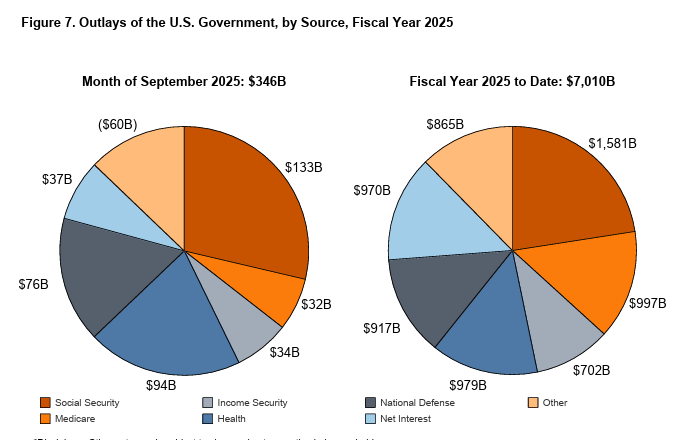
The Trump administration blew through a record of just over $7 trillion last year, a 4.1 percent increase.
There is no indication that spending will slow down any time soon. The Big Beautiful Bill “cut” some spending but increased it in other areas. Furthermore, those “cuts” were from projected spending increases. Actual expenditures will still go up, just not as fast as originally planned. The bottom line is that even with the Big Beautiful Bill, spending will increase on an absolute basis.
This is par for the course.
You might recall that President Biden promised that the [pretend] spending cuts would save “hundreds of billions” with the debt ceiling deal (aka the [misnamed] Fiscal Responsibility Act).
That never happened.
Supporters of the Big Beautiful Bill expect economic growth stimulated by tax cuts to boost revenue and narrow the deficit. However, history casts significant doubt on this claim.
The ugly truth is the government isn't committed to cutting spending in any meaningful way, and it always finds new reasons to spend even more, whether for "crises" at home or wars overseas.
Paying for the debt
The federal government is being increasingly burdened by its skyrocketing interest expense. This is one of the reasons President Trump and others in the administration are pressuring the Federal Reserve to slash interest rates.
Interest on the national debt cost $1.2 trillion in fiscal 2024. That was up 7.3 percent over 2024.
Net interest (interest expense – interest receipts) stands at $970 billion in fiscal ‘25.
In the last fiscal year, the federal government spent more on interest on the debt than it did on national defense ($917 billion) or Medicare ($997 billion). The only higher spending category is Social Security ($1.58 trillion).
Uncle Sam paid $1.13 trillion in interest expenses in fiscal 2024. It was the first time interest expense had ever eclipsed $1 trillion.
Much of the debt currently on the books was financed at very low rates before the Federal Reserve started its hiking cycle. Every month, some of that super-low-yielding paper matures and must be replaced by bonds yielding much higher rates. And even after the Federal Reserve cut rates, Treasury yields have pushed upward as demand for U.S. debt sags.
Why does it matter?
A lot of people act like massive budget deficits don’t matter. However, as the Bipartisan Policy Center points out, the growing national debt and the mounting fiscal irresponsibility undermine the dollar.
“Confidence in U.S. creditworthiness may be undermined by a rapidly deteriorating fiscal situation, an increasing concern with federal debt set to grow substantially in the coming years.”
This could lead to lower economic growth, higher unemployment, and less investment wealth.
Lack of confidence in the U.S. fiscal situation could also lower demand for U.S. debt. This would force interest rates on U.S. Treasuries even higher to attract investors, exacerbating the interest payment problem.
The bottom line is the U.S. government has a spending problem it won’t address. No matter what the politicians in D.C. claim, there is no way to fix the budget problem by shoveling more money into the hole with tariffs, much less replacing the IRS.
The rest of the world is paying attention.
Biden ran the debt higher at a dizzying pace, but to be fair, this isn’t just a Biden problem. Every president since Calvin Coolidge has left the U.S. with a bigger national debt than when he took office.
It’s going to take more than DOGE rooting out waste to get the borrowing and spending under control. Even if the Trump administration manages to slash discretionary outlays as promised, that only accounts for 27 percent of total spending. The vast majority is for entitlements, and there is little political will to take the scissors to Social Security or Medicare.
And the sad fact is that, given the political incentives, people in power will always kick the debt can down the road. It is a long-term problem that will require painful measures to fix. Politicians don't want to create pain. That's a quick path out of office. So, they will punt the debt problem and spend more to make constituents happy.
This is all well and good, but the problem with playing kick the can down the road is that you eventually run out of road.
To receive free commentary and analysis on the gold and silver markets, click here to be added to the Money Metals news service.
To receive free commentary and analysis on the gold and silver markets, click here to be added to the Money Metals news service.
Author
Mike Maharrey
Money Metals Exchange
Mike Maharrey is a journalist and market analyst for MoneyMetals.com with over a decade of experience in precious metals. He holds a BS in accounting from the University of Kentucky and a BA in journalism from the University of South Florida.

















