|

US Fed's balance sheet hits new record high

Overall sentiment prevailing globally can be best described as one of cautious optimism. With a couple of vaccines having been proven effective in trials, the question now is how much the situation gets worse before it becomes better and how much more damage is inflicted upon the economy until then. 

This week, the focus remains on the FOMC minutes. Markets would look for cues from the FOMC minutes regarding possibilities whether the Fed would extend the timeline of its asset purchases in Dec policy. On the domestic front, FPI Inflows into equities are likely to continue this week. Also, MSCI index rebalancing later this week is likely to result in passive flows to the extent of USD 2.5bn. 

With these flows, November would surpass August to witness the highest ever FPI inflows into equities. Month-end exporter selling is also likely to cap up side in USD/INR this week. If the broader Dollar does not weaken further, we expect the RBI to mop up inflows this week and therefore a rapid move lower in USD/INR too is unlikely. For the day, we expect the Rupee to trade in a range between 73.95-74.30 range. 

Importers are advised to cover on dips to 73.80-73.90. Exporters are advised to hedge through risk reversals to retain participation on the upside. 

Strategy: Exporters are advised to cover around 74.30 level. Importers have been advised to cover through Option strategy. The 3M range for USDINR is 72.50 - 74.50 and the 6M range is 72.50 – 75.40.
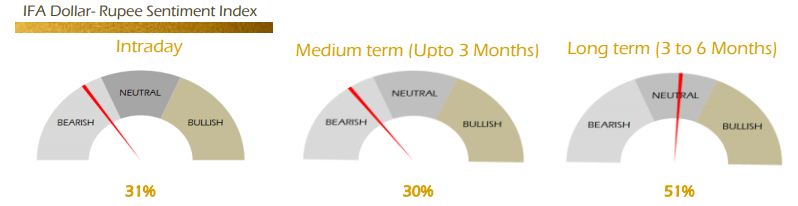
Chart

Download The Full Daily Currency Insight

Author

Abhishek Goenka

Abhishek Goenka

IFA Global

Mr. Abhishek Goenka is the Founder and CEO of IFA Global. He pilots the IFA Global strategic direction with a focus on relentlessly improving the existing offerings while constantly searching for the next generation of business excellence.


More from Abhishek Goenka
Share:

Editor's Picks

GBP/USD strengthens to near 1.3400 as UK political risk fades

The GBP/USD pair gathers strength near 1.3395 during the Asian trading hours on Thursday, bolstered by fading domestic political uncertainty. However, hawkish minutes from the Federal Reserve and renewed tensions between the US and Iran might support the US Dollar and cap the upside for the major pair.


EUR/USD sticks to positive bias above 1.1400; Mideast tensions cap gains

The EUR/USD pair attracts some buyers for the second straight day, though it lacks follow-through and remains confined within the previous day's range during the Asian session on Thursday. Spot prices currently trade around the 1.1420 area, up less than 0.10% for the day, and remain at the mercy of the US Dollar price dynamics.

Gold sees more pain as Iran tensions revive inflation fears

Gold price reflects signs of softness on Thursday, trading 0.5% lower at around $4,056 during the Asian trading session. The precious metal is under pressure as Middle East hostilities have revived fears of high global inflation, a scenario that discourages major central banks from easing monetary conditions. This framework bodes well for interest-bearing assets, but diminishes the appeal of non-yielding assets, such as Gold.


Ripple and Stellar extend downside as weakening technicals

Ripple and Stellar extend losses on Thursday, correcting over 6% and 10%, respectively, so far this week. XRP falls below $1.090, while XLM posts a fifth consecutive day of correction and closes below key support levels.

2.50%: Why the Kiwi's first hike in three years is a wager on a number nobody can see
The Reserve Bank of New Zealand (RBNZ) raised the Official Cash Rate (OCR) by 25 basis points to 2.50% at 02:00 GMT on Wednesday, its first hike in three years and the moment the bank that cut deeper than any G10 peer last cycle turned to face the other way.
Bye, forward guidance: How to trade when central banks choose silence

Central banks have spent years telling markets what might come next. Now, traders face the possibility that they say a lot less. From the Federal Reserve to the European Central Bank and the Bank of England, policymakers are pushing back against forward guidance.

US Fed's balance sheet hits new record high