US Durable Goods Orders Preview: Sentiment is not enough
- Durable goods orders expected to drop sharply after a strong March
- Business investment thought to cool following the best quarter in nine months
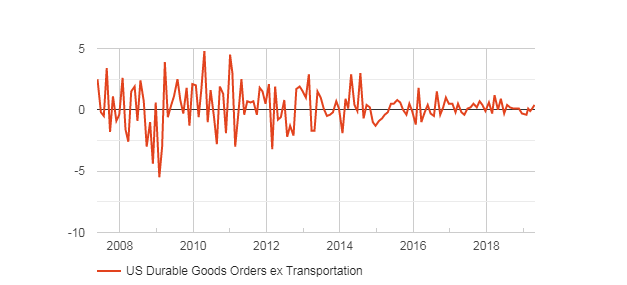
- Goods orders ex-transport have slowed despite strong consumer sentiment readings

The US Census Bureau will release its report on Manufacturers New Orders for Durable Goods on May 24th at 8:30 am EDT, 12:30 pm GMT
Forecast
Durable goods orders are predicted to fall 2.0% in April after rising 2.8% in March. Orders outside of the transportation sector are projected to be unchanged at 0.2%. Orders without government defense procurement are expected to fall 2.0% following the March 1.3% increase. Non-defense capital goods orders excluding aircraft and parts, an equivalency for business investment are forecast to decline 0.3% after a 1.0% increase in March.
FXStreet
Durable Goods and Retail Sales
Durable goods represent a portion of the overall retail sales category which is about one-third of all consumer spending. Its items are designed to last three years or more in normal use. Comprising manufactured products across a wide spectrum from bicycles to commercial airplane, from hair dryers to blast furnaces, durable goods are bought less often and with a lower degree of necessity giving a view into longer term household finances.
Even for a normally volatile category retail sales have had a bumpy four months. December’s 1.6% decline and January’s 0.8% gain were affected by reporting issues around the government shutdown. The February 0.3% fall and March’s 1.7% increase gave the first quarter the best monthly average since October 2017.
Durable goods have been more restrained, particularly the ex-transport category which excludes commercial aircraft, in practice the sales of Boeing Company of Chicago. The 0.133% three month moving average in March is far from the relative boom of the year ending last September with its 0.55% average monthly gain.
Durable Goods and the Consumer Economy
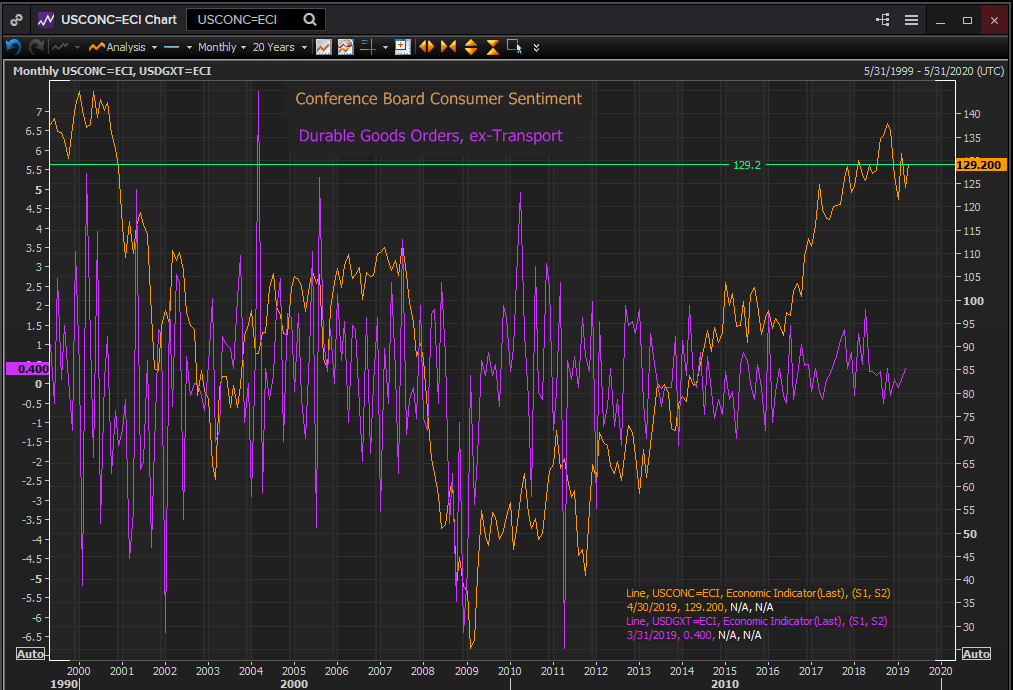
There is an interesting dichotomy in the relationship between consumer sentiment and the purchase of long-term goods. When sentiment falls sharply, as it did in the financial crisis purchases of durable goods (ex-transport) follow attitudes down. People put off buying a new car or a new air conditioner, understandably so. But when sentiment recovers, purchase do not follow beyond a certain level, they seem to be constrained somewhat by need..
Reuters
If you look at the period from the middle of 2016 onward, Conference Board consumer sentiment soared from 92.4 in May to 137.3 last September, a 48.5% jump in optimism. Durable goods purchases did increase 1.4% in October 2017 and 1.9% in April 2018 with the three month moving averge reaching 1.23% in April 2018 but they quickly fell back to earth. By March 2019 the three month moving average was 0.133% while consumer sentiment remained at 129.2 in April above every score for the 17 years prior to February 2018.
Judging by that relationship the excellent job market, rising wages and overall strength of the US economy may have less to do with durable goods purchases than the burst of buying from July 2017 through April of 2018
Author

Joseph Trevisani
FXStreet
Joseph Trevisani began his thirty-year career in the financial markets at Credit Suisse in New York and Singapore where he worked for 12 years as an interbank currency trader and trading desk manager.
















