US Durable Goods Orders Preview: Business and consumer spending diverge
- Durable goods orders to fade from strong June
- Business spending expected to decline slightly
- Retail sales suggest active consumer durable goods

The US Census Bureau will release its report on Manufacturers New Orders for Durable Goods in July on Monday August 27th, 12:30 GMT, 8:30 EDT.
Forecast
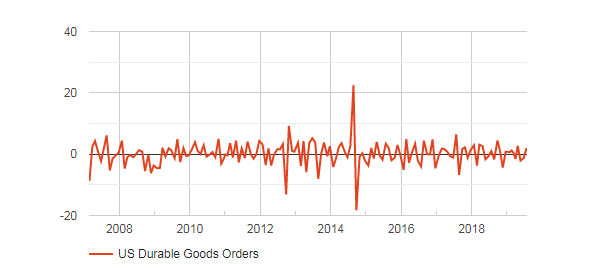
Durable goods orders are expected to rise 1.1% in July after June’s revised 1.9% gain-originally 2.0%. Orders outside of the transportation sector are predicted to be flat following June’s revised 1.0% increase-initially 1.2%. Non-defense capital goods orders excluding aircraft and parts, a commonly used indicator proxy for business spending, are thought to be flat in July after rising a revised 1.5% in June-originally 1.9%. Orders aside from Defense Department expenditures in June were revised down to 2.9% from 3.1%.
Durable goods
Durable goods are the government’s classification for long lived retail goods. Its products are designed to last three years or more in normal use. Items in this category extend from consumer durables like automobiles, exercise equipment and lawn mowers that may be replaced frequently to business investment purchases like electric turbines and commercial aircraft whose useful life may last in decades to office software whose utilization may not survive the next release.
FXStreet
Durable goods in business
The Census Bureau’s category, non-defense capital goods ex aircraft and parts, is essentially business durable goods purchases minus those generated by government defense spending and excluding commercial aircraft.
Business capital spending is an important cyclical component of GDP and an indicator of future economic activity. Businesses spend most liberally to replace aging equipment or expand capacity when they anticipate growth in consumer spending. The lead time may be anywhere from a few months to years depending on the type of business and the size of the investment.
Business sentiment
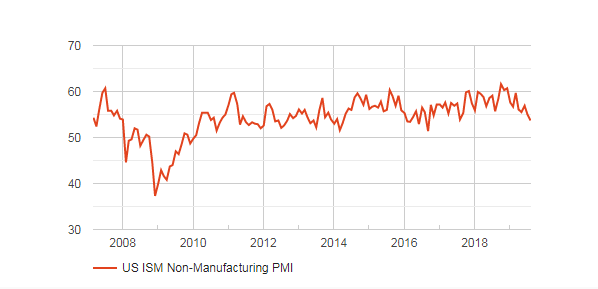
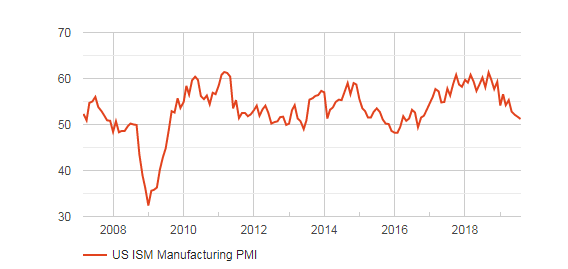
Business sentiment and spending has been deeply affected by the US trade dispute with China. Sentiment has fallen steadily in both the manufacturing and service sectors this year.
The overall purchasing managers’ index (PMI) in services dropped to 53.7 in July the lowest in three years and is down from last September’s 13 year high of 60.8.
FXStreet
Manufacturing’s PMI is yet weaker registering 51.2 in July also down from a 13 year top last August of 60.8.
FXStreet
Retail Sales and consumer sentiment
Consumer spending has been healthy in the past five months. The Census Bureau’s retail sales category rose 0.7% in July, more than double the 0.3% forecast and June’s 0.3% result. Over the last five months it has gained an average of 0.6%.
Likewise the control group which enters into the government’s GDP calculation jumped 1.0% in July, ahead of the 0.7% prediction and June’s 0.7% increase. These sales have measured 0.64% monthly in March through July’
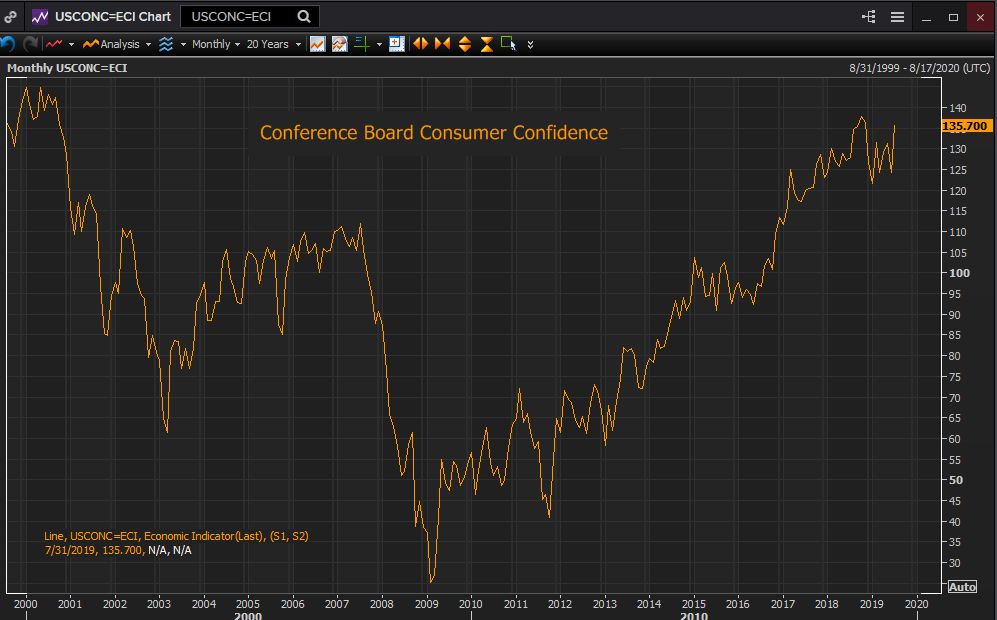
Consumer sentiment has been buoyant supported by the still surging labor market. The Conference Board Consumer Sentiment Index of 135.7 in July was among the highest reading of the last two decades and was the second highest post-recession reading. Though the sentiment index is expected to drop to 130.0 when the August score is reported on the 27th that would still place consumer optimism above every reading from December 2000 to August 2018.
Reuters
Consumer satisfaction is a generally reliable guide to retail sales and though strong consumption is normally followed by business spending the US China trade dispute has severely inhibited business investment. The consumer is as yet, largely unaffected by the competing tariffs placed by Washington and Beijing.
The divergence between the active consumer and recoiling business will likely widen in July as the trade war between the world’s two largest economies has continued to deepen since the previous durable goods report.
Author

Joseph Trevisani
FXStreet
Joseph Trevisani began his thirty-year career in the financial markets at Credit Suisse in New York and Singapore where he worked for 12 years as an interbank currency trader and trading desk manager.

















