US Dollar Weekly Forecast: US inflation to test recent strength as markets pare Fed rate cut bets
- The USD Index (DXY) closed the week on the back foot.
- Friday’s NFP-led rebound lent oxygent to DXY.
- Expectations for a June rate cut by the Fed lost some momentum.
- Markets’ attention now shifts to the US inflation data.

Towards the end of the week, the US Dollar (USD) managed to regain balance, reversing a three-day negative streak and reclaiming the area beyond the 104.00 barrier when gauged by the US Dollar Index (DXY).
Concurrently, the index extended its distance from the critical 200-day Simple Moving Average (SMA) at 103.79, signaling a potential continuation of the bullish trend, at least in the short-term horizon.
Interestingly, the Greenback's weekly advancement occurred almost exclusively on the back of another robust print from the US labour market for March. On the latter, the US economy added 303K jobs during the last month, the Unemployment Rate improved to 3.8%, and Average Hourly Earnings increased by 4.1% over the last twelve months, down from the 4.3% seen in February. The labour market not only remains healthy and tight, but it has also poured cold water over broad investors’ expectations of an interest rate cut by the Federal Reserve (Fed) at its June 12 meeting.
It is worth mentioning that the positive week in the Dollar also came in tandem with barely changed developments in the US money markets, where yields across the curve alternated gains with losses throughout the week just to end the trading week almost at Monday’s levels.
Only one interest rate cut?... Maybe…
The Greenback’s weekly price action appeared to be dominated by the generalized cautious (hawkish?) message from many Fed speakers, who maintained their prudent stance. On this, still sticky US inflation and the tight labour market seem to give them the reason.
Speaking about the Federal Reserve’s (Fed) rate-setters: A week ago, Fed Chairman Jerome Powell demonstrated that there is no haste to begin lowering interest rates. In fact, he reaffirmed that the Fed has the flexibility to carefully examine its first interest rate cut, given the economy's strength and recent high inflation rates.
Raphael Bostic, President of the Federal Reserve Bank of Atlanta, restated earlier this week his expectation of only one rate cut this year, most likely in the fourth quarter.
His colleague Austan Goolsbee of the Federal Reserve Bank of Chicago said on Thursday that the most important impediment to the bank's attempts to return inflation to its 2% target rate is the ongoing occurrence of major price increases in the housing services sector. Furthermore, Loretta Mester, President of the Federal Reserve Bank of Cleveland, stated on Thursday that she would be willing to reduce the rate at which securities are removed from the Fed's balance sheet in the near future, while Minneapolis Federal Reserve Bank President Neel Kashkari argued on Thursday that during the Fed's meeting last month, he penciled in two interest rate cuts this year, but if inflation remains low, none may be required this year.
According to the FedWatch Tool, managed by CME Group, current indications support the notion that there's about a 58% chance of a 25 bps reduction in June.
Anticipated caution ahead of CPI release
Investor focus is now directed towards the upcoming release of crucial US inflation data, specifically from the Consumer Price Index (CPI) towards the middle of next week. Alongside these figures, other key fundamentals such as the Producer Price Index (PPI) and the preliminary Michigan Consumer Sentiment will also be observed, as well as speeches by FOMC members.
Given this scenario, the Greenback may enter a phase of consolidation, while bullish sentiments could remain temporarily capped by recent yearly highs past 105.00 (April 2).
Interest rate trajectories and currency vigor
When examining central banks and inflation dynamics among the G10, the Fed and the European Central Bank (ECB) are still anticipated to decrease their interest rates around the summer season along with maybe the Bank of England (BoE). Conversely, the Reserve Bank of Australia (RBA) is expected to initiate its easing cycle later in the year. Despite raising its policy rate by 10 bps after 17 years at its March meeting, the Bank of Japan (BoJ) remains an outlier.
Furthermore, with both the ECB and the Fed increasingly likely to ease monetary policy at the same time, the superior position of US fundamentals is expected to keep the Dollar strong against its G10 peers, notably the Euro, for the foreseeable future.
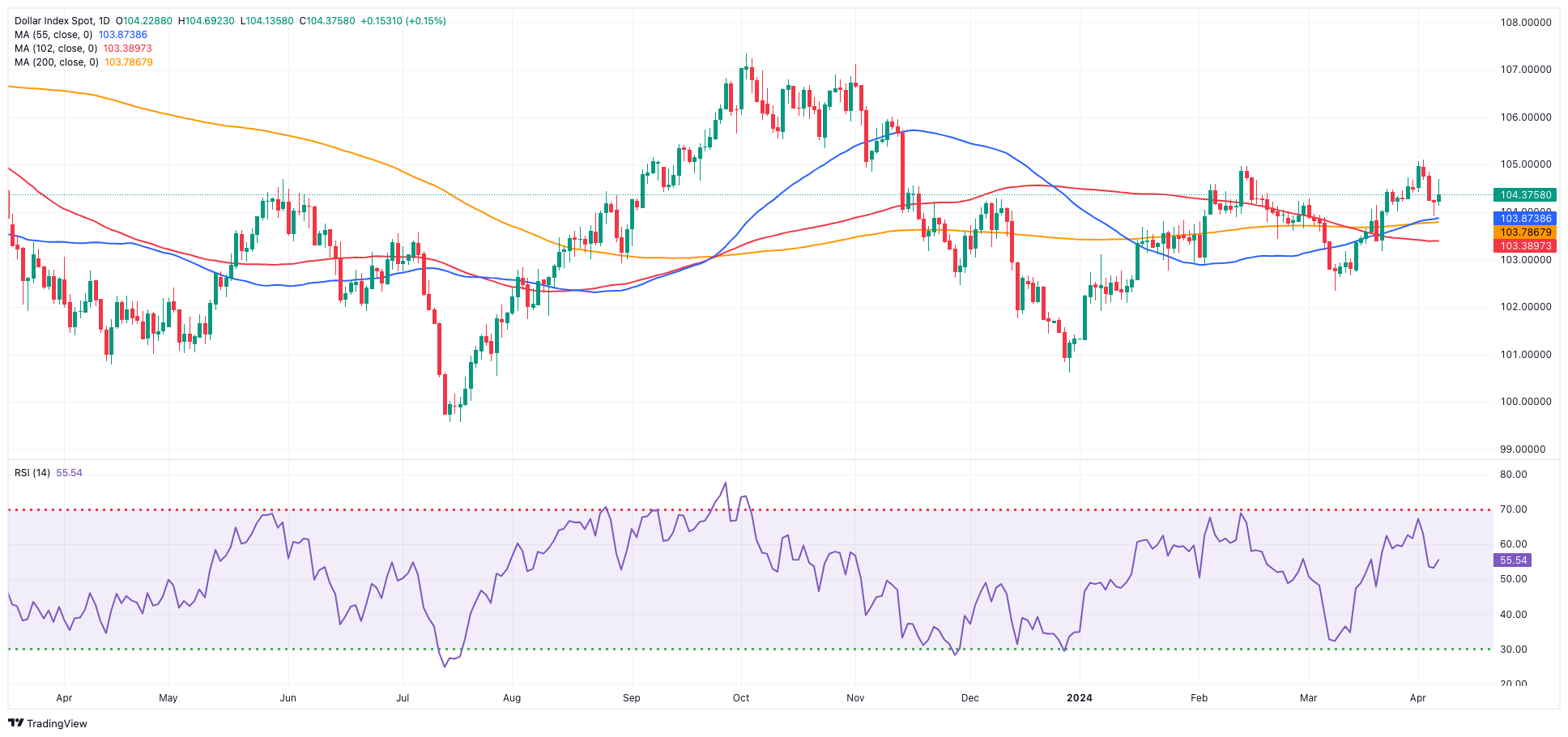
DXY technical outlook
The daily chart shows an imminent resistance region at the 2024 top at 105.10, which occurred on April 2. Moving forward, the weekly peak of 106.00, achieved on November 10, and the November high of 107.11, set on November 1, provide a slight stumbling block.
In the other direction, the 200-day SMA at 103.79 should offer initial and decent contention prior to the provisional 100-day SMA at 103.42 and the March low of 102.35. If the DXY falls further, it may reach its December low of 100.61, recorded on December 28, which preceded the crucial 100.00 level and the 2023 low of 99.57 set on July 14.
Maintaining a position above the 200-day Simple Moving Average (SMA) indicates an optimistic outlook.
US Dollar price today
The table below shows the percentage change of US Dollar (USD) against listed major currencies today. US Dollar was the strongest against the Canadian Dollar.
| USD | EUR | GBP | CAD | AUD | JPY | NZD | CHF | |
| USD | 0.10% | 0.18% | 0.40% | 0.20% | 0.20% | 0.27% | -0.07% | |
| EUR | -0.09% | 0.09% | 0.30% | 0.12% | 0.11% | 0.20% | -0.16% | |
| GBP | -0.19% | -0.09% | 0.21% | 0.01% | 0.01% | 0.11% | -0.25% | |
| CAD | -0.40% | -0.30% | -0.21% | -0.20% | -0.20% | -0.10% | -0.46% | |
| AUD | -0.19% | -0.10% | -0.01% | 0.21% | 0.00% | 0.09% | -0.27% | |
| JPY | -0.20% | -0.10% | -0.02% | 0.18% | -0.01% | 0.11% | -0.27% | |
| NZD | -0.30% | -0.19% | -0.11% | 0.11% | -0.09% | -0.10% | -0.37% | |
| CHF | 0.07% | 0.17% | 0.26% | 0.46% | 0.28% | 0.26% | 0.37% |
The heat map shows percentage changes of major currencies against each other. The base currency is picked from the left column, while the quote currency is picked from the top row. For example, if you pick the Euro from the left column and move along the horizontal line to the Japanese Yen, the percentage change displayed in the box will represent EUR (base)/JPY (quote).
Author

Pablo Piovano
FXStreet
Born and bred in Argentina, Pablo has been carrying on with his passion for FX markets and trading since his first college years.