|

US Dollar Index outlook: Bears pressure key support zone and risk deeper fall on break

US Dollar Index

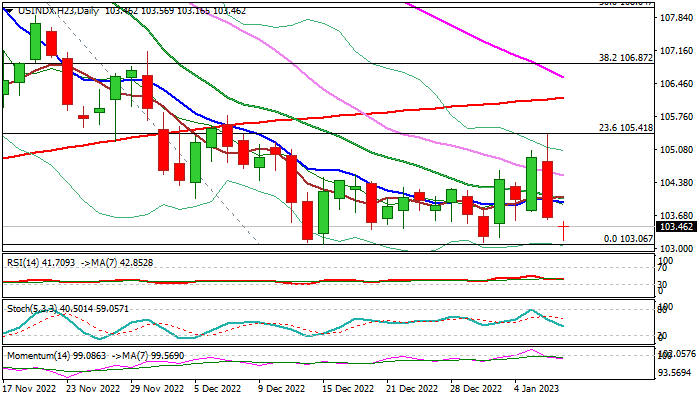
The dollar index remains at the back foot on Monday and pressuring key supports at 103 zone (lows of mid / late Dec, where a temporary base has formed) after strong fall on Friday (down 1.1% for the day).

The dollar came under increased pressure after US labor data signaled that the Fed may further ease its stance on interest rates, while China’s further easing of strict Covid policy, added to improving risk sentiment.

Daily studies returned to bearish configuration, contributing to weakening tone, though fresh bears need to register a clear break of 103 support zone, which would also confirm penetration into rising weekly cloud (top of the cloud lays at 103.64) and signal continuation of the downtrend from 114.72 (2022 high, the highest since 2002) which paused for consolidation in past two weeks.

Sustained break of 103 zone pivots (also bull-trendline off 89.50, May 2021 low) would risk drop towards 101.94 (50% retracement of 89.15/114.72 ascend), 100.44 (weekly cloud base) and 100 (psychological).

Initial resistances at 103.95 (10DMA) and 104.11 (20DMA) should ideally cap, but extended upticks should not exceed 105.41 (Friday’s high (Fibo 23.6% of 113.02/103.06) to keep larger bears intact

Res: 103.95; 104.11; 104.52; 105.41.
Sup: 103.06; 102.63; 101.94; 100.44.
Chart

Author

Slobodan Drvenica

Slobodan Drvenica

Windsor Brokers

Industry veteran with over 22 years’ experience, Slobodan Drvenica joined Windsor Brokers in 1995 when he was an active trader for more than 10 years, managing the trading desk and own account departments.


More from Slobodan Drvenica
Share:

Editor's Picks

AUD/USD hangs close to monthly lows, still defends 0.7100 ahead of Fed decision

AUD/USD retains its negative bias for the third straight day, defending 0.7100 while trading close to a monthly low in Wednesday's Asian session on Wednesday. The US Dollar stands firm near a two-week high as the anticipated Fed rate hike and oil-driven inflation fears continue to push US bond yields to a multi-year high. Furthermore, escalating Middle East tensions benefit the safe-haven buck and weigh on the risk-sensitive Aussie.

USD/JPY holds firm above 155.00, awaits the key Fed verdict

USD/JPY climbs to a fresh one-week high above 155.00 in the Asian session on Wednesday amid a bullish US Dollar. Oil-driven inflation fears, along with the anticipated Fed rate hike, continue to support surging US bond yields. Moreover, rising US-Iran tensions underpin the USD's reserve currency status. The pair, however, remains below the mid-155.00s as bulls seem hesitant ahead of the Fed decision later today and the BoJ meeting, starting on Thursday.

Gold struggles below $4,300 as Fed decision looms

Gold remains depressed below $4,300 in the Asian session on Wednesday as traders look to the crucial Fed decision for a fresh impetus. Meanwhile, a surge in US bond yields, bolstered by oil-driven inflation fears, continues to weigh on the non-yielding bullion. Furthermore, escalating Middle East tensions underpin the safe-haven US Dollar and act as a headwind for XAU/USD.

Ethereum continues to attract capital despite impending rate hike and Clarity Act failure

Ethereum declined to $2,400 on Tuesday after the Clarity Act failed to progress in the Senate. Despite that and the market's near certainty of an interest rate hike at the next Federal Reserve (Fed) meeting, the top altcoin has continued to attract fresh capital. Ethereum buyers have been dominating sellers over the past few days.

August UK inflation report expected to show rising inflation

The United Kingdom Office for National Statistics will publish the highly anticipated Consumer Price Index data for August on Wednesday at 06:00 GMT. The inflation report could trigger volatility in the British Pound, as it comes just one day before the Bank of England monetary policy decision.

How Japan became the World's Banker and why that era may be ending

Japan's ultra-low interest rates helped finance trillions of dollars in global investments for more than a decade, making the Japanese Yen one of the world’s cheapest sources of funding. With the Bank of Japan expected to tighten policy again this week, that advantage may be entering a new phase. While most major economies raised interest rates, Japan remained the world's outlier.