US Core PCE Inflation Preview: US Dollar selling opportunity? Three reasons to expect a slide
- Economists expect the United States Core Personal Consumption Expenditure to have risen by 0.4% in January.
- Shoppers' adjustments to rising prices imply a lower outcome.
- A small sign of slower inflation may trigger profit-taking on US Dollar longs.
- Robust Personal Income and Personal Spending figures would help stocks, also weighing on the Greenback.

It ain't over until the Federal Reserve (Fed) gets its favorite inflation figure – and any 0.1% can make a difference. The Personal Consumption Expenditure (Core PCE) report is published after the Consumer Price Index (CPI) one, this month on Friday, February 24 at 13:30 GMT. Nevertheless, PCE is what the world's most powerful central bank targets – especially the core figure.
Core PCE and the accompanying Personal Income and Personal Spending reports may turn into a US Dollar downer. Here are three reasons why.
1) High PCE inflation expectations may lead to disappointment
Economists expect Core PCE to come out at 0.4% MoM in January, above 0.3% reported in December. These estimates are based on the upbeat Core CPI report, which showed an increase of 0.4%.
Core PCE has been more stable than Core CPI:
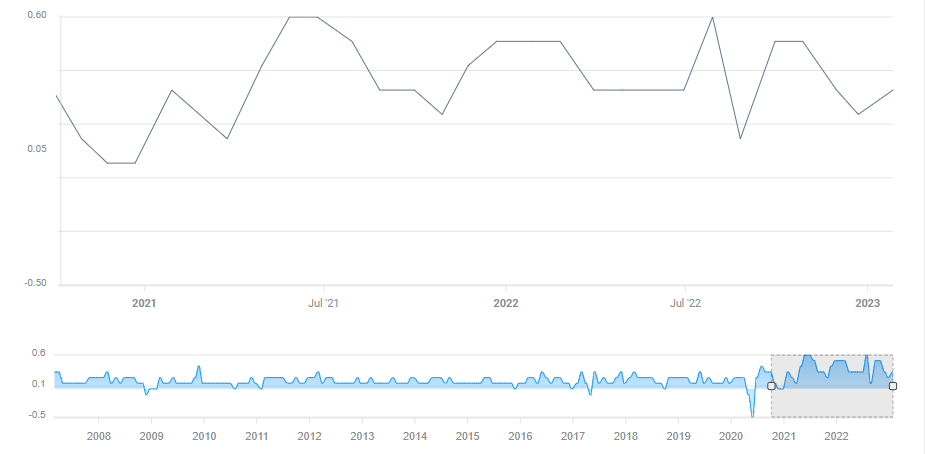
Source: FXStreeet
Makes sense? Not exactly. The Personal Consumption Expenditures formula is adjusted more rapidly than the CPI one, and reflects what people have consumed more recently. For example, if coffee prices shot up, the CPI would give coffee the same weight. However, if some people opted to drink cheaper tea instead of coffee, the PCE inflation report would adjust to such a change and reflect a more moderate increase in prices.
Therefore, there is room for a downside surprise in Core PCE, and that would hurt the US Dollar.
2) Correction time for the US Dollar
The Greenback has been gaining ground for several days, benefiting from the hawkish FOMC Meeting Minutes. These showed some members wanted a large 50 bps hike in the meeting earlier this month. Strong jobless claims also supported the US Dollar.
Zooming out, the world's reserve currency has been dominant since the super-strong Nonfarm Payrolls report for January. Yet every trend has a counter-trend. Even if Core PCE comes out at 0.4% as expected, I believe it would trigger an "it could have been worse" outcome in markets.
It would probably take a surprising 0.5% read to reinforce the notion that inflation is out of control and needs even stricter tightening from the Fed.
3) Personal Spending and Personal Income may trigger a positive impact in stocks
The US Dollar is negatively correlated to stocks. While data that exceeds expectations is positive for the US Dollar, upbeat figures for the economy have been proving positive for equities, and that may indirectly weigh on the Greenback.
Assuming Core PCE rises by 0.4%, the focus could shift to Personal Spending and Personal Income data for January.After downbeat figures in December, a significant bounce is likely in both data points.
In that case, an increase in the stock markets could weigh on the US Dollar, adding to the downtrend.
Final thoughts
Core Personal Consumption Expenditures carries high expectations, comes a winning streak for the US Dollar and could be accompanied by data that buoys stocks – all pushing the Greenback down.
Author

Yohay Elam
FXStreet
Yohay is in Forex since 2008 when he founded Forex Crunch, a blog crafted in his free time that turned into a fully-fledged currency website later sold to Finixio.















