US core consumer prices register a record drop, overall CPI falls the most since the financial crisis
- Core CPI falls 0.4%, overall index 0.8% in April.
- Closed sectors, retail and transport, had largest declines.
- Shutdown orders and social restrictions widespread in Apri.
- Fed interest rate and QE policies operational in March.
- Dollar weakens slightly on historic CPI decline.

American consumer prices fell by the largest amount in modern history as demand for a wide array of goods and services plunged with the nation under commercial and social restrictions ordered in the effort to control the coronavirus pandemic.
CPI and core CPI
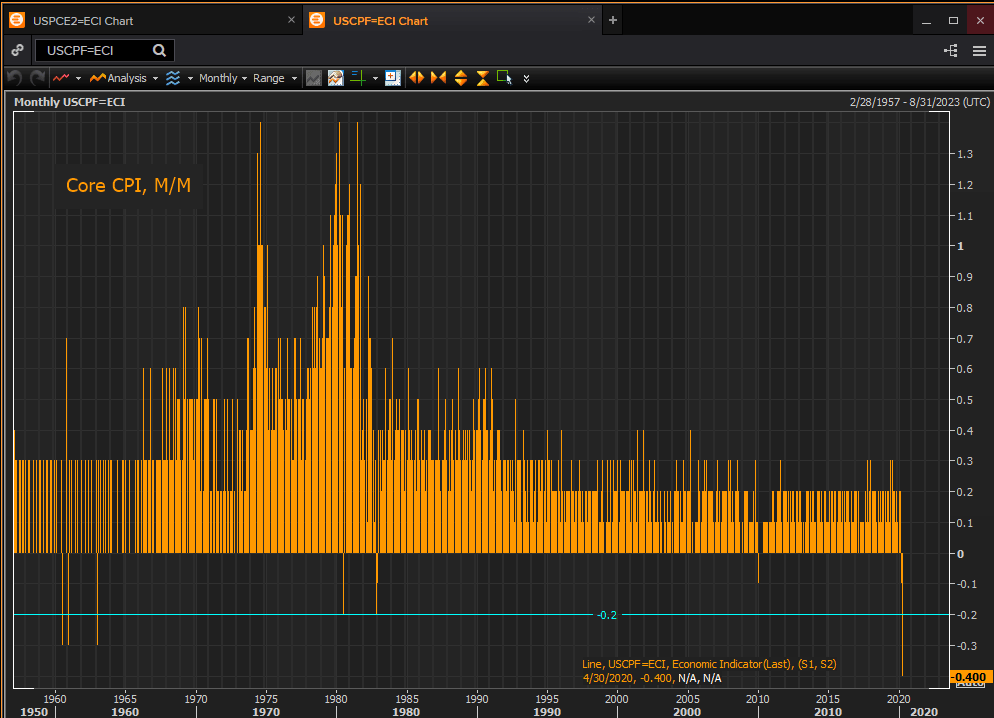
Core CPI which does not include food and energy prices dropped 0.4% in April, reported the Bureau of Labor Statistics, the largest one month decline since these records began in 1957. They had been predicted to slip 0.2%. In the 63 years of CPI data core prices have only fallen 0.2% or more in a month five times, twice in the 1980s at 0.2% and 0.3% three times, twice in 1960 and once in 1963.
The indexes for transportation services and clothing had the largest declines at 4.7% each. With discretionary travel largely halted airlines fares skidded 15.2% and car and truck rental fees dropped 16.2%. Working from home is a far more informal affair, the prices for men’s suits fell 11.3%.
Annual core prices rose just 1.4% the smallest gain since April 2011, a 1.7% increase had been forecast. The March increase was 2.1%.
Overall CPI dropped 0.8% in April as expected, which was the largest decrease since the height of the financial crisis in the fall of 2008 doubling the decline in March.
In October 2008 CPI plummeted- 0.9% followed by -1.8% in November and -0.8% in December. These three months are the deepest and fastest price declines in the 73 years of this series. In this entire history prices have only dropped 0.7% or more five times, the three above and 0.7% in March 1948 and 0.9% in July 1949. On the year CPI increased just 0.3% in April down from 1.5%in March, 0.4% had been predicted.
Food and energy prices
Food prices saw a substantial rise in April as increased demand created shortage for some products and supply chain disruptions cut availability for others. The index for bakery goods and cereals jumped 2.9% in April, its largest gain ever. Price for delivered food climbed 2.6%.
Energy prices dropped 10.1% in April mostly from a 20.6% decrease in gasoline prices. The price of West Texas Intermediate (WTI, CLc1), the North American crude oil price standard, has fallen 60% since the beginning of March as demand has collapsed.
April’s price action in the May futures included the singular meltdown to $-37.63 on April 20 as traders long the contract and not wanting to take delivery on the commodity accepted any price to be relieved of their responsibility under exchange regulations.
Consumer demand destruction
The historic collapse in consumer spending has put tremendous pressure on retailers of goods and services to lower prices to secure cash flow and clear inventory.
Retail sales are expected drop 10% in April after falling a record 8.4% in March. The ‘control group’ which is an analog for the consumption component of GDP is forecast to fall 3.9% after rising 1.7% in March. These statistics will be issued by the Census Bureau this Friday at 8:30 am EDT.
The March numbers for durable goods order and personal spending at, -14.8% and-7.5% were already the second largest and largest declines in their respective series. As with retail sales the April results are expected to be much worse when they are released on May 28 and 29.
Fed preemptive response
The central bank began its pandemic actions on March 3 with a 0.5% cut in the fed funds rate followed two weeks later by a further 1.0% reduction to 0.25% and a $700 billion quantitative easing bond program since supplemented.
The governors have also initiated a $2.3 billion business and local government loan program. Chairman Jerome Powell has said the FOMC expect to keep the measures active until the economy is securely on the road to recovery.
Deflation and disinflation
The Fed’s long-standing concern that inflation below its 2% core PCE target will evolve into permanently lower expectations was one of the early rationales behind the first quantitative easing programs under Chairman Ben Bernanke.
Current price decline will probably not elicit any additional Fed response for two reasons. First the Fed’s actions have been exactly the prescribed policy to prevent a deflationary spiral. Second and more important, the price retreats, as in the financial crisis, are the product of a specific event. As the lock downs end and the economy revives, the downward pressure on prices will ease then disappear.
The dollar and the Fed
April CPI has confirmed the enormous impact of the economic closures on consumption and prices. The CPI decline will be understood to be a precursor for the Fed’s preferred core PCE gauge even if it is unlikely to garner a new policy response. The abbreviated currency movement affirms the notion that no Fed action is expected.
In the longer term, Fed policy is directed to the revival of the US economy. The best way to terminate deflation is to recreate consumer demand. The dollar’s slowly ebbing risk premium is a corollary until the US economy returns to its historical growth path.
Author
Joseph Trevisani
FXStreet
Joseph Trevisani began his thirty-year career in the financial markets at Credit Suisse in New York and Singapore where he worked for 12 years as an interbank currency trader and trading desk manager.