US Consumer Confidence Preview: No good news for Americans
- CB Consumer Confidence is expected to shrink for a third consecutive month in March.
- Market players remain sensitive to banking system-related headlines.
- US Dollar's broad weakness hints at limited gains in the case of a huge disappointment.

The United States will publish the March Conference Board Consumer Confidence index, and market players anticipate it has contracted to 101 from 102.9 in February. That would make the third consecutive decline in consumer sentiment after an encouraging improvement in December that proved short-lived.
Breaking down the February report, the Present Situation index increased from 151.1 to 152.9, although the Expectations Index plunged to 69.7 from 76.0 in January. It is worth reminding that readings below 80 often signal a recession within the next year. It has been below this level for 11 of the last 12 months, according to the official report.
Since the release of the latest report, the banking crisis hit financial markets, and there’s a good chance the situation has further affected consumers’ sentiment. The latest to suffer from clients' distrust was Deutsche Bank, whose shares edged sharply lower on Friday, although they managed to trim a good part of their losses on Monday.
Meanwhile, the United States Federal Reserve (Fed) moved forward with monetary tightening and hiked its benchmark rate by 25 basis points (bps) as widely anticipated. The accompanying statement and the press conference from Chair Jerome Powell were read as dovish as Powell acknowledged they considered the financial system situation before taking their decision. Furthermore, policymakers upwardly revised their inflation forecast, while growth is now seen advancing at a slower pace. Finally, the dot plot anticipated one more 25 bps hike before a pause, while rate cuts are on the table for 2024.
With that in mind, it is possible the CB Consumer Confidence report will have a limited impact on financial markets.
USD possible scenarios
The US Dollar’s direction is strongly linked to market sentiment these days, which means a better-than-anticipated outcome could play against the safe-haven currency. On the other hand, a disappointing figure may boost demand for safety and trigger near-term US Dollar buying. Still, and given its overall weak tone, chances of a firmer advance seem limited at the time being.
Rather than watching the CB Consumer Confidence survey, market players will likely maintain their attention on banking sector developments and whether governments will provide support to avoid a financial cataclysm.
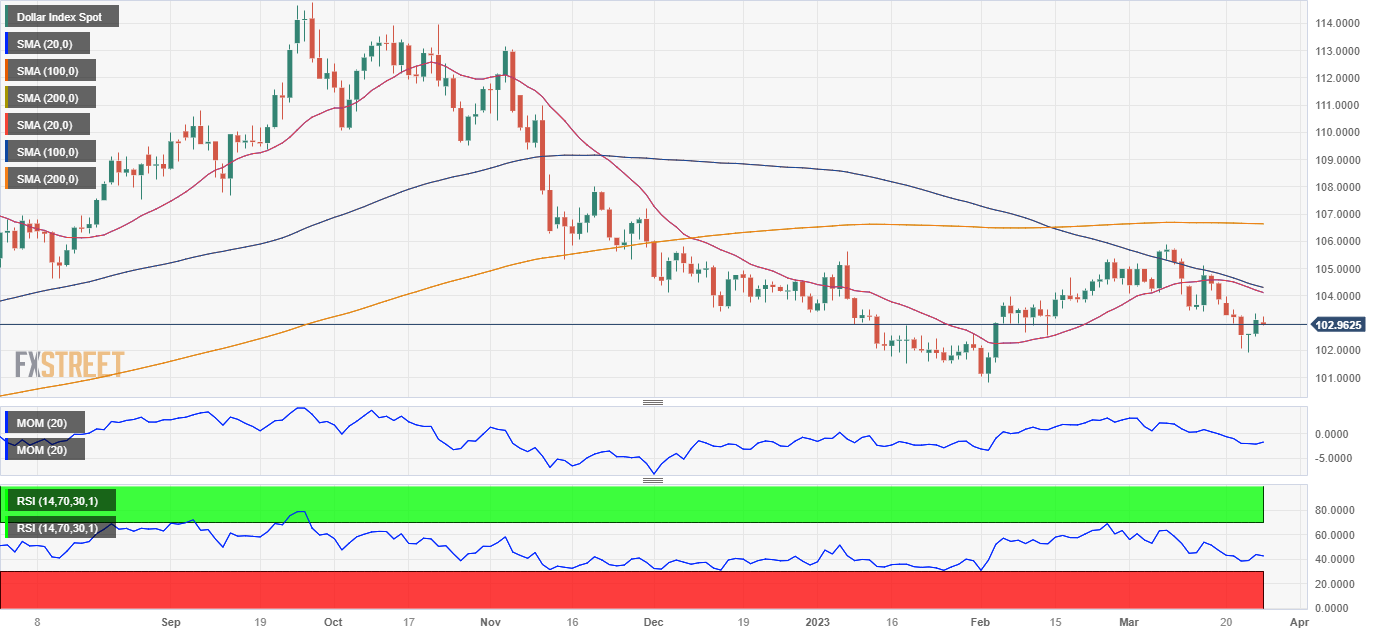
From a technical point of view, the Dollar Index (DXY) offers a neutral-to-bearish bias on the daily chart. It bottomed at 101.58 last week, recovering afterwards towards the 103.00 level, a tough bone to break as the DXY has posted multiple daily highs and lows around it. A break above the level would mean easing bearish pressure but remaining short of signaling a firmer advance. For the latter to happen, the index would need to recover beyond 104.70, the March 15 high, an unlikely scenario with the release of Consumer Confidence.
Critical support stands at 102.25, as once below it, a test of the aforementioned low seems likely, en route to this year's low at 100.66.
Author

Valeria Bednarik
FXStreet
Valeria Bednarik was born and lives in Buenos Aires, Argentina. Her passion for math and numbers pushed her into studying economics in her younger years.