US Conference Board Consumer Confidence Preview: Happiness is relative or are your relatives happy?
- Confidence expected to rise into the third quarter
- Labor market, wages and low unemployment boost confidence
- Trade, global slowdown not affecting sentiment

The Conference Board, a private business group will release its Consumer Confidence Index for July on July 30th at 10:00 EDT, 14:00 GMT.
Forecast
The Consumer Confidence Index is projected to rise to 125.0 in July from 121.5 in June. The Present Situation Index was 162.6 in June down from 170.7 in May. The Expectations Index was 94.1 in June and 105.0 in May.
US Labor Economy
Employment and wages are the most telling signposts for consumer sentiment. The trends have been positive for two years and sentiment reflects the excellent labor market.
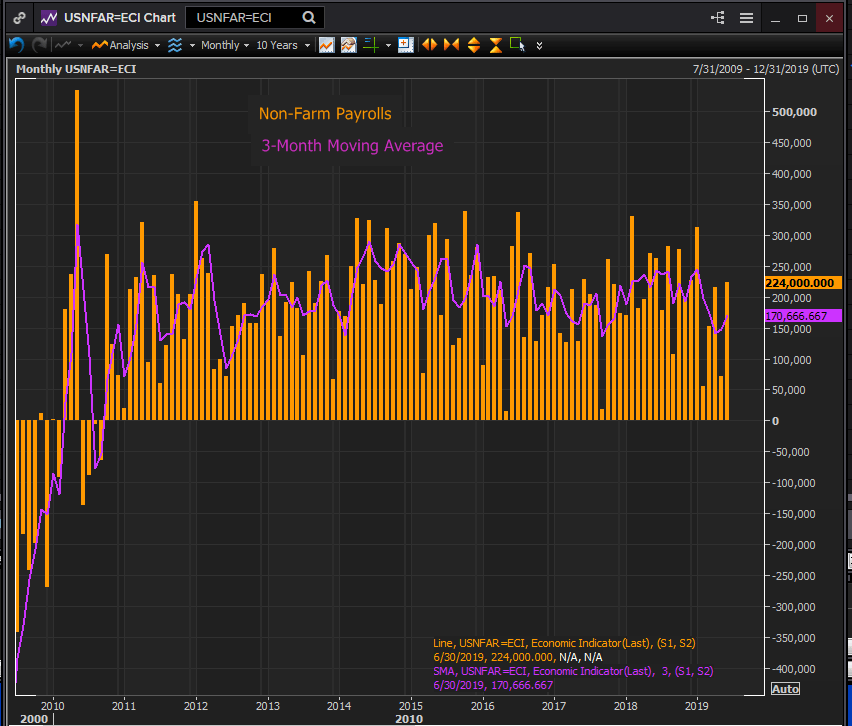
Job creation returned to form in June with 224,000 new positions, putting to rest, at least temporarily, the fear that the labor market was entering a slower phase after February and May at 56,000 and 72,000. The three month moving average has dropped from 245,000 in January to 171,000 in June with 165,000 forecast for the July payrolls to be released on Friday, August 2nd. The unemployment rate of 3.7%, predicted to fall to 3.6% in July continues its historic run with the longest period below 4% in five decades.
Reuters
Wages remain buoyant at a 3.1% annual increase in June and a forecast 3.2% in July.
Business employment sentiment and jobless claims
Business optimism has taken a serious hit from the 18 month trade dispute with China. Overall sentiment dropped from 60.8 in August 2018 and 56.6 this January to 51.7 in June, not far from the 50 division separating expansion from contraction.
Hiring sentiment has fared somewhat better. Although it is down from the most recent high of 58.2 last September, it has recovered from its twin lows of 52.3 in February, a residue of the January government shutdown, and 52.4 in April, with June's 54.5 reading. July’s score will be released on August 1st and is forecast to slip to 53.4.
Service sector business sentiment shows a similar pattern. From a 14 year high of 60.8 in September 2018 the index has dropped to 55.1 in June, matching the post-election low in July 2017. Here also employment sentiment has held up better than the overall, falling from 60.4 in September 2018 to 53.7 in April with a small rebound to 55.0 to June.
One interesting item from the employment front is that although the hiring optimism has faded, and that may partially reflect the difficult in finding qualified employees, it is not because of a change in the need for new workers.
The four week moving average for initial jobless claims was 213,000 in the July 20th week, a level not seen since December 1969. Whatever is depressing the spirits of business executives it is not the necessity of cutting costs and workers.
GDP and inflation
The US expansion slowed to a 2.1% annualized pace in the second quarter from 3.1% in the first. The drop was largely due to a run-off but not replacement in inventory accumulated in the prior three months and a 5.2% decline in exports which in BEA accounting is subtracted from economic activity.
Consumer spending, which may be taken as a marker of sentiment rose 4.2% in the quarter.
Inflation is quiescent with core PCE at 1.6% in May and 1.7% expected in June. The overall PCE rate which is what the consumer pays was 1.5% in June.
The Fed has cited low inflation as one of the reasons it is contemplating a 0.25% rate cut at the FOMC meeting ending Wednesday. But over the seven months since the last rate hike in December 2018, the global economic slowdown, the US China trade war and Brexit have been of more moment to the governors than the long underperforming US inflation rate.
The central bank considers persistently low inflation to be a threat to the economy. It is doubtful many consumers agree.
Michigan Consumer Sentiment
The second major consumer survey from the University of Michigan supports the positive view of the US economy and of their own immediate future prevalent in US households. The 98.4 reading in June is in the middle of the range of the past two years which have seen the best sustained scores in almost 20 years. The shutdown induced plunge in January was an anomaly related to nothing but the month long government closure and the electorate's intense dislike of such DC political maneuvers.
Consumer Confidence
The US economy has prospered over the past two years and the expansion became the longest on record in July. The longevity of the job boom has brought employment and wage gains to many groups on the margins of the economy which had been largely ignored by the weak growth of the prior decade.
There is no mystery that confidence measures reflecting this reality have seen their best reading in two decades and those of the Conference Board in particular are at marks reached only twice before in the 52 year history of the survey.
As the job market goes so goes the consumer. With employment and wages at levels that many workers have never seen, with inflation unnoticed and with the economy continuing a healthy expansion despite the concerns of the economic professionals there is every reason for US families, that is American employees, to be happy.
Author

Joseph Trevisani
FXStreet
Joseph Trevisani began his thirty-year career in the financial markets at Credit Suisse in New York and Singapore where he worked for 12 years as an interbank currency trader and trading desk manager.
















