US Conference Board Consumer Confidence February Preview: Steady as the labor market goes
- Consumer confidence expected to remain strong in February.
- Labor market, wages and unemployment support optimism.
- Michigan sentiment near post-recession highs in February.

The Conference Board, a private non-profit business group, will release its February Consumer Confidence Index on Tuesday February 25th at 15:00 GMT, 10:00 EST.
Forecast
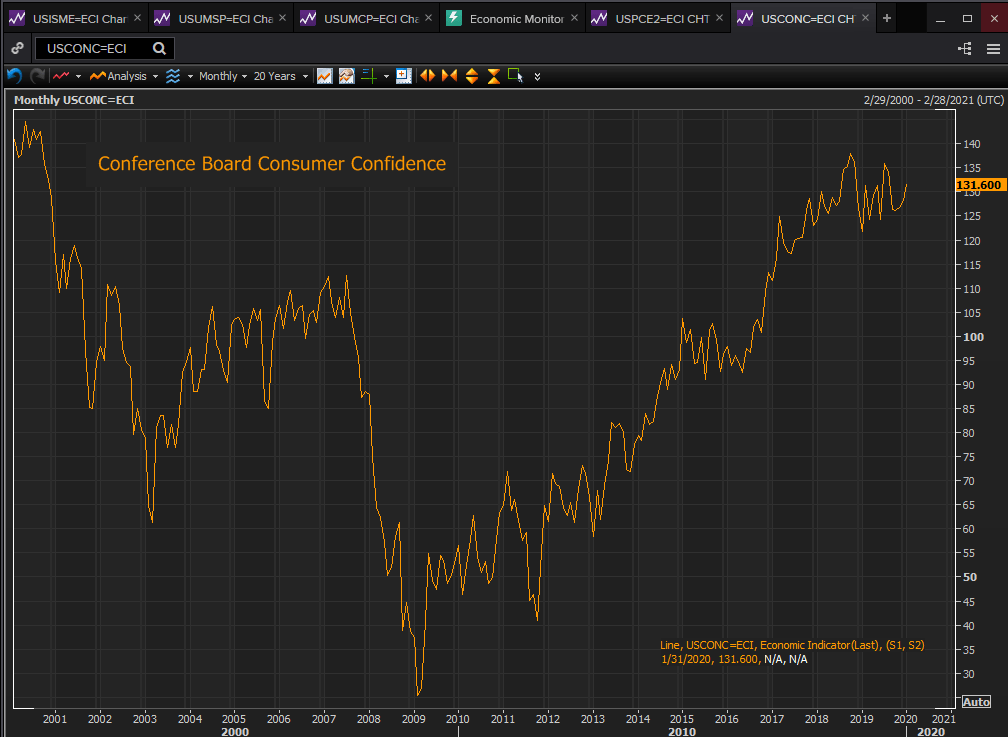
The Conference Board Consumer Confidence Index is expected to rise to 132.0 in February from 131.6 in February.
US labor market
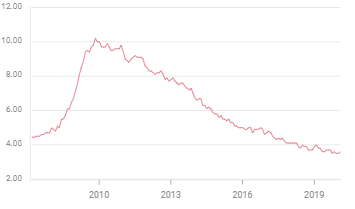
The labor market is expected to continue its winning ways after adding 225,000 new jobs in January and averaging 175,000 per month last year. New positions remain far ahead of underlying growth in the labor force. Annual wage gains have been at or above 3% for 16 months and the unemployment rate of 3.6% is within 0.2% of its half-century record.
Unemployment Rate, U-3
The four-week moving average for initial jobless claims at 212,250 is close to a five decade low.
These well known facts of the job market are the primary reasons that consumer confidence has kept close to its post-recession high. Consumer confidence is a reflection of the financial condition of households and, despite occasional tremors in sentiment from external factors, like the government shutdown in January 2019, it accurately mirrors the success of the economy.
The consumer economy
Retail sales have averaged a 0.25% monthly gain over the past half year and 0.40% over the 12 months to January. The sales control group which mimics the consumption component of the GDP calculation by the Bureau of Economic Analysis, is weaker at 0.10% for six months and 0.33% for 12.
Personal spending, which measures consumption from the business side has averaged 0.32% for the half–year to December and 0.38% in 2019.
Consumers do not normally restrain their purchases when income and employment are plentiful. Whatever the news flow and the disputes in the nation’s capital and on the campaign trail, households make economic and financial not political decisions on spending.
Michigan Consumer Sentiment
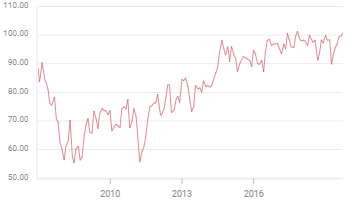
At 100.9 in February the Michigan score is at its second highest level since the financial crisis. In five of the last six months and eight of the last 12 months the performance was better than the consensus estimate.
Michigan Consumer Sentiment
Conclusion and the dollar
The US economy, as Fed Chairman Powell’s likes to say, “Is in a good place.” Consumers are employed and their incomes are rising. Though the trade war and Brexit concerns of last summer that prompted 0.75% in rate cuts have been replaced by the potential economic and social effects of the corona virus, the consumer continues to translate financial well-being into consumption.
Sentiment is not a key indicator for Fed policy or for the dollar. It is more a reflection of the state of economy than a direct contributor.
Growth has increased in the first quarter form its 2.1% paces in the final three months of last year. The Atlanta Fed estimates it is 2.6% annualized through February 19th.
The dollar has been bolstered over the past two weeks by the relatively strong statistical performance of the US economy and by safety flows as the world negotiates the threat of the virus that originated in China.
Thus far the health crisis on the mainland has not affected attitude or spending of the American consumer. That may change in the months ahead but February seems secure.
Author

Joseph Trevisani
FXStreet
Joseph Trevisani began his thirty-year career in the financial markets at Credit Suisse in New York and Singapore where he worked for 12 years as an interbank currency trader and trading desk manager.
















