US Conference Board Consumer Confidence: Labor market feeds confidence
- Jobs, income, restrained inflation continue to drive consumer confidence
- Lower 2nd quarter estimated GDP with limited impact
- Confidence stable near two decade high

The Conference Board will release its Consumer Confidence Index for May at 10:00 am EDT, 14:00 GMT on Wednesday May 28th.
Forecast
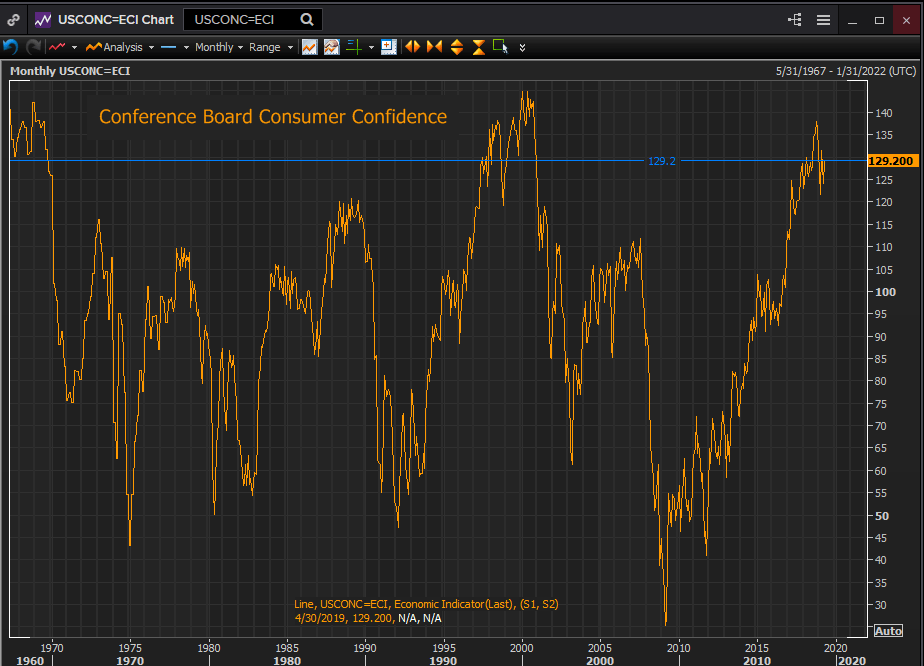
The Consumer Confidence index from the business group the Conference Board is predicted to rise to 130.0 in May from 129.2 in April. The Present Situation Index in April was 168.3 up from 163.0 in March. The Expectations Index rose to 103.0 in April from 93.3 the prior month.
Reuters
US Economy: GDP vs Labor Market
The growth rate of the American economy in the second quarter is estimated by the Atlanta Fed’s GDPNow model to be 1.3% annualized. That is just over one-third of its 3.2% pace in the first three months of the year and close to one-half its 2.2% pace in the fourth quarter of last year.
Despite the variation in GDP job creation remained healthy. Non-farm payrolls averaged 233,333,333 in the fourth quarter. The 185,666,667 average in the first quarter was dragged down by 56,000 in February. April produced 263,000 new positions and 190,000 are forecast for May.
Wages had even less alteration. The increase in annual average hourly earnings was 3.3% in the fourth quarter, 3.267% in the first three months of this year and 3.2% in April with the same forecast for May.
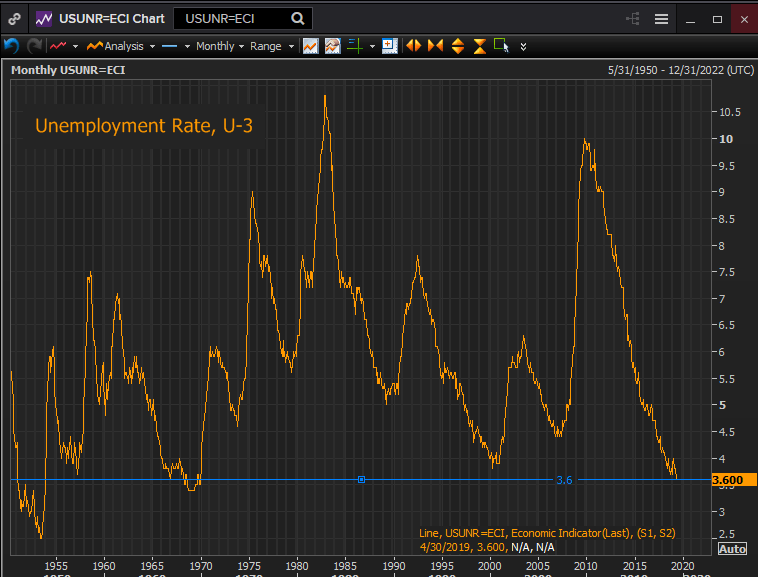
Unemployment dropped to a 50 year low of 3.6% last month making 14 months at or below 4%. That will become 15 months in May, the longest period for sub-4% unemployment since 1968 and 1969.
Reuters
The employment components of the Institute for Supply Management purchasing managers’ indexes in manufacturing and services have been falling for most of the year suggesting that confidence among business managers is waning. But in the crucial test of current hiring, the job numbers belie the concerns. Businesses continue to seek and employ new workers.
For consumer attitudes the abstract notation of GDP and business executives’ future concerns are far less important than the concrete facts of jobs and income.
Inflation
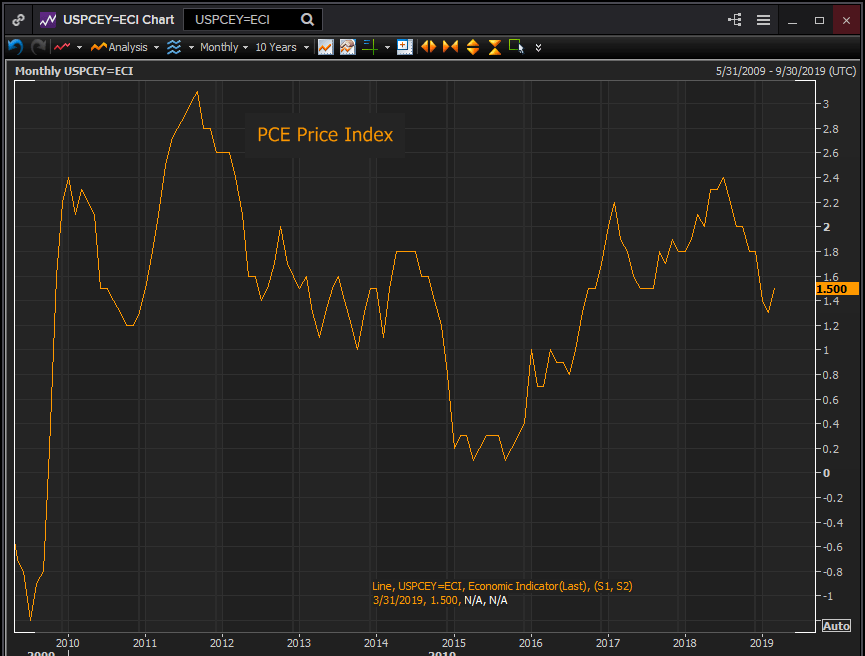
The Fed may strive to keep inflation “symmetric” around its 2% target. But for consumers consistent low inflation is an addition to disposable income. Over the past ten months overall PCE annual inflation has fallen 0.9% from 2.4% last July to 1.5% in March. Whatever the economic virtue of the Fed’s price target declining inflation is a boon to consumers and another source of optimism.
Reuters
Consumer Confidence
Considering the performance of the US economy over the last two years and the ascent of the labor market in particular it is not remarkable that consumer confidence scores have been the best in two decades and comparable to the strongest in the 52 year history of the Conference Board’s survey.
With the job market steadily producing more positions than there are workers to fill them with wages rising at the best pace in a decade and inflation quiescent, consumers are going to remain happy and confident as long as their paychecks tell them they are.
Author

Joseph Trevisani
FXStreet
Joseph Trevisani began his thirty-year career in the financial markets at Credit Suisse in New York and Singapore where he worked for 12 years as an interbank currency trader and trading desk manager.
















