Silver has left the building
Silver does not move like a gentleman. It does not advance further in orderly channels or adhere to polite valuation frameworks. Silver was treated as a global event that everyone ignored until kickoff. By the time the crowd realizes what is happening, most of the entrances are already closed. Now, this is shaping up to be silver’s strongest year since 1979, and that comparison is not merely calendar trivia. That year saw the Iranian Revolution, an oil shock, double-digit inflation, a collapsing dollar, tanks rolling into Afghanistan, and the Hunt brothers turning the silver market into a global spectacle. You do not get that kind of price behaviour in calm macro waters.
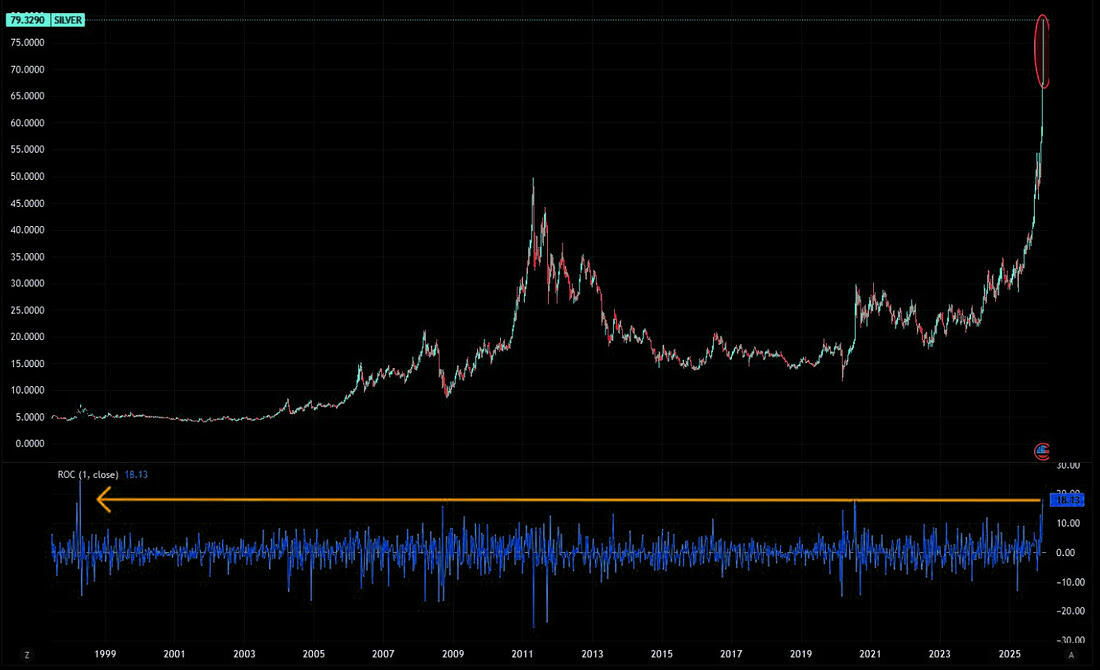
The tape alone tells you something structural is shifting. An eighteen percent weekly gain is not enthusiasm; it is stress. That kind of move has only occurred twice in modern history, once during the 2011 hard-asset panic and once during the 2021 retail-driven supply squeeze. Layer on top of that the prior week being the strongest since the pandemic metal rush, and you start to realize this is not a one-off headline trade. This is positioning colliding with scarcity.
Scarcity is no longer theoretical. Beijing’s decision to move from quotas to licensing for silver exports starting in 2026 is a regime change, not a bureaucratic footnote. China sits at the center of global silver refining, and when the world’s top refiner starts tightening the valve, downstream users feel it immediately. Solar panels, electric vehicles, advanced electronics, and power grids all function without silver’s conductivity. When even industrial optimists publicly warn that this is not good, it is worth listening. The market already ran a deficit of nearly 150 million ounces last year, and another deficit is projected for next year. That is before policy starts biting.
Price has responded the only way it can when physical reality meets financial leverage. Silver has nearly tripled since January, and the market is openly whispering about triple-digit prints. That does not mean the path will be smooth. Silver never is. Volatility is the toll you pay for being early to a shortage. But ignoring the signal because the ride is violent is how traders miss regime shifts.
One of the more revealing tells is not price but rank. Silver has quietly overtaken the British pound to become the world’s eleventh most valuable asset. Whether you fully trust how aggregate market caps are calculated across futures and physical is almost beside the point. Capital is voting with size, and metals are outranking money. That rarely happens unless confidence in paper claims is eroding.
The derivatives market is flashing hazard lights. Trading volume in the largest silver ETF exploded to nearly ten billion dollars in a single session, something that has only occurred during peak stress episodes in the past. Options markets are even louder. The implied volatility on deep out-of-the-money silver calls is more than twice that of comparable gold strikes. That tells you participants are not hedging; they are reaching. Silver is being treated less like a precious metal and more like an emerging market currency in the early innings of a credibility crisis.
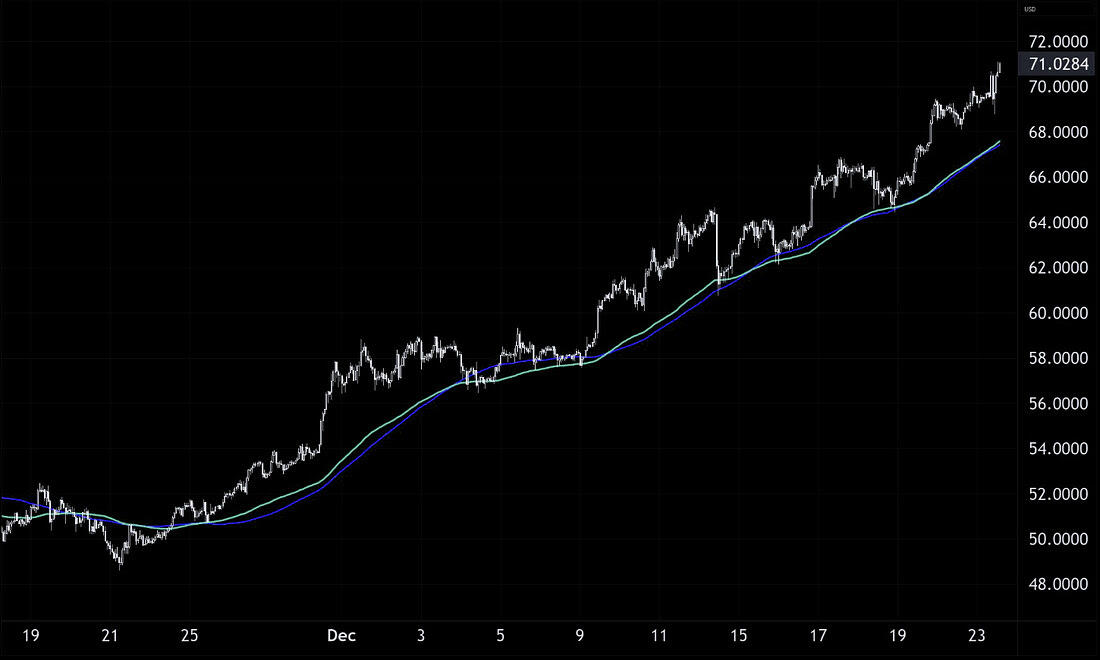
Systematic players are already in. Silver has refused to close below its short-term moving averages throughout the advance, a classic signal that trend-following models are fully engaged. When quant exposure goes from participation to saturation, it changes the microstructure. Dips stop being pullbacks and become air pockets because no one is left willing to short.
Silver has yet to close below the 100-hour MAs
Zoom out, and the relative performance picture becomes uncomfortable for equity-only narratives. Since the current stock bull market began in late 2022, silver has risen more than 300%. Gold and platinum have also outpaced equities. This is happening during the loudest AI boom in history, which tells you something important. Hard assets are not competing with technology optimism; they are feeding off the same energy demand and capital intensity. Data centers do not run on stories. They run on metals and electrons.
There is also a tone shift that traders who grew up outside the developed world recognize instantly. Precious metals are starting to trade with a hyperinflationary feel. Not the textbook kind taught in economics courses, but the lived version where people stop asking what something should be worth and start asking whether it will be available tomorrow. That psychology does not announce itself with CPI prints. It shows up first in metals, then in energy, then in food.
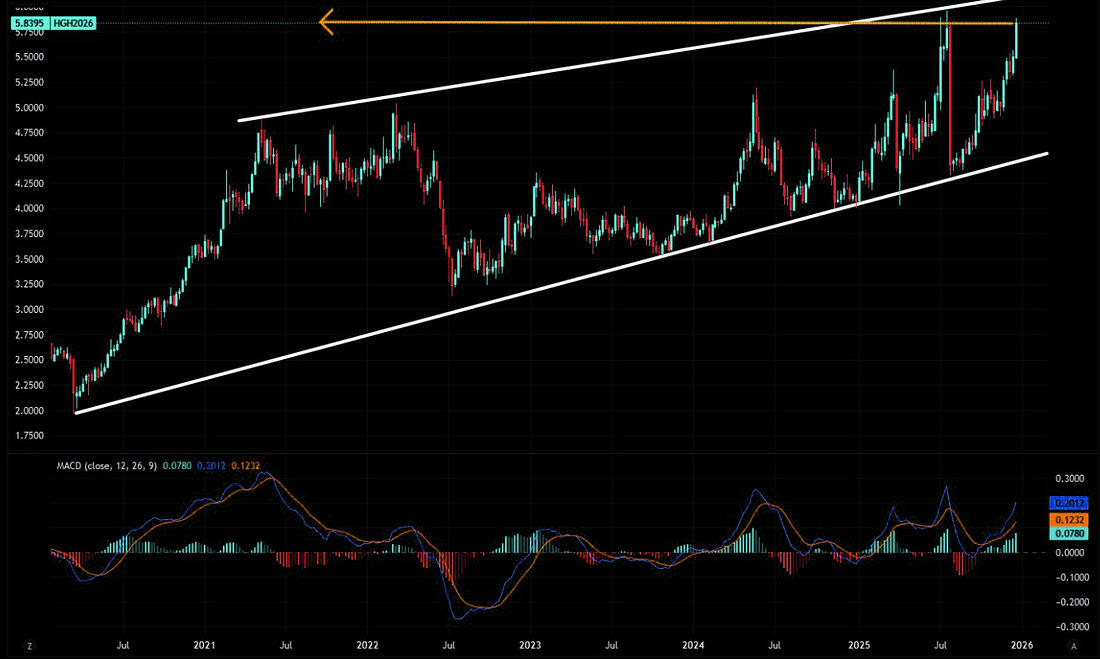
Copper confirms the message. Dr Copper just printed all-time weekly closing highs, quietly validating that this is not a speculative island. Industrial metals are tightening across the board. The electrification and infrastructure buildout that policymakers discuss in the future tense is colliding with supply chains that were never rebuilt after decades of underinvestment.
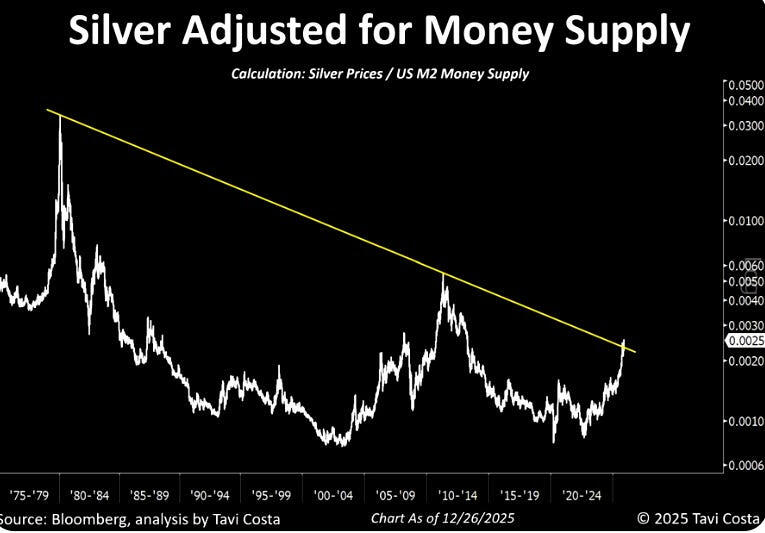
Silver’s longer-term chart adds another layer. Adjusted for money supply growth, silver is only now breaking above the resistance that has capped it for more than four decades. That is not a breakout measured in weeks or quarters. That is a generational compression releasing. When assets escape forty-five years of monetary gravity, valuation anchors snap.
And then there is the most poetic signal of all. An ounce of silver is now worth more than a barrel of oil. That has only happened once before. Oil is the bloodstream of the industrial world. When silver outranks it ounce for barrel, the market is telling you that the marginal unit of conductivity, storage, and trust is being repriced faster than energy itself.
This is not about chasing candles. It is about recognizing when a market stops behaving like an asset class and starts behaving like a warning system. Silver is not just reflecting inflation fears or industrial demand or geopolitical anxiety. It is reflecting all of them at once, compressed into a thin, volatile market with very little slack.
Silver does not whisper. It screams. And right now, it is screaming that something in the global balance sheet is under far more strain than most portfolios are positioned to admit.
Author

Stephen Innes
SPI Asset Management
With more than 25 years of experience, Stephen has a deep-seated knowledge of G10 and Asian currency markets as well as precious metal and oil markets.