|

US banks: Reactivation of the Fed’s reverse repo facility, a factor in reducing balance sheets
On 17 March, the US Federal Reserve (Fed) raised the ceiling on transactions under its Reverse Repo Program (RRP). Each eligible counterparty can now take, on each trading day, up to USD 80 billion in Treasuries held by the Fed on repo, from a limit of USD30 billion previously.
Fed

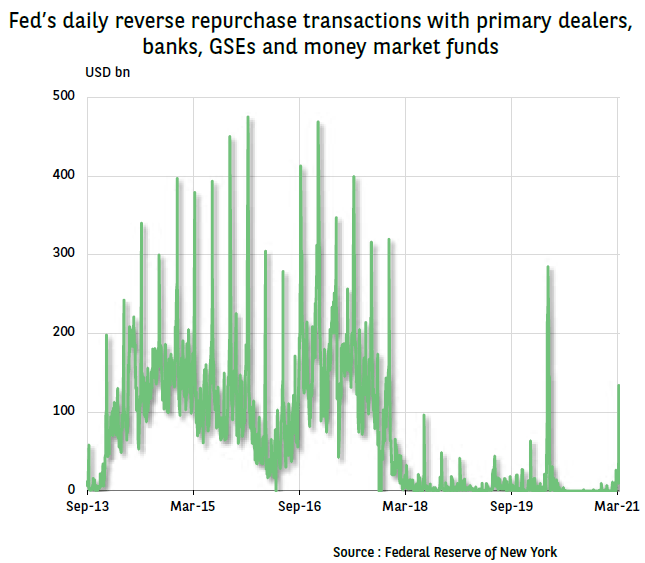
Introduced in the autumn of 2013, one year before the ending of QE3 (the Fed’s third quantitative easing programme) and two years before the beginning of the post-crisis monetary tightening, this facility saw high levels of participation by money market funds (with interest rates of between 0.01% and 0.07% up to the end of 2015) and helped establish a floor for short-term market interest rates. Against a background of abundant central bank liquidity, the programme has the effect of reducing downward pressure on short-term rates by encouraging money market funds and GSEs to “lend“ part of their cash to the Fed rather than on markets (repo, Fed Funds) where demand has dried up. Although the reactivated RRP has not so far seen much uptake (the interest rate paid is zero), it could allow, over the coming weeks, a slimming down of bank balance sheets. The penalty that certain banks are preparing to introduce on deposits from institutional clients, in a bid to reduce their balance sheets, could push this cash towards money market funds and from there, via the reactivation of the RRP, to the Fed.

Download The Full EcoFlash

Author

BNP Paribas Team

BNP Paribas Team

BNP Paribas

BNP Paribas Economic Research Department is a worldwide function, part of Corporate and Investment Banking, at the service of both the Bank and its customers.


More from BNP Paribas Team
Share:

Markets move fast. We move first.

Orange Juice Newsletter brings you expert driven insights - not headlines. Every day on your inbox.

By subscribing you agree to our Terms and conditions.

Editor's Picks

EUR/USD holds around 1.1750 after weak German and EU PMI data

EUR/USD maintains its range trade at around 1.1750 in European trading on Tuesday. Weaker-than-expected December PMI data from Germany and the Eurozone make it difficult for the Euro to find demand, while investors refrain from taking large USD positions ahead of key employment data.

GBP/USD climbs above 1.3400 after upbeat UK PMI data

GBP/USD gains traction and trades in positive territory above 1.3400 on Tuesday as the British Pound benefits from upbeat PMI data. Later in the day, crucial data releases from the US, including Nonfarm Payrolls, Retail Sales and PMI, could trigger the next big action in the pair.

Gold retreats from seven week highs on profit-taking; all eyes on US NFP release

Gold price loses momentum below $4,300 during the early European trading hours on Tuesday, pressured by some profit-taking and weak long liquidation from the shorter-term futures traders. Furthermore, optimism around Ukraine peace talks could weigh on the safe-haven asset like Gold.

US Nonfarm Payrolls expected to point to cooling labor market in November

The United States Bureau of Labor Statistics will release the delayed Nonfarm Payrolls (NFP) data for October and November on Tuesday at 13:30 GMT. Economists expect Nonfarm Payrolls to rise by 40,000 in November. The Unemployment Rate is likely to remain unchanged at 4.4% during the same period.

NFP preview: Complex data release will determine if Fed was right to cut rates

The long wait is over, and the Bureau of Labor Statistics in the US will release nonfarm payrolls reports for both November and October at 1330 GMT on Tuesday. The overall NFP figure for October is expected to be -10k, however, it is expected to be influenced by a massive 130k drop in federal department workers. 

BNB Price Forecast: BNB slips below $855 as bearish on-chain signals and momentum indicators turn negative

BNB, formerly known as Binance Coin, continues to trade down around $855 at the time of writing on Tuesday, after a slight decline the previous day. Bearish sentiment further strengthens as BNB’s on-chain and derivatives data show rising retail activity.