US ADP Employment Change March Preview: The job onslaught begins
- Private payrolls expected to shrink for the first time in in 10 years.
- Initial jobless claims indicate continuing massive layoffs.
- First payrolls numbers with partial virus impact.

Automatic Data Processing (ADP) the US private payroll processing company will release its National Employment Report for March y on Wednesday April 1 at 12:15 GMT, 8:15 EDT
Forecast
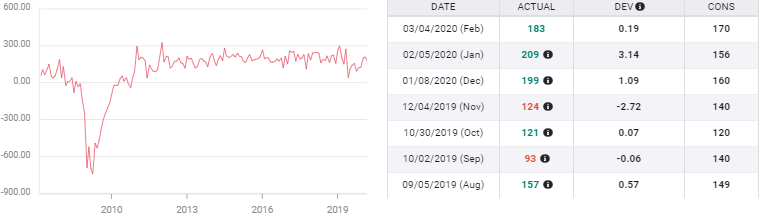
Payrolls for ADP’s clients are expected to have cut payrolls by 154,000 in March after adding 183,000 workers in February and 209,000 in January.
ADP Payrolls
FXStreet
Labor market actors
The shock to US labor markets in March from the Coronavirus induced layoffs will find its first, if partial expression from the ADP figures as the US job expansion, the longest on record comes shuddering to a halt. Private payrolls last had a negative month in October 2010.
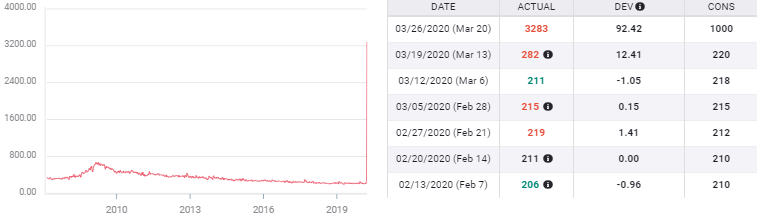
Initial jobless claims saw 3.283 million filings for the week of March 20 the largest on record by a factor of 4.7 and they are expected to be nearly duplicated when the subsequent week’s numbers are released by the Department of Labor on Thursday.
Initial jobless claims
Purchasing managers’ indexes (PMI) for manufacturing employment have been in contraction since last August. The January and February gain, 46.6 and 46.9, from the December low of 45.2 are expected to be reversed to 45.4 in March. The service employment index for March is forecast to drop to 53.7 from 55.6 in February. Its recent low was 51.7 last September.
While the polling for these PMI measures is conducted in the month being considered it is likely that neither has captured the full implication of the spreading shutdowns in the US economy which accelerated as the month progressed.
The same is true for the overall labor trends through February. Non-farm payrolls, the unemployment rate, average weekly hours and earnings and the labor force participation rate will have little to convey pertaining to the situation that began evolving in early March.
ADP and NFP
The chief interest of the ADP Employment Change Report is that it is a good indicator for the nationwide for the Employment Situation Report from the Bureau of Labor Statistics (BLS) which is normally issued on the Friday of the same week. In essence the ADP figures are a limited version of the NFP private payrolls figure. The main structural difference between the NFP payroll figures and those of ADP is that the BLS numbers include hiring and firing by local, state and federal governments.
Trend correlation between the two measures is excellent though individual monthly variation is not uncommon. In 2019 the 12-month moving average for the NFP decreased 25.9% and the ADP dropped 26.5%.
Conclusion and market impact
It is probably that the estimates for the ADP and by implication NFP on Friday understate the damage from the fast moving Coronavirus on the US economy. The number of state, local and business closures was far greater at month end than in the beginning and there was little anticipation in the first week how fast the situation would escalate.
After the initial claims number last week it would be hard to overstate the negative but largely priced market expectation for US job numbers. Though the risk for the ADP figure is on the downside its dollar impact is the reverse as the US currency is benefiting from its revived safety status.
Author

Joseph Trevisani
FXStreet
Joseph Trevisani began his thirty-year career in the financial markets at Credit Suisse in New York and Singapore where he worked for 12 years as an interbank currency trader and trading desk manager.