|

United Kingdom: Private sector loans drive growth in bank balance sheets

The Bank of England's (BoE) aggregate balance sheet statistics for the Monetary and Financial Institutions (MFIs) provide a macroeconomic picture of the UK banking system.

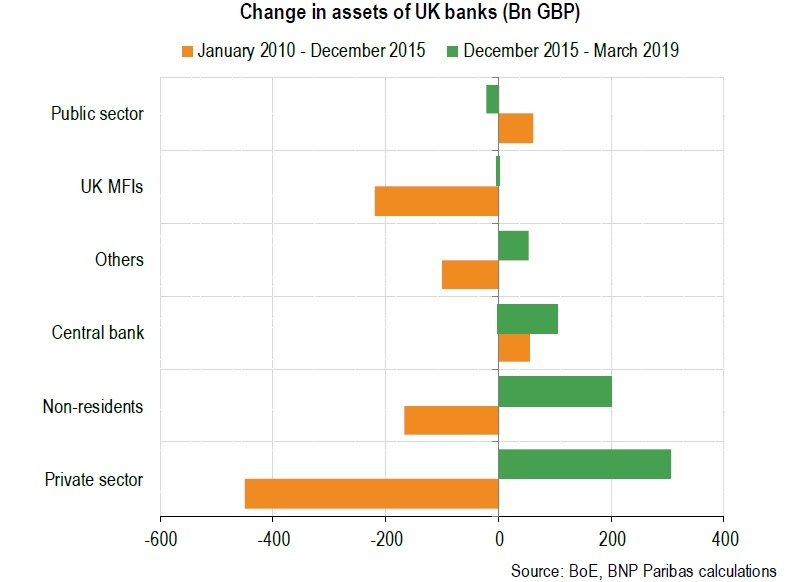
They illustrate the contraction of bank balance sheets until December 2015 (-19% compared to January 2010). This was mainly the result of the decline in outstanding loans to the resident non-financial private sector, whose debt was returning to more sustainable levels. Non-resident claims and interbank transactions also contributed to the decline in bank balance sheets.

The trend has reversed since 2016 (+ 19% between December 2015 and March 2019), but the balance sheet of the UK banking sector has not yet returned to its 2010 size in terms of value or as a percentage of GDP (GBP 4,122 bn or 195% of GDP in March 2019 vs. GBP 4,288 bn or 279% of GDP in January 2010). The recovery is driven by the recovery of outstanding vis-à-vis the resident non-financial private sector (+ 17% after -20% between 2010 and 2015), and for nonresidents (+ 21% after - 15%). The interbank market remained at a low level, partly driven by the BoE's operations* (+ 68% after + 49%).

*such as quantitative easing or term funding scheme implemented by the BoE to inject liquidities
UK

Download The Full EcoFlash

Author

BNP Paribas Team

BNP Paribas Team

BNP Paribas

BNP Paribas Economic Research Department is a worldwide function, part of Corporate and Investment Banking, at the service of both the Bank and its customers.


More from BNP Paribas Team
Share:

Editor's Picks

EUR/USD bears Flirt with 61.8% Fibo. support near 1.1775 area

The EUR/USD pair extends the previous day's late pullback from the 1.1835 region and attracts some follow-through selling during the Asian session on Tuesday. Spot prices currently trade around the 1.1775-1.1770 area, down nearly 0.15% for the day amid a modest US Dollar strength.

GBP/USD holds losses below 1.3500 due to BoE rate cut bets

GBP/USD edges lower after two days of gains, trading around 1.3480 during the Asian hours on Tuesday. The pair declines as the US Dollar rebounds from losses recorded over the previous two sessions. Traders will focus on the US ADP Employment Change four-week average later in the day, along with speeches from Federal Reserve officials.

Gold down but not out as key $5,140 support holds

Gold consolidates the advance to monthly top of $5,250 in Tuesday’s Asian trades. The US Dollar finds demand as liquidity returns and risk sentiment recovers, despite US tariffs uncertainty. Gold defends 61.8% Fibo resistance at $5,142 amid the pullback, daily RSI remains bullish.

Dogecoin, Shiba Inu, and Pepe extend losses on bearish signals

Meme coins are facing renewed selling pressure amid fading broad risk-on sentiment so far this week, with Dogecoin, Shiba Inu, and Pepe extending their losses after recent corrections.

Supreme Court nixes tariffs, Trump teases 15% global tariff

On February 20th, the Supreme Court ruled that Trump’s global tariffs under IEEPA authority were unconstitutional, effectively nullifying the framework. However, the relief was short-lived. Within hours, Trump floated a 15% blanket tariff under an alternative legal authority.

XRP recovers slightly as bearish sentiment dominates crypto market

Ripple is rising above $1.40 at the time of writing on Monday amid fresh tariff-triggered headwinds in the broader cryptocurrency market. The sell-off to $1.33, the token’s intraday low, can be attributed to macroeconomic uncertainty, geopolitical tensions and risk-averse sentiment among other factors.