Ukrainian debt sustainability challenges remain heightened as new IMF programme talks accelerate

As Russia’s war in Ukraine war drags on with no end in sight, the challenges for Ukraine’s debt sustainability and finances are mounting. Addressing them requires the use of frozen Russian reserves. Deeper debt restructuring should also be considered.
Scope Ratings (Scope) recently trimmed its growth estimate for Ukraine to 2.0% for 2025 before 2.25% for 2026 after weaker-than-expected activity during the first half of the year. Consolidated fiscal deficits are likely to remain elevated at around 18.3% of GDP this year and 15.3% next year. Public debt will continue to rise to well above 95% of GDP by the end of this year from 91.2% at end-2024 and 49% at end-2021.
Gloomier, uncertain outlook for Ukrainian growth as estimates trimmed
Annual real growth, %.
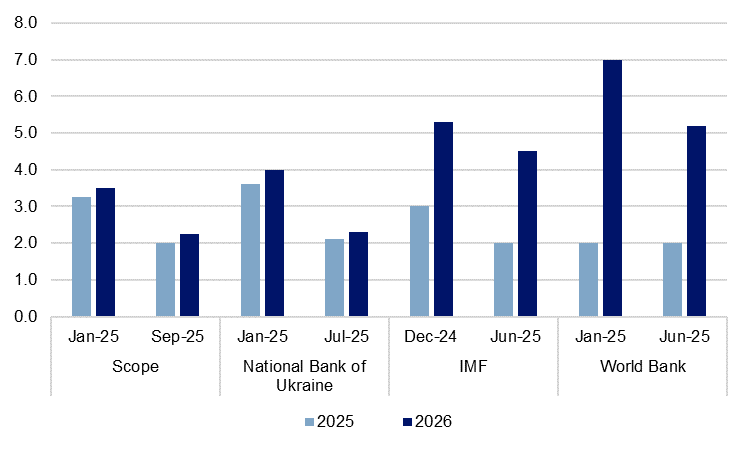
Source: National Bank of Ukraine, IMF, World Bank and Scope forecasts
Financing questions are pressing as IMF programme concludes in March 2027
If the war continues into next year – as appears inevitable – decisions must be made around the financing of Ukraine after an existing IMF programme concludes in March 2027. Ukraine has formally requested a further four-year programme from the Fund. Military spending absorbs 60% of the total budget, leaving Kyiv heavily reliant on foreign and official-sector assistance to cover the costs of pensions, public-sector wages and humanitarian aid. The present goal is to secure a favourable decision from the IMF by the end of this year.
However, the IMF lends only to sovereigns whose debt is sustainable with the prospect of the Fund being repaid. In 2023, the IMF approved the Extended Fund Facility of Ukraine, a first-ever programme for a country at war, a situation which creates extra uncertainty for assessing debt sustainability and the probability of repayment. Given the exception made by approving the current USD 15.5bn programme, the IMF will have to re-assess Ukraine’s debt sustainability carefully, amid the possible political pressures inside the United States against financing a protracted war, before approving a new programme.
A core IMF programme objective that public debt, excluding the Extraordinary Revenue Acceleration (ERA) loans, would fall to 82% of GDP by 2028 and 65% of GDP by 2033 is at risk as the full-scale war heads into its fifth year. The IMF’s original baseline assumption was for the war to have wound down by the end of last year.
However, the Ukrainian government’s debt continues to increase. The IMF has revised its own debt projections up despite the successful 2024 restructuring of USD 20.5bn of Eurobond securities. Scope Ratings’ long-standing assumption of protracted conflict suggests the war might easily continue beyond mid-2026 – which is the IMF’s downside scenario for the conflict ending.
Ukrainian debt sustainability remains challenging as the war drags on
Public debt, % of GDP.
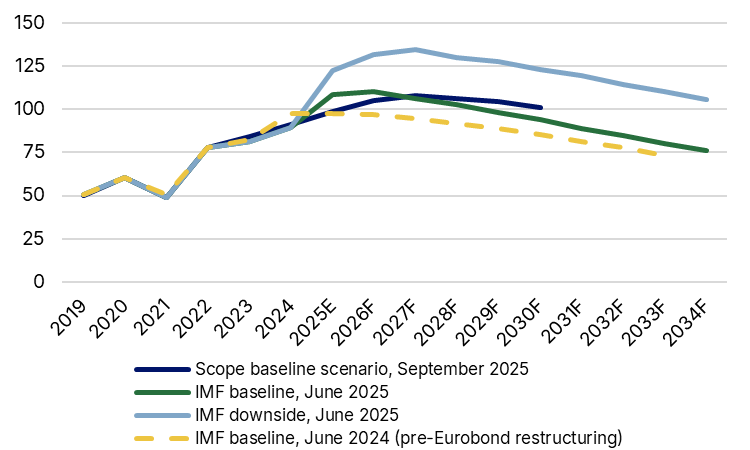
N.B. Scope and IMF projections are for the public and publicly guaranteed debt stock of Ukraine including the ERA loans. June-2024 IMF projections made before the August-2024 Eurobond debt restructuring. Source: IMF, Scope Ratings.
Meeting the financing gap represents an historic challenge – especially for the EU
Funding Ukraine represents an historic challenge given the IMF estimates the country’s additional foreign financing requirement at around USD 65bn to end-2027. The government in Kyiv has recently accepted the IMF appraisals, after initially estimating the gap at just USD 38bn. The Fund may assume budget deficits of nearer to 20% of GDP a year lasting for longer, updating its earlier less-conservative projection of a rapidly narrowing deficit.
All told, Ukraine needs to secure around USD 50bn a year from its allies. In view of the likely hesitation of the US under President Donald Trump to provide more financial support, the European Union – already Ukraine’s single largest financier – may need to foot much of the bill.
These figures do not consider the further military financing needs of Ukraine, making it hard to see how the country and its allies can mobilise the necessary funds without using USD 330bn in frozen Russian reserves. Many EU member states have stretched finances while the resources of the EU Macro-Financial Assistance+ facility and the G-7 ERA loans (which already use the interest on seized Russian assets) are nearly exhausted.
An innovative proposal from the European Commission (EC) is to use the available cash balance generated by the frozen Russian assets, equivalent to around EUR 140bn. The plan, still being debated, would see the substitution of the balance generated by matured Russian assets with zero-coupon short-term EU bonds ensuring Russia retains legal claims to the funds. The cash balance would be extended as zero-interest “reparations” loans to Ukraine, repayable only if Russia ceases the war and compensates Ukraine for damages. As it is unlikely Russia would ever pay Ukraine for the damages of the war, the loans to Ukraine would effectively be grants. Among options under consideration is making bilateral bond guarantees to sidestep the possible veto of the EU’s plan by member states such as Hungary.
German Chancellor Friedrich Merz supports the EC’s proposal, with a preference for proceeds to be used exclusively to procure military equipment. The EC plan invites partners with frozen Russian assets to participate. The British government has presented a parallel proposal for repackaging around GBP 25bn of UK-held Russian assets as loans.
Question remains of whether Ukraine needs further external debt restructuring
The question remains if deeper external debt restructuring might be needed to support Ukraine’s debt sustainability, sustain IMF support and help plug external financing gaps. The IMF most recently assessed the debt of Ukraine as unsustainable absent the full implementation of the debt-restructuring strategy. The assumptions around how long the war will last and its impact on associated debt and deficit projections have deteriorated since.
Ukraine continues re-negotiating the so-called perimeter external claims – such as the GDP warrant securities – and has also agreed to second-stage restructuring late 2026. For now, such a move would involve only the narrow restructuring of select G-7 loans provided to Ukraine before the full-scale war.
Nevertheless, the sovereign’s Eurobonds – rated CCC and Negative Outlook by Scope – are not necessarily out of the woods. The successful 2024 restructuring included an effective 35.75% haircut after Ukraine and the IMF failed to achieve the up to 60% haircut initially sought. Coupon payments following the restructuring step up by 2026-27 – assumed at the time by the Fund as post-war reconstruction years – with an original USD 1.2bn principal repayment falling due February 2029. In addition, a sweetener granted to asset managers last year to increase participation may involve an increase of up to 12% of the pre-restructuring Eurobond principal by November 2029 should Ukraine’s GDP meet defined thresholds.
Should an external financing gap emerge, such channelling of official funding for repaying private investors may come under greater scrutiny. If debt sustainability cannot be assured through other means, the restricted options for relief from debt operations mean the Eurobonds remain subordinated.
In the aftermath of the 2024 restructuring, the Eurobonds represent less than 10% of the outstanding public debt stock of Ukraine. Nevertheless, the Eurobond securities are the only available conduit for achieving meaningful savings from debt restructuring once the renegotiations of the GDP warrants are complete.
Much of the debt service of the sovereign is tied to the domestic debt, not subject to reprofiling so long as the war requires the financing support of Ukrainian banks and corporates – and financial stability remains a priority.
Author

Dennis Shen
Scope Ratings
Dennis Shen is Chair of the Macroeconomic Council and Lead Global Economist of Scope Ratings, the European rating agency, based in Berlin, Germany.