Gold Weekly Forecast: Post-midterm elections relief rally loses momentum
- Gold recovered sharply after falling to its lowest level in over a year below $3,900.
- The near-term technical picture is yet to confirm a bullish reversal.
- US October inflation data and developments surrounding the Middle East conflict could drive Gold’s valuation.

Gold (XAU/USD) staged an impressive rebound after dropping to a fresh 2026 low below $3,900 at the end of the previous week. Although the precious metal retreated from the two-week top it set near $4,150, it managed to end the week decisively higher. October inflation data from the United States and geopolitics could impact XAU/USD’s performance in the near term.
Gold rises sharply in response to US midterm election outcome
Improving risk mood at the beginning of the week caused the US Dollar (USD) to come under bearish pressure and helped XAU/USD register gains on Monday. US Secretary of State Marco Rubio said over the weekend that President Donald Trump would like to resolve the Iranian war “diplomatically,” without the use of military force, and Gold gained nearly 2% on the day.
As markets adopted a cautious stance heading into the midterm elections in the US, Gold registered marginal losses on Tuesday. During the early trading hours of the Asian session on Wednesday, Gold gathered bullish momentum as Democrats racked up wins in key states. With Democrats taking control of the US Congress in the last two years of Donald Trump's presidency, crude Oil prices declined sharply and helped ease inflation fears. In turn, the USD came under heavy selling pressure, fuelling XAU/USD’s upsurge. US President Donald Trump acknowledged that the Iran war is "partly to blame" for Republicans' defeat.
After rising more than 3% on Wednesday, Gold extended its rally and touched its highest level in two weeks near $4,150 on Thursday. However, the USD capitalized on risk-aversion, as reflected by the sharp declines seen in major equity indexes in the US, and capped the precious metal’s upside. XAU/USD erased a large portion of its gains to end the day marginally higher and extended its pullback early Friday toward $4,050.
Strategists at OCBC highlight that political developments in Washington have quickly spilled over into equity markets, with “concerns that the Democratic sweep of Congress could slow the US AI buildout” triggering a sharp reversal in the sector. They note that the resulting de-risking saw “a sharp sell-off in AI-related equities,” with the broader market also caught in the downdraft as “the S&P 500 fell 4.4%, while the VIX surged to an eight-month high as investors unwound crowded AI positions.”
Additionally, crude Oil prices rebounded on Thursday after US President Donald Trump’s comments on Iran caused geopolitical tensions to re-escalate. “I would rather not destroy the rest of the country if possible, but maybe I will have to. You will know soon enough,” he noted.
Heading into the weekend, the USD preserved its strength on the back of an impressive employment report for October and made it difficult for Gold to keep its footing. The US Bureau of Labor Statistics reported Nonfarm Payrolls (NFP) rose by 165K in October. This print followed the 60K increase recorded in September (revised from 29K) and surpassed the market expectation of 65K by a wide margin. Additionall, the Unemployment Rate declined to 4.1% from 4.2%, even though the Labor Force Participation Rate improved to 61.9% from 61.8%.
Gold investors await US inflation data
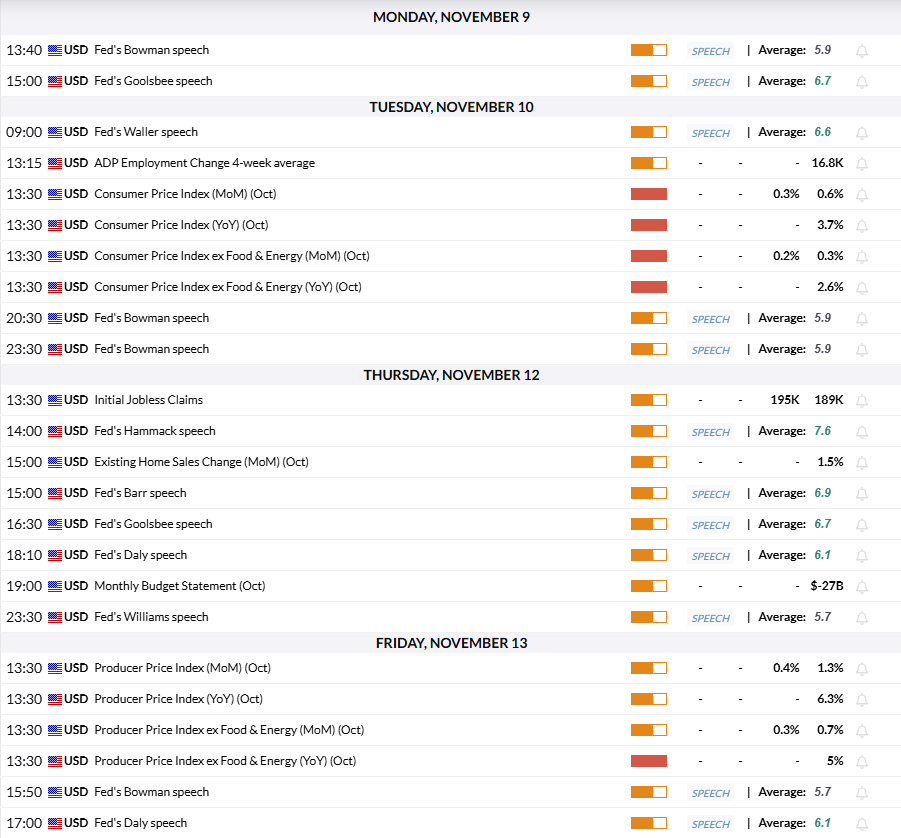
The US Bureau of Labor Statistics (BLS) will publish the Consumer Price Index (CPI) data on Tuesday. Investors expect the core CPI to rise 0.2% on a monthly basis in October following the 0.3% increase seen in September.
Speaking at a news conference after the Fed's decision to leave interest rates unchanged at a range of 3.75%-4.00% , Federal Reserve (Fed) Chair Kevin Warsh described labor market conditions as “positive,” and added that the discussion among policymakers is focused mainly on the price stability mandate.
The CME FedWatch Tool currently shows that markets are pricing in about a 76% probability of a 25 basis points (bps) rate hike in December. In case the monthly core CPI rises 0.4% or more, investors could continue to price in a policy action at the last meeting of the year. In this scenario, the USD could gather strength alongside rising US Treasury bond yields and weigh on Gold.
Conversely, a print at or below market expectations could keep the possibility of a Fed policy hold in December and help XAU/USD gain traction.
Since the US economic calendar will not feature any high-tier data releases, investors will stay focused on headlines coming out of the Middle East in the near term. A re-escalation of the conflict in the Middle East could pave the way for a leg higher in Oil prices and hurt Gold’s performance. On the other hand, the precious metal could gather bullish momentum if investors grow optimistic about a diplomatic solution.
Strategists at ING highlight that official-sector demand remains an important pillar of support for the Gold market, even after the latest surge in prices. They note that “central bank buying continues to provide underlying support, with official-sector demand remaining strong in September,” as “central banks added 61 tonnes during the month, according to the World Gold Council, while third-quarter purchases reached 228 tonnes (-7% year-on-year).” ING points out that Poland and China “continued to lead purchases, reinforcing the structural demand story for gold.”
However, the bank cautions that “despite the rebound, the near-term outlook remains challenging for the precious metal.” ING argues that “inflation concerns continue to support expectations for tighter monetary policy,” keeping the policy backdrop restrictive, while stressing that “much depends on developments in the Middle East and what they mean for energy markets.”
Gold technical analysis: Bullish reversal needs further confirmation
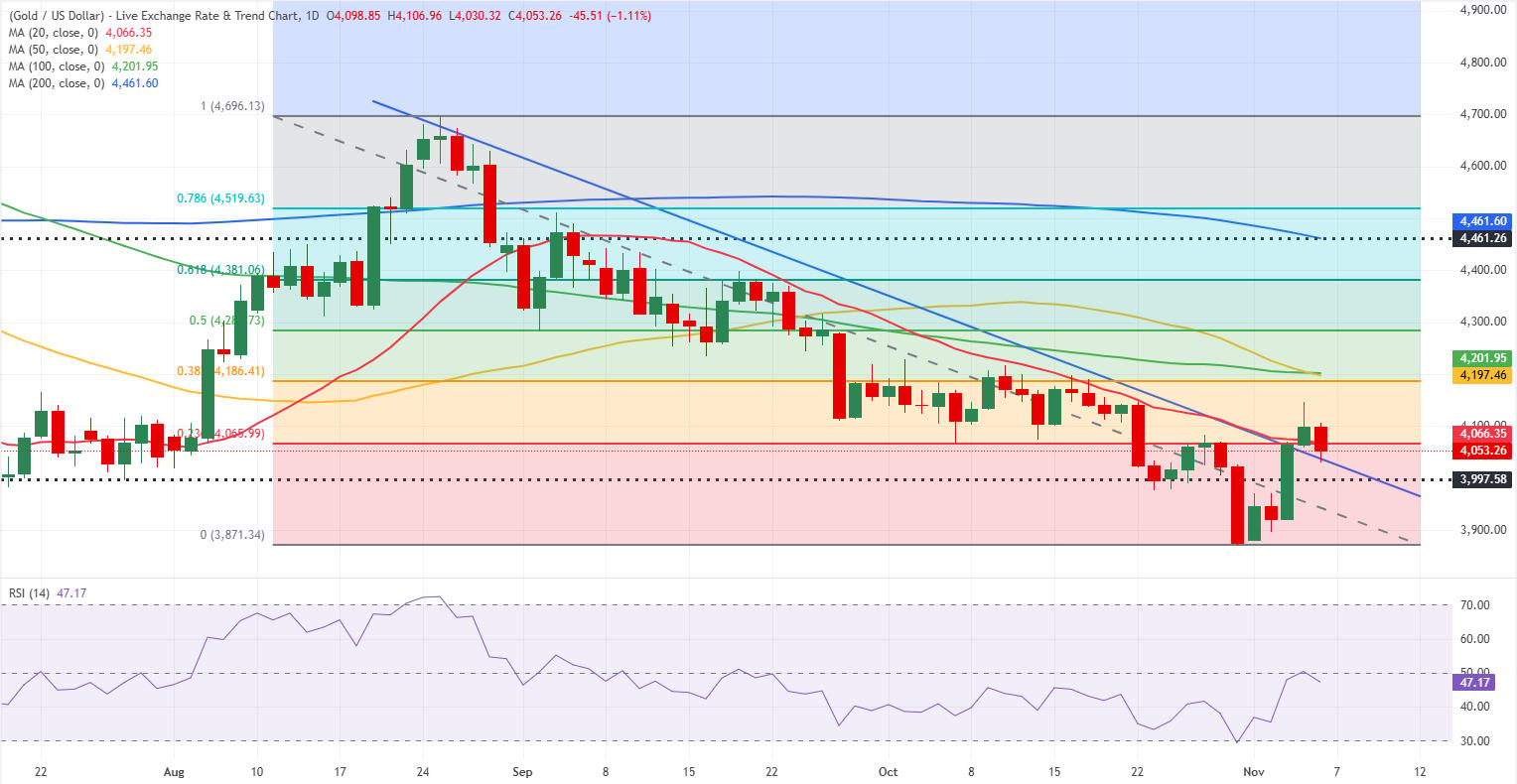
This week’s bullish action pointed to an easing of bearish pressure but fell short of confirming a bullish reversal. The Relative Strength Index (RSI) indicator on the daily chart retreated slightly after failing to clear 50 and Gold is yet to confirm the 20-day Simple Moving Average (SMA), currently located near $4,070, as support despite closing above this level on Thursday.
In case Gold holds steady above $4,065-$4,070 (Fibonacci 23.6% retracement of September-November downtrend, 20-day SMA) and confirms that region as support, the next critical resistance area could be spotted at $4,185-$4,200, where the Fibonacci 38.2% retracement, 50-day SMA and 100-day SMA align, ahead of $4,285-$4,300 (Fibonacci 50% retracement, round level).
On the downside, $4,000 (static level, psychological level) could be seen as the first support level ahead of $3,870 (2026 low).
Gold FAQs
Gold has played a key role in human’s history as it has been widely used as a store of value and medium of exchange. Currently, apart from its shine and usage for jewelry, the precious metal is widely seen as a safe-haven asset, meaning that it is considered a good investment during turbulent times. Gold is also widely seen as a hedge against inflation and against depreciating currencies as it doesn’t rely on any specific issuer or government.
Central banks are the biggest Gold holders. In their aim to support their currencies in turbulent times, central banks tend to diversify their reserves and buy Gold to improve the perceived strength of the economy and the currency. High Gold reserves can be a source of trust for a country’s solvency. Central banks added 1,136 tonnes of Gold worth around $70 billion to their reserves in 2022, according to data from the World Gold Council. This is the highest yearly purchase since records began. Central banks from emerging economies such as China, India and Turkey are quickly increasing their Gold reserves.
Gold has an inverse correlation with the US Dollar and US Treasuries, which are both major reserve and safe-haven assets. When the Dollar depreciates, Gold tends to rise, enabling investors and central banks to diversify their assets in turbulent times. Gold is also inversely correlated with risk assets. A rally in the stock market tends to weaken Gold price, while sell-offs in riskier markets tend to favor the precious metal.
The price can move due to a wide range of factors. Geopolitical instability or fears of a deep recession can quickly make Gold price escalate due to its safe-haven status. As a yield-less asset, Gold tends to rise with lower interest rates, while higher cost of money usually weighs down on the yellow metal. Still, most moves depend on how the US Dollar (USD) behaves as the asset is priced in dollars (XAU/USD). A strong Dollar tends to keep the price of Gold controlled, whereas a weaker Dollar is likely to push Gold prices up.
Author

Eren Sengezer
FXStreet
As an economist at heart, Eren Sengezer specializes in the assessment of the short-term and long-term impacts of macroeconomic data, central bank policies and political developments on financial assets.

















