US Dollar breaks below 101.50 as Democrats sweep Congress

The US Dollar (USD) comes under heavy selling pressure on Wednesday, with the US Dollar Index (DXY) falling around 0.5% to trade near 101.35 after sliding below the 101.50 level. The Greenback retreats to its lowest level in four weeks as investors reassess the political and economic outlook following the Democratic Party's sweeping victory in the United States (US) midterm elections.
Democrats secure control of both the House of Representatives and the Senate, dealing a significant political setback to US President Donald Trump and raising expectations of legislative gridlock during the final two years of his presidency.
The election results threaten two important pillars of the US Dollar's recent strength: expectations of continued fiscal stimulus and strong investment in artificial intelligence. However, the prospect of further interest rate increases by the Federal Reserve (Fed) could prevent the political shock from turning into a prolonged bearish trend.
Why the Democratic victory is weighing on the US Dollar
The Democratic sweep significantly changes the balance of power in Washington, potentially limiting Trump's ability to implement additional tax cuts, fiscal stimulus and deregulation. Investors anticipate that a divided government could lead to more restrained public spending and lower inflationary pressures, reducing the need for aggressive monetary tightening.
US Treasury yields declined following the election results, with the benchmark 10-year yield falling toward 4.92%. Lower yields reduce the attractiveness of US Dollar-denominated assets and contribute to the currency's weakness.
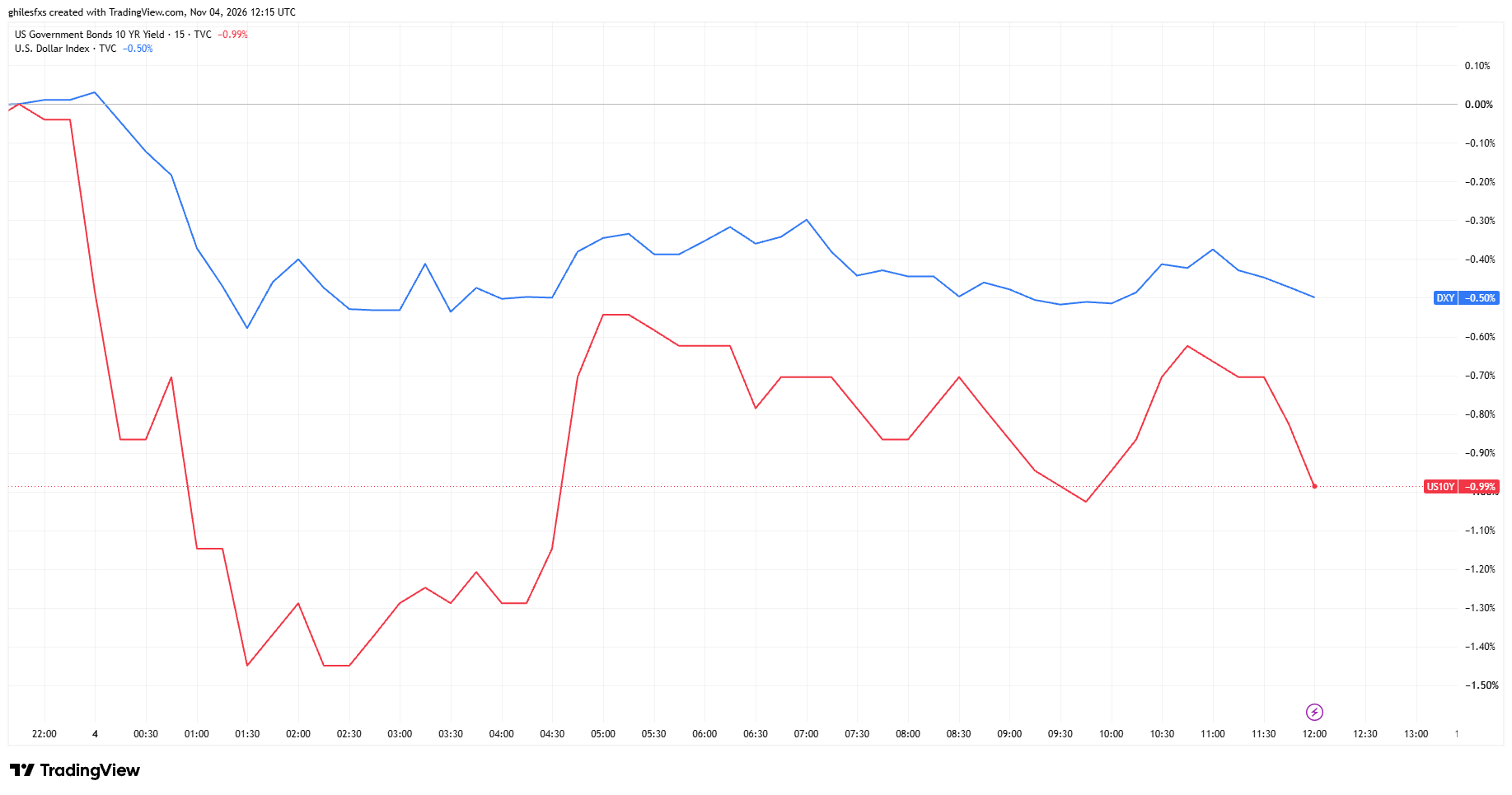
Commerzbank highlights the potential consequences for US fiscal policy: "First, Democratic control of both the House and Senate should make further fiscal easing unlikely over the next two years." However, the election results also introduce uncertainty surrounding the US economic outlook, particularly as Democrats could seek tighter oversight of the technology sector.
Artificial intelligence could become the US Dollar's next vulnerability
Beyond fiscal policy, the possibility of stricter regulation of Artificial Intelligence (AI) represents another significant risk for the US Dollar. AI-related investment has become an important driver of US economic growth, supporting technology stocks and attracting substantial international capital inflows.
A Democratic-controlled Congress could increase scrutiny of data center construction, energy consumption and environmental regulations, potentially slowing investment in AI infrastructure.
According to Goldman Sachs analysts cited by Morningstar, states where Democrats are likely to introduce restrictions account for approximately 45% of planned US data center capacity.
Commerzbank warns that weaker investment momentum could have broader consequences: "If investment begins to lose momentum, markets could start pricing in a weaker phase of US growth, which would weigh on the dollar."
This risk helps explain the initial weakness in technology stocks following the election results. However, equity markets subsequently recover some of their losses, suggesting investors remain cautious about anticipating a major deterioration in US growth. Moreover, significant federal regulatory changes would still face legislative obstacles and the possibility of a presidential veto.
The Federal Reserve could prevent a deeper US Dollar sell-off
Despite the political uncertainty, the US Dollar continues to benefit from relatively supportive monetary fundamentals. Persistent inflation and resilient economic activity reinforce expectations that the Fed will raise interest rates again in December. Markets currently assign approximately an 81% chance of another increase, according to the CME FedWatch Tool.
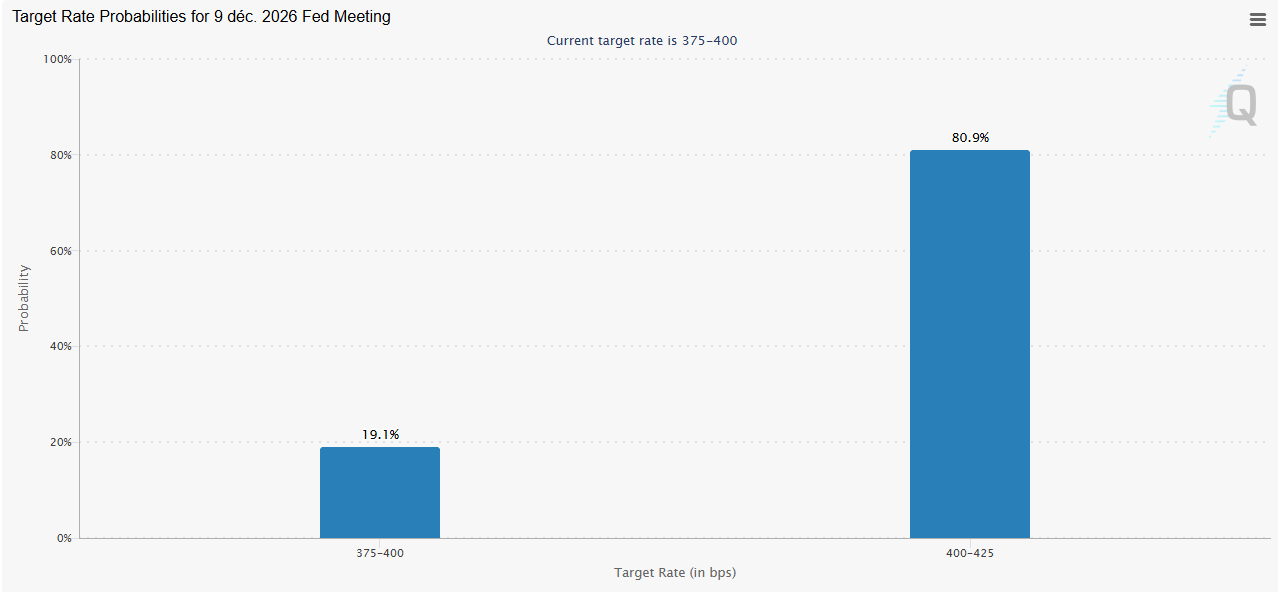
Higher interest rates generally support the US Dollar by increasing returns on US assets, potentially offsetting the negative impact of political developments.
ING remains cautious about extrapolating the initial market reaction into a sustained bearish trend: "We would not chase the dollar lower today for what, after all, could be a 2027 story. Instead, the dollar looks likely to be traded through the macro/monetary lens, which remains supportive."
Similarly, Societe Generale suggests that crowded positioning may be amplifying the correction, rather than signaling a fundamental change in the US Dollar's outlook: "Overall, I’m minded to conclude that 1) the market was very long dollars and the elections are a catalyst for position reduction; 2) the level of economic, geopolitical and market uncertainty is very elevated, which points to choppy FX markets."
This suggests that the election results may have triggered profit-taking among investors holding substantial long-Dollar positions.
Friday's US Nonfarm Payrolls (NFP) report could, therefore, prove decisive. Strong employment figures would reinforce expectations of additional Fed tightening, while weaker data could temper those expectations.
US Dollar breaks 101.50, but the broader bullish structure remains intact
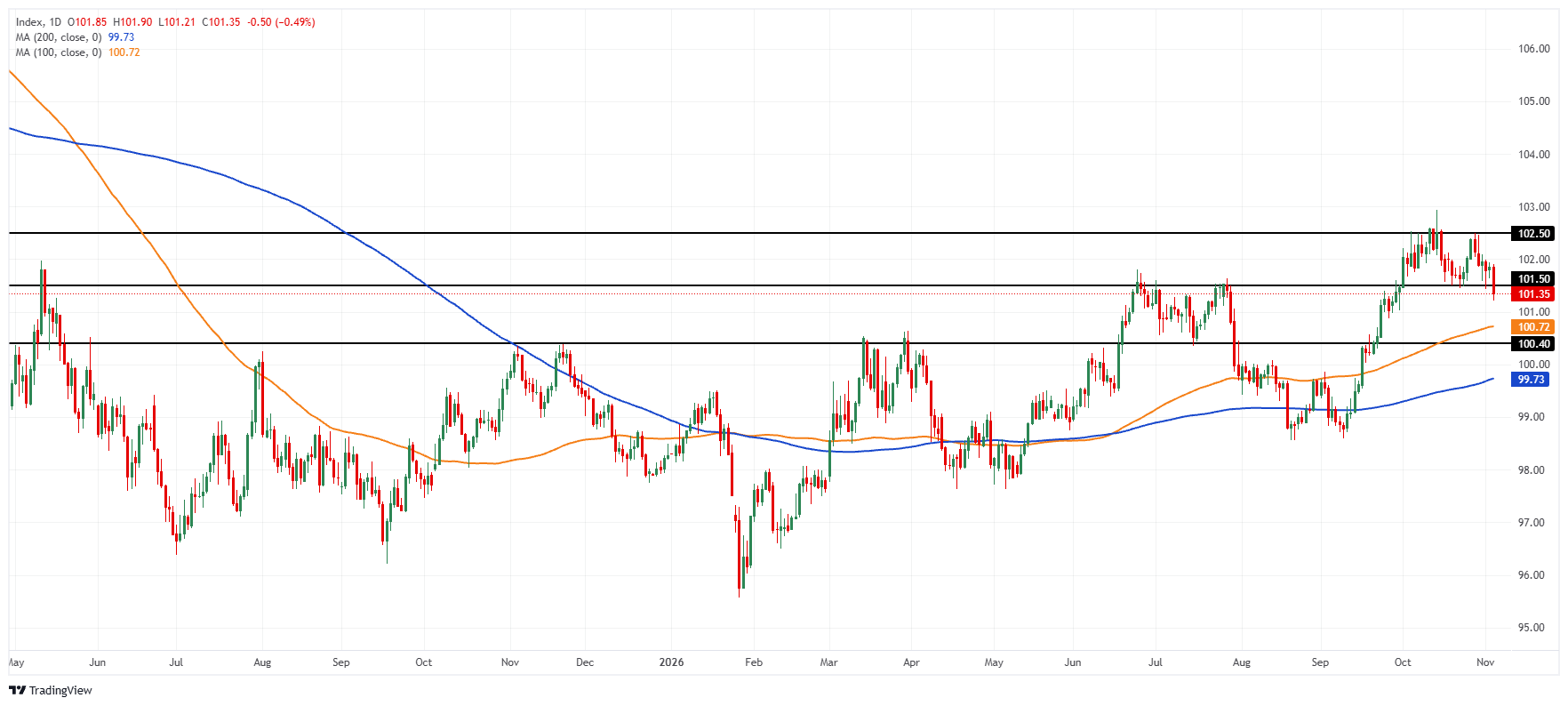
The daily chart shows the US Dollar Index retreating sharply after repeatedly failing to overcome resistance around 102.50 in October. Wednesday's decline below 101.50 marks a deterioration in short-term momentum, with the index approaching the 101.25 area, which represents the next immediate support. A decisive break below 101.25 could extend the correction toward the 100.70-100.40 region, where the 100-day Simple Moving Average (SMA) and a previous horizontal support level converge.
However, the broader technical outlook remains relatively constructive, as the DXY continues to trade above its 100-day and 200-day moving averages, currently near 100.72 and 99.73, respectively. Moreover, a break of 101.50 still requires confirmation with a daily close below.
This suggests that the current decline may represent a correction within the broader recovery that began earlier this year, rather than a confirmed bearish reversal.
On the upside, the US Dollar would need to reclaim 101.50 to ease immediate selling pressure. A subsequent move above the 102.50 resistance would strengthen the case for a resumption of the bullish trend.
Is the US Dollar's weakness a warning for 2027?
The Democratic victory creates new uncertainties for the US Dollar, particularly regarding fiscal policy, technology investment and future economic growth. However, the longer-term implications remain more complex than the immediate market reaction suggests.
Rabobank Senior FX Strategist Jane Foley argues that greater fiscal discipline could eventually strengthen confidence in US assets: "In essence, more fiscal prudence, while USD negative in the short-term, is likely to positively impact the credibility of the greenback and its safe haven character over the long-term."
The US Dollar faces competing forces: political uncertainty and lower Treasury yields on one side, and restrictive monetary policy and potential improvements in fiscal credibility on the other.
For now, the decline below 101.50 signals that bullish momentum is weakening, but it does not invalidate the broader recovery. A sustained break below 100.40 would raise more serious questions about the US Dollar's upward trajectory. Until then, the post-election sell-off appears more consistent with a significant correction than the beginning of a confirmed bearish reversal.
US Dollar Price Today
The table below shows the percentage change of US Dollar (USD) against listed major currencies today. US Dollar was the strongest against the Japanese Yen.
| USD | EUR | GBP | JPY | CAD | AUD | NZD | CHF | |
|---|---|---|---|---|---|---|---|---|
| USD | -0.38% | -0.43% | -0.17% | -0.38% | -0.67% | -0.29% | -0.46% | |
| EUR | 0.38% | -0.05% | 0.18% | -0.02% | -0.31% | 0.08% | -0.08% | |
| GBP | 0.43% | 0.05% | 0.23% | 0.08% | -0.27% | 0.14% | -0.03% | |
| JPY | 0.17% | -0.18% | -0.23% | -0.20% | -0.50% | -0.12% | -0.28% | |
| CAD | 0.38% | 0.02% | -0.08% | 0.20% | -0.30% | 0.08% | -0.08% | |
| AUD | 0.67% | 0.31% | 0.27% | 0.50% | 0.30% | 0.38% | 0.22% | |
| NZD | 0.29% | -0.08% | -0.14% | 0.12% | -0.08% | -0.38% | -0.16% | |
| CHF | 0.46% | 0.08% | 0.03% | 0.28% | 0.08% | -0.22% | 0.16% |
The heat map shows percentage changes of major currencies against each other. The base currency is picked from the left column, while the quote currency is picked from the top row. For example, if you pick the US Dollar from the left column and move along the horizontal line to the Japanese Yen, the percentage change displayed in the box will represent USD (base)/JPY (quote).
Author

Ghiles Guezout
FXStreet
Ghiles Guezout is a Market Analyst with a strong background in stock market investments, trading, and cryptocurrencies. He combines fundamental and technical analysis skills to identify market opportunities.