U.K. Mid-Year Economic Outlook

Executive Summary
Economic growth in the United Kingdom remained modest in Q2, growing at a 1.2 percent annualized rate over the quarter. Monthly data suggest that a deceleration in consumer spending has played a role in the downshift in the British economy as rising inflation and stagnant wage growth have taken a bite out of household purchasing power. This combination of rising inflation, sluggish wage growth and tepid economic activity has put the Bank of England (BoE) in a bit of a bind. Although five members voted to keep Bank Rate unchanged at 0.25 percent at the last policy meeting on June 14, three members voted to hike rates by 25 bps at that meeting. We believe that the views of the majority will continue to prevail, and that policymakers at the BoE will refrain from raising rates through at least the end of 2017 as inflationary pressures from weak sterling begin to subside. Looking ahead, we forecast that real GDP growth will strengthen modestly in 2018 as some of the forces that have led to a slowdown this year reverse, although uncertainty related to Brexit continues to lurk in the background as a major downside risk to the economy.
Economic Growth Trudges Along in Q2
The 1.2 percent annualized growth rate in Q2 matched expectations (Figure 1). The data are preliminary and could be subsequently revised. Moreover, a breakdown of the overall GDP data into its underlying demand components will not be released until next month. In general, the 1.7 percent year-over-year growth rate that was registered in the second quarter indicates that the underlying pace of economic growth in the United Kingdom is only modest at present.
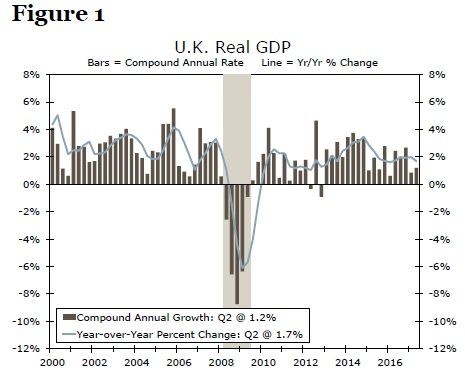
As noted above, a detailed breakdown of the Q2 GDP data into its underlying demand components is not yet available. Service industries accounted for all of the growth, while production-oriented industries such as manufacturing and construction contracted in the quarter.
Author
Wells Fargo Research Team
Wells Fargo