UK jobs market shows hints of improvement


The UK jobs market is undoubtedly cooling, though a more modest fall in payroll employment suggests that the worst may be behind us, following big tax and Living Wage hikes. Better news on wage growth suggests the Bank can still afford to cut rates in November, though after last week's hawkish meeting, this call has become less clear-cut.
There were many notable things about August’s Bank of England decision, but one of them was just how unfazed policymakers appeared to be about the jobs market. That was despite a sizable cooling in hiring conditions over recent months.
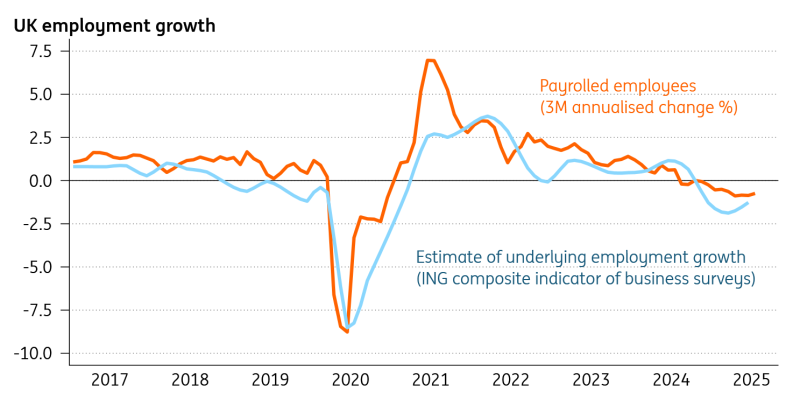
However, the Bank’s view appears to be borne out by the most recent set of job numbers. Payroll employment fell only fractionally, by 8,000 workers between June and July. Though that marks the eighth monthly fall in the past nine months, it is the smallest of those declines. And given that these figures have a tendency to be revised up, it may transpire that employment actually grew slightly through July, once we get the final numbers.
This tallies with some of the business surveys which suggest hiring appetite has begun to improve after a torrid spring. The combination of National Insurance (payroll tax) hikes and a sizable increase in the National Living Wage in April had become a major headwind, particularly in consumer services. It’s notable how the majority of job losses over the past 12 months have been in hospitality, a sector particularly reliant on low-wage staff.
Surveys suggest the worst is behind us on employment
Source: Macrobond, ING
That might also help explain why, despite the steady fall in payrolls, the volume of redundancy notifications sent to the government has barely increased in recent months. Firms only need to notify the authorities of layoffs if they total more than 20 at any one site, and given many hospitality firms are likely to be smaller than this, it’s unlikely to capture the weakness in the sector.
None of this means the Bank of England can relax about the jobs market. Looking at the bigger picture, vacancies are below pre-Covid levels in virtually all sectors now and in many cases, by some margin. The fall in the total number of job openings is showing no signs of easing, and relative to pre-pandemic levels, the number of vacancies has fallen more sharply than in the US, France and Germany, judging by data from Indeed. The unemployment rate has also risen this year, though this data is still potentially dubious owing to long-running reliability issues.
That is helping wage growth to – very slowly – fall. Annual private sector regular pay growth stayed at 4.8% in the most recent month, but in month-on-month terms, the increase was much more modest. We think private sector wage growth will fall back to 4% or below by the end of the year.
If that happens, that’s still a good reason to think the Bank of England will cut rates again in November. That remains our base case, though after last week’s surprisingly hawkish meeting, were we to get a combination of better jobs data and hotter-than-expected inflation data, the Bank may well prefer to remain on hold until the new year.
Read the original analysis: UK jobs market shows hints of improvement
Author
ING Global Economics Team
ING Economic and Financial Analysis
From Trump to trade, FX to Brexit, ING’s global economists have it covered. Go to ING.com/THINK to stay a step ahead.