UK Budget check list
- No room for surprises in this Budget.
- How big should the government’s rainy-day fund be?
- Fiscal Drag to hurt the Middle Classes.
- Will this be Reeves’ Liz Truss moment?
- Inflation risks from budget could deter BoE from cuts.
- A no-growth Budget could sink the Pound.
- The three non-negotiables.


It’s finally here, in a few hours we will be told what fiscal measures will be included in this year’s UK Budget. This will end one of the most speculative Budgets in recent memory.
No room for surprises
You might ask, is there anything that we don’t know about this Budget? We have already been told that the two-child benefit cap will be scrapped, that income taxes won’t rise directly, although they will be going up for many indirectly through an extension on frozen thresholds, that property taxes and a potential mansion tax will be included in this Budget and that banks are one of the few lucky ones who won’t see their taxes go up.
The latest Budget pre-announcement confirmed that the national minimum wage will rise by an inflation-busting 4.1%, including bigger increases for teenage workers. The fact that this hike in the minimum wage comes at a time when the unemployment rate is rising and AI is threatening many entry level jobs seems lost on the Chancellor.
How big should the government’s rainy-day fund be?
The big unknown at the heart of this Budget is just how big the fiscal hole will be. The decision to reverse course, and abandon plans to hike income tax suggests that this could be £20bn, although the Chancellor will need to raise government revenue by more to ensure that she has enough fiscal headroom to deal with any unexpected crises in the coming years. The headroom is a bit like a rainy-day fund, except the way that the government has handled this Budget could mean that they will need to pray very hard for no rain in the coming years.
Office for Budget Responsibility growth forecasts and their assessment of how measures included in this Budget will impact growth will also determine how much fiscal headroom the Chancellor has for the rest of this parliament. If she doesn’t have enough headroom, or if the restive soft left of the Labour Party clamour for more spending giveaways, then the Chancellor could end up coming back for more tax next year. This may be why she didn’t break her manifesto pledge in her second year of government. If this Budget does not cover the nation’s spending, then she will need to come back for more in 2026, by then she may be only have the big kahunas of income tax, VAT or corporation tax to increase.
Fiscal drag to hurt the middle classes
The single biggest revenue generator in this Budget is expected to be the freezing of tax thresholds, which means that more workers will get dragged into higher tax bands even though actual income tax will not have risen. This is controversial and is a nasty little stealth tax with an additional 4.1 million people expected to be pushed into the higher rate tax bracket by the end of this parliament, compared to if tax thresholds had risen with inflation.
Inflation allowances will only be given to pensioners and young workers or those on the national minimum wage. This could upset an electorate who are already tiring of Labour, and this Budget still risks political volatility, even if Kier Starmer seems safe as Prime Minister for now.
Will this be Reeves’ Liz Truss moment?
The bond market reaction will be crucial to how the Budget is perceived by investors. Ultimately the bond market wants to see cuts in government spending and revenue generators that do not stoke inflation. However, a higher than inflation rise in the national living wage, along with large spending increases may leave the bond market disappointed.
In the lead up to this Budget, yields have been falling. In the past week, the UK bond market has been the top performer bar the US, and 10-year Gilt yields have fallen by more than 10 bps. However, the bond market is unlikely to tolerate any increase in borrowing in this Budget, or any move from the Chancellor to distance herself from her own fiscal rules. Fiscal headroom also needs to be higher than the £10bn last year. A figure between £15bn and £20bn could be warmly received by the bond market.
Inflation risks from budget could deter BoE from cuts
If the Bank of England cannot resume rate cuts from next month due to inflation-busting measures in this budget, then the bond market will react. This is why the chancellor is trying to put upward pressure on the lowest wages, while dragging moderate to higher income workers into higher tax rates. The Middle Classes are in Rachel Reeves’ cross hairs, and some estimates suggest that middle-class families will be £1,600 a year worse off due to the measures included in this Budget, for some, it will be much more.
A no-growth budget could sink the Pound
The focus in the long run up to this Budget has mostly been about tax rises and an ever-growing welfare bill. However, for financial markets, the focus is on whether this Budget can deliver growth.
There is very low confidence that the Chancellor and the government can deliver their growth promises for the UK economy. Thus, the OBR’s forecasts alongside the Chancellor’s message will be scrutinized to see the trajectory of the UK economy. If the outlook is weak, then the market reaction could be brutal, and the pound may come under downward pressure.
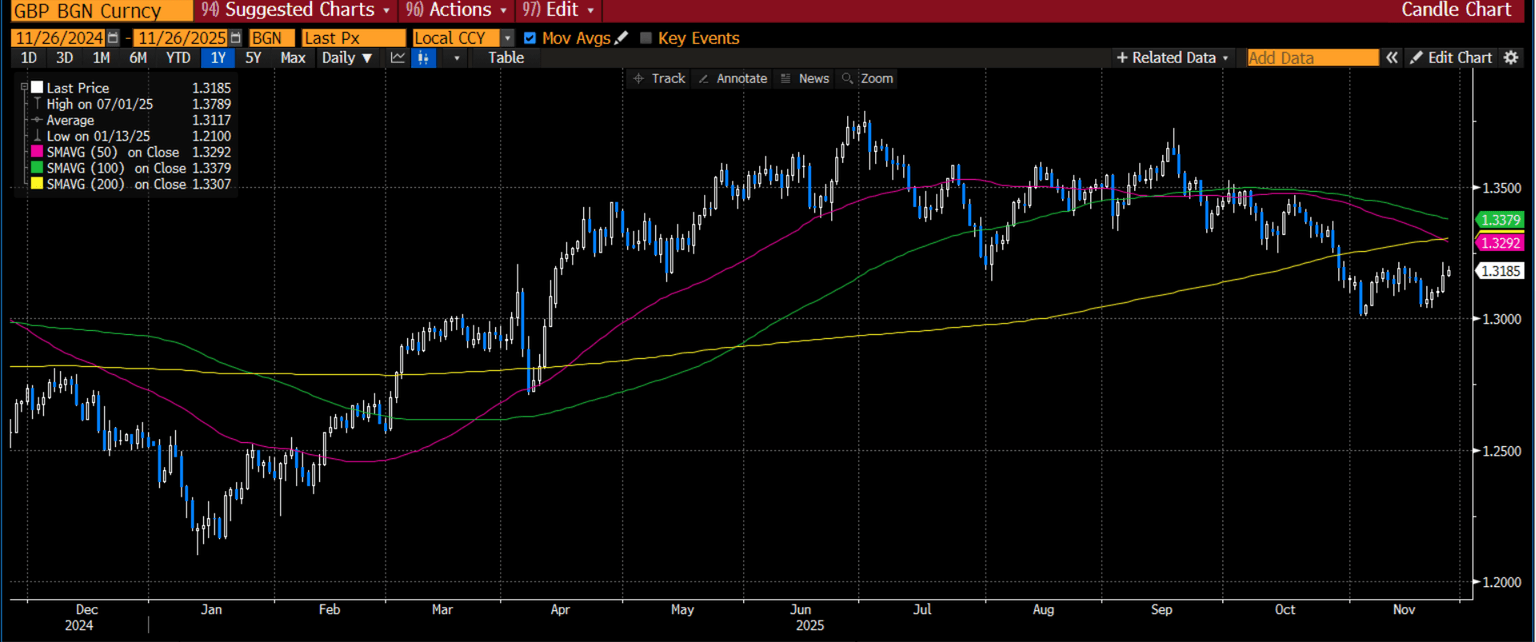
In the lead up to this Budget, the pound has been on a grind lower since September. GBP/USD has fallen from $1.37 to $1.3180 today, as the dollar has made a comeback. However, in the last few days, the pound has been trending higher, although it remains below the key 200-day sma level at $1.3307. Nothing good happens below the 200-day sma, so the market will be looking for something positive from Rachel Reeves to push the pound back above key resistance level. A sign that this is the last tax grab budget from Reeves could be enough to moderately boost sterling later today.
Chart 1: GBP/USD
The three non-negotiables
Overall, this Budget needs to deliver three things to keep the bond market happy and sterling stable:
- An increase in fiscal headroom.
- Front loaded fiscal tightening, preferably with spending cuts.
- A firm commitment from the Chancellor that this will be the last time that she uses the budget for tax raids. This could boost spending and confidence in the economy and help boost growth.
Author
Kathleen Brooks
XTB UK
Kathleen has nearly 15 years’ experience working with some of the leading retail trading and investment companies in the City of London.

















