|

Turkey: New financial tensions

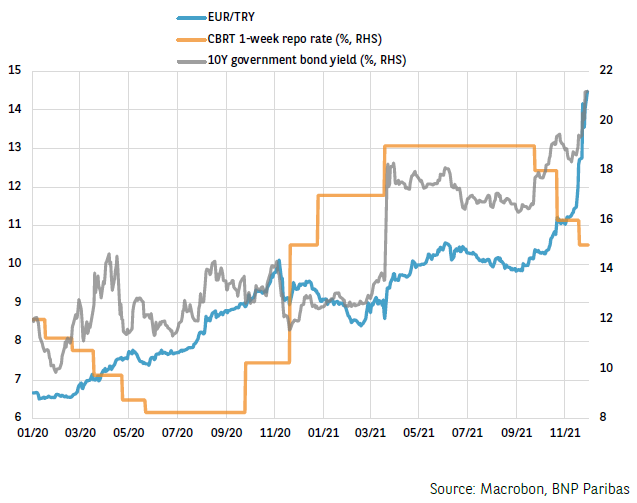
Over the past 15 days, the Turkish lira has depreciated 21% against the euro, including a single-day decline of more than 10% on 23 November. At the same time, 10-year government bond yields have risen above the 20% threshold. This bout of weakness was triggered by 1) another cut in the central bank’s key rate on 19 November, from 16% to 15%, despite surging inflation, which reached 19.9% year-on-year in October, and 2) President Erdogan’s statements justifying the easing of monetary policy as part of a new economic policy, after the President demanded that the National Security Council declare an “economic war of independence”. The President also lashed out at the opportunistic speculative behavior that took advantage of the lira’s depreciation to raise prices.

The main axis of the new economic policy is to improve the competitiveness of exports, which should be facilitated by currency depreciation. The central bank is giving priority to reducing the current account deficit, which is the main cause of the lira’s weakness, and not to fighting inflation. The paradox is that the current account deficit has been cut by half, from USD 35 bn in 2020 to a cumulative 12-month total of USD 18.4 bn in September 2021, thanks precisely to strong export performances. The capital account balance (including errors and omissions) also showed a very big surplus, entailing official foreign reserves to recover, to a total of USD 88 bn (excluding gold) on 21 November, up from USD 50 bn at the beginning of the year. Clearly, markets have another view of what should be the objective of monetary policy. And despite exchange rate pressures, they are not anticipating a sudden about-face, as was the case in September 2020.
EURTRY

Download The Full EcoFlash

Author

François Faure

François Faure

BNP Paribas

Expert in Capital flows to emerging markets, and Turkey.

More from François Faure
Share:

Editor's Picks

EUR/USD hits two-day highs near 1.1820

EUR/USD picks up pace and reaches two-day tops around 1.1820 at the end of the week. The pair’s move higher comes on the back of renewed weakness in the US Dollar amid growing talk that the Fed could deliver an interest rate cut as early as March. On the docket, the flash US Consumer Sentiment improves to 57.3 in February.

GBP/USD reclaims 1.3600 and above

GBP/USD reverses two straight days of losses, surpassing the key 1.3600 yardstick on Friday. Cable’s rebound comes as the Greenback slips away from two-week highs in response to some profit-taking mood and speculation of Fed rate cuts. In addition, hawkish comments from the BoE’s Pill are also collaborating with the quid’s improvement.

Gold climbs further, focus is back to 45,000

Gold regains upside traction and surpasses the $4,900 mark per troy ounce at the end of the week, shifting its attention to the critical $5,000 region. The move reflects a shift in risk sentiment, driving flows back towards traditional safe haven assets and supporting the yellow metal.

Crypto Today: Bitcoin, Ethereum, XRP rebound amid risk-off, $2.6 billion liquidation wave

Bitcoin edges up above $65,000 at the time of writing on Friday, as dust from the recent macro-triggered sell-off settles. The leading altcoin, Ethereum, hovers above $1,900, but resistance at $2,000 caps the upside. Meanwhile, Ripple has recorded the largest intraday jump among the three assets, up over 10% to $1.35.

Three scenarios for Japanese Yen ahead of snap election

The latest polls point to a dominant win for the ruling bloc at the upcoming Japanese snap election. The larger Sanae Takaichi’s mandate, the more investors fear faster implementation of tax cuts and spending plans. 

XRP rally extends as modest ETF inflows support recovery

Ripple is accelerating its recovery, trading above $1.36 at the time of writing on Friday, as investors adjust their positions following a turbulent week in the broader crypto market. The remittance token is up over 21% from its intraday low of $1.12.















