Trump's Seriously Misguided Ban On Huawei

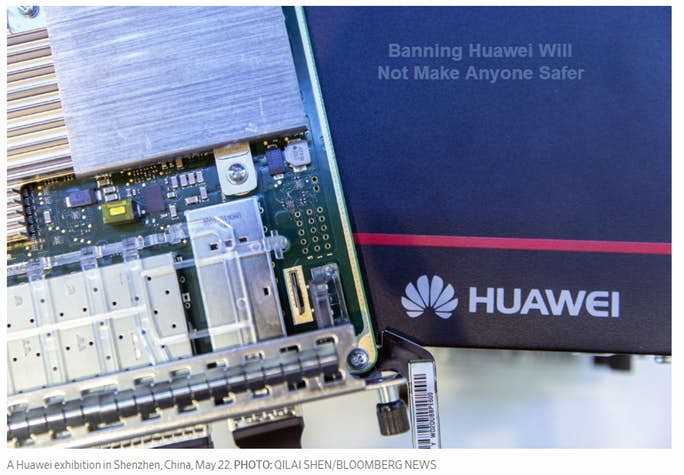
Trump's approach toward Huawei is the wrong one no matter what Trump's goal happens to be.
Wall Street Journal writer Holman W. Jenkins, Jr. hits the nail squarely on the head with How the U.S. Went Wrong on Huawei.
Nobody’s equipment in your telecom network can be trusted as long as governments like China’s, Russia’s, Iran’s or North Korea’s, in cahoots or in competition with criminal gangs, are trying to break into them. Let’s not kid ourselves: The U.S. CIA and National Security Agency are also looking for vulnerabilities to exploit.
Whoever’s equipment you install, relentless monitoring and vetting will be necessary to make sure data isn’t being intercepted, stolen or misused.
While security cannot be guaranteed by buying one company’s equipment and refusing to buy another’s, it can be strengthened by having a mix of suppliers, by pitting them against each other, by constantly testing for vulnerabilities and watching for suspicious traffic flows, and by being ready to yank hardware and shift traffic whenever problems are detected.
All this is a lot more complicated than: If we keep out Huawei equipment, because Huawei equipment might have “backdoors,” then our networks will be safe.
Our networks won’t be safe. Anybody who thinks so is barking up the wrong tree.
Banning Huawei from the U.S. market only increases China’s incentives for recklessness in the cyber sphere. Mr. Trump turns out to be right about one thing: Access to our market is our most powerful weapon in the various trade wars he’s sought to foment. Unfortunately, in the case of Huawei, we have made the worst possible use of it.
Flawless Analysis
Jenkins' analysis is flawless.
Huawei was not responsible for the DNC breakown or the US intercepting communications from Angel Merkel. The former was an inside job, Not Russia. The latter was US spying on allies plain and simple.
There's just one problem in all of this: It assumes Trump wants to deal with security rationally.
There is every indication Trump is using Huawei in a trade fight just as he proposed European cars are a serious threat to US national security.
1-D Chess
Trump doesn't play 4-D chess, 3-D chess, or even 2-D chess.
Trump plays in a single dimension at a time, and mostly badly.
Right now, Trump is concerned about a trade deal with China. Since he cannot do two things at once, he suspended his trade war with the EU.
Trump also took away tariffs on Canadian and Mexican steel in a desperate attempt to secure passage of USMCA, his treaty that is nearly identical to NAFTA.
Trump 101
- Trump puts on tariffs with great fanfare
- Trump waits for countries to come crawling to him
- When they don't, Trump rescinds the tariffs as soon as the stock market revolts
- Then a deal is worked out that Trump claims is the greatest deal ever made.
By now, every country in the world should have figured this out.
Author

Mike “Mish” Shedlock's
Sitka Pacific Capital Management,Llc
Mike “Mish” Shedlock is a registered investment advisor for SitkaPacific Capital Management.


![How Wall Street rigs the game [Video]](https://editorial.fxsstatic.com/images/i/market-chaos-01.jpg)