Trump is unhappy: He wanted a cut


Recall that the EU summit aims to develop a pan-EU bond of some $500 billion that would likely yield more than the US yield and pose an actual threat to US dominance in the bond world. Commentary so far indicates the likelihood is still pretty low.
How the Fed decision and dot-plot are perceived depends to some extent on how much panic one felt over the reckless, slipshod tariff rhetoric and Constitutional crisis.
For his part, Trump is unhappy—he wanted a cut. Last night he wrote “The Fed would be MUCH better off CUTTING RATES as U.S. Tariffs start to transition (ease!) their way into the economy. Do the right thing.” This is the beginning of the threat to the Fed’s composition and mission we have noted before.
Overall, the new dot plot is not accepted as realistic. GDP growth is reduced from 2.1% this year to 1.7%. Unemployment is forecast up from 4.3% to 4.4%. The median PCE forecast is forecast from 2.5% to 2.7%. And the Fed is tapering the monthly roll-off of Treasuries not replaced by $5 billion to $25 billion.
The WSJ notes investors are slow to appreciate the shift away from near-term cuts, meaning the timing. “The number of officials who penciled in fewer cuts compared with December went up. And Powell conceded that a ‘highly uncertain environment’ led some officials to simply not fuss over big changes to the rate outlook. ‘There is a level of inertia where you just say, maybe I’ll stay where I am,’ he said.” Wow, sounds like defeatist talk.
He also said “It’s a different situation” than in 2019 when Trump did the tariffs. “We haven’t had real price stability fully re-established yet, and we have to keep that in mind.” For Powell to describe the upcoming tariff effects as “transitory” is not acceptable to many, and it doesn’t help that it then took it away, saying a one-time hit is the base case, but the Fed “really can’t know” if the effect will be temporary.
Analysts note that to expect a one-time inflation surge on disrupted supply chains is naïve in such a complex world. Former Fed Kohn told the WSJ “You have to figure out how much is transitory and how much is likely to be perpetuated by these second-round effects, and there is no clean way of doing that.”
“Officials could be hard-pressed to declare price increases from tariffs as temporary if they set in motion a reordering of global production processes that takes years to play out.
“On top of that, Fed officials are nervous that the postpandemic inflation might have given businesses and consumers more acceptance of higher inflation. Policymakers pay close attention to expectations of future inflation because they think those expectations can be self-fulfilling.”
Bottom line, the consensus has it that the Fed is behind the curve in more ways than one. Expectations for growth are only a little lower and not in keeping with mainstream forecasts from the big banks and regional Feds. And Mr. Powell dismissed as “outliers” the surveys showing rising consumer inflation expectations (Bloomberg points out the U Michigan shows “consumers expect prices to rise at an annual rate of 3.9% over the next five to 10 years, the highest in more than three decades.”)
Not to inject politics where it normally doesn’t belong, we opine that Trumps’ disregard and open disrespect for US institutions, especially the Constitution and rule of law, colors the economic views of consumers and business leaders alike. All those colors are gray and black.
Forecast
For forecasting purposes, too much depends on the verbal garbage spilling out of the White House. The dollar is gaining ground pretty much everywhere as the tariff date approaches (April 4) If that’s the reasoning, it’s a big reason because yield are still falling and yields are normally a bigger factor. We also see the usual profit-taking in some currencies that got overbought, especially the euro and pound but also perhaps the AUD.
Over the next few days, we expect a chorus of disapproval over the Fed’s use of a toxic word, transitory, to describe the effect of tariffs. It was a mistake when used to describe inflation from Covid supply chain problems and it’s a mistake now.
A bottoming pattern may be in the works but we have been here before and got our heads handed to us. The alternative is a plain, old-fashioned correction/consolidation. If so, the limit is probably down around the confluence of the 200-day and 20-day near 1.0725, with a pause around 1.0825 coming first.
Tidbit: Trump intends to wipe out the Dept of Education today, one of the few things he is doing that is actually a campaign promise. Those who want to get rid of teaching about the civil war and the existence of gays to their children will be happy… until they see their next property tax bill, the primary means of funding schools.
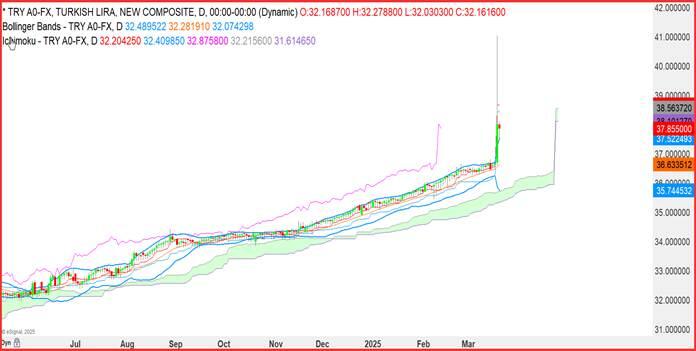
Tidbit: The Turkish central bank intervened in favor of the lira to the tune of some $8 billion, after the lire crashed on political news. Pres Erdogan arrested his main rival, the mayor of Istanbul, on what are probably trumped-up charges of planning an insurrection. The lira is still crashing and the Borsa Istanbul 100 stock index fell more than 9%, according to the WSJ.
This is an excerpt from “The Rockefeller Morning Briefing,” which is far larger (about 10 pages). The Briefing has been published every day for over 25 years and represents experienced analysis and insight. The report offers deep background and is not intended to guide FX trading. Rockefeller produces other reports (in spot and futures) for trading purposes.
To get a two-week trial of the full reports plus traders advice for only $3.95. Click here!
This is an excerpt from “The Rockefeller Morning Briefing,” which is far larger (about 10 pages). The Briefing has been published every day for over 25 years and represents experienced analysis and insight. The report offers deep background and is not intended to guide FX trading. Rockefeller produces other reports (in spot and futures) for trading purposes.
To get a two-week trial of the full reports plus traders advice for only $3.95. Click here!
Author
Barbara Rockefeller
Rockefeller Treasury Services, Inc.
Experience Before founding Rockefeller Treasury, Barbara worked at Citibank and other banks as a risk manager, new product developer (Cititrend), FX trader, advisor and loan officer. Miss Rockefeller is engaged to perform FX-relat