Three markets to watch: Gold, the future of AI and European stocks

2025 has seen a shake up of financial markets. Stock market and FX leadership has changed, European indices are outperforming US indices for now. This is typical at this early stage of the year, with less loved parts of global financial markets playing catch up to 2024’s winners. The external picture is also complicated by geopolitical tensions and US trade tariffs. There are an unusually large number of risks in financial markets right now, below, we look at how these risks could impact gold, the tech trade and European stocks.
Gold
The gold price reached a fresh record at the start of this week, and is higher by more than 10% YTD, easily outpacing US equities and most global equity indices. The gold price has soared through $2,900 on Monday and is higher by $40. Gold is usually driven by central bank policy and inflation concerns. However, the surge to a fresh record high is also linked to Donald Trump’s trade tariff threats. Trump’s latest round of tariffs on steel and aluminum were not country specific, so it could be harder to negotiate a reversal. Also, the fact that tariffs are now a reality for industrial metals means that precious metals could be next. Thus, there is a rush to bring gold back onshore. Gold is also acting as the most reliable haven in this new era of tariffs and global trade wars, it has avoided the tariff fatigue that has set in among other markets, such as stocks.
Gold is benefitting from safe haven demand, and geopolitical and trade tensions, it is also soaring at the same time as the dollar is strong. In the past this has been a headwind for gold, however, the fact it is rallying alongside the greenback is a sign of the strength of demand for gold right now. The strength of the gold price is also boosting gold miners, and South Africa’s FTSE JSE index is close to a record high, as gold miners benefit from the rise in the price of the precious metal.
This is an interesting junction for gold. $3,000 is now in focus, but what happens next? Could this be buy the rumor and then sell the fact? If Trump doesn’t levy tariffs on gold in the coming weeks, will investors start to sell? Added to this, gold tends to trade sideways around key psychological levels. For example, it moved in a range between $1600- $2,000 between 2022- late 2023, and we could see similar range bound activity if investors push the gold price above $3000 anytime soon.
For now, gold is the clear winner of the trade wars.
Tech stocks after DeepSeek
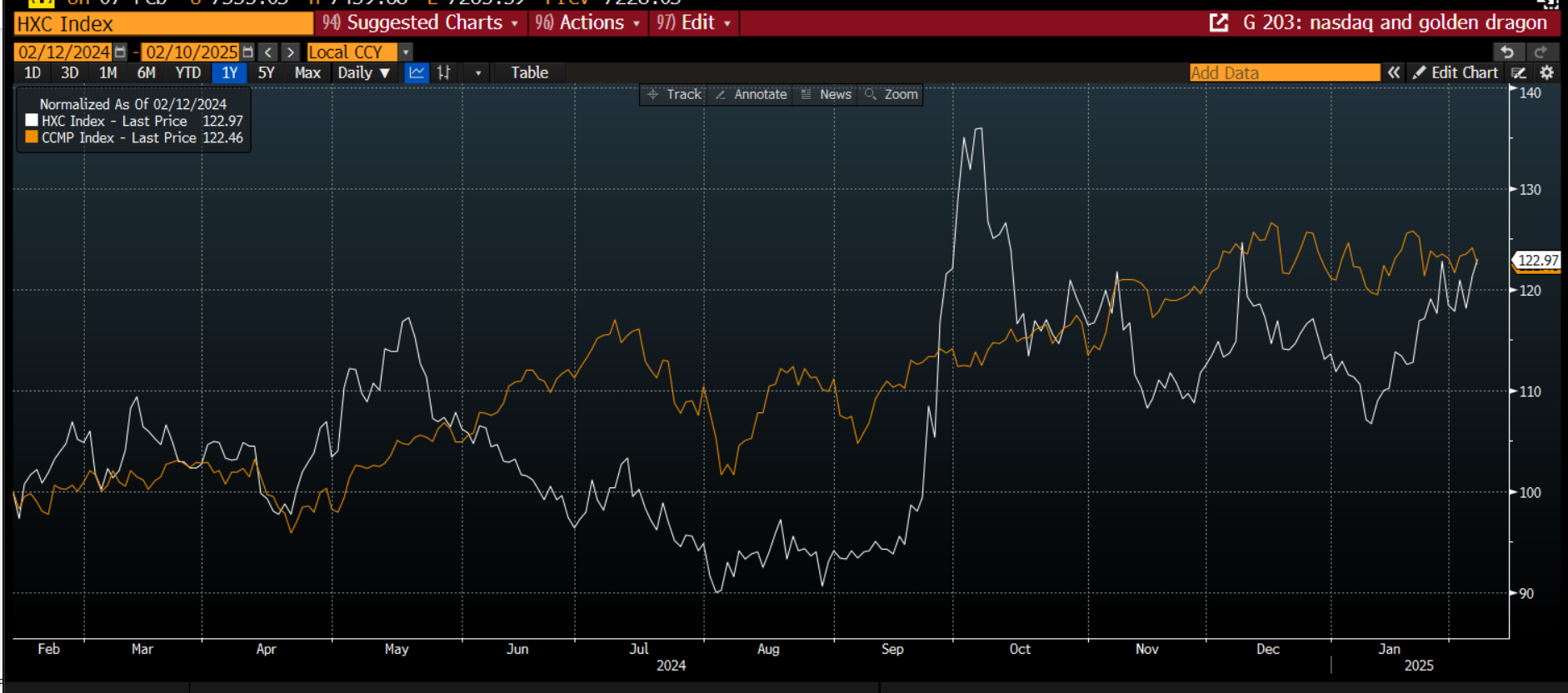
The fallout from DeepSeek continues, as some analysts question whether it is possible to create a large language model for only $6mn. This allowed Nvidia to erase some losses last week. However, DeepSeek has unleashed a wave of interest in Chinese tech firms. This is visible in the Nasdaq. The Golden Dragon index, which includes US listed Chinese tech firms, has raced to catch up with the overall Nasdaq Composite, after underperforming for most of this year.
This suggests that while DeepSeek may have questions to answer, it has awakened investors to China’s AI capabilities, and this is fueling demand for Chinese stocks. Interestingly, inflows into US listed emerging market ETFs rose by more than $398mn last week, and China and Hong Kong had the largest inflow of $346.7mn, which further supports the view that DeepSeek has stoked interest in the Chinese stock market.
The Nasdaq’s Golden Dragon Index is catching up the Nasdaq Composite, 12-month chart, normalized to show how they move together
Source: XTB and Bloomberg
European stocks: What next after a stellar January
European equity indices have had their best start to the year since 2000. The Eurostoxx index is higher by 9% YTD, The Dax is higher by nearly 10% and the Cac 40 is higher by more than 8%. This is better than many forecasters had predicted for the entire year.
The question is, can this continue, or will the rally in European stocks fade? Without a doubt, European stocks face several problems including the threat of US tariffs and weak economic growth. However, US stocks are also facing some key tests in the months ahead. The Fed remains firmly on hold, and American companies could end up taking the brunt of the pain from President Trump’s programme of tariffs due to their central position in the global economy, and their reliance on a global supply chain. US-listed multinational companies could get hit by a double whammy of tariffs: US tariffs on imports, and retaliatory tariffs on US goods. The strong dollar is already having an impact on earnings calls. Several US companies said that currency effects could impact future profits. For example, Amazon said that there was an unusually large and unfavorable impact from FX rates of $2.1bn for Q1 this year.
European stocks have also benefitted from the lower valuations than their US peers. The top performing European stocks so far this year are all banks: Banco Santander, UniCredit and Banco Bilbao Vizcaya Argenta. Banco Santander reported extremely strong revenue growth of 9.8% YoY in Q4, which helped to boost its stock price, however, analysts do not expect this to continue in Q1. Net income growth is also expected to slow. Unless analysts revise up their expectations, it could be hard for Europe’s banking sector to continue to see share price gains like they did in January.
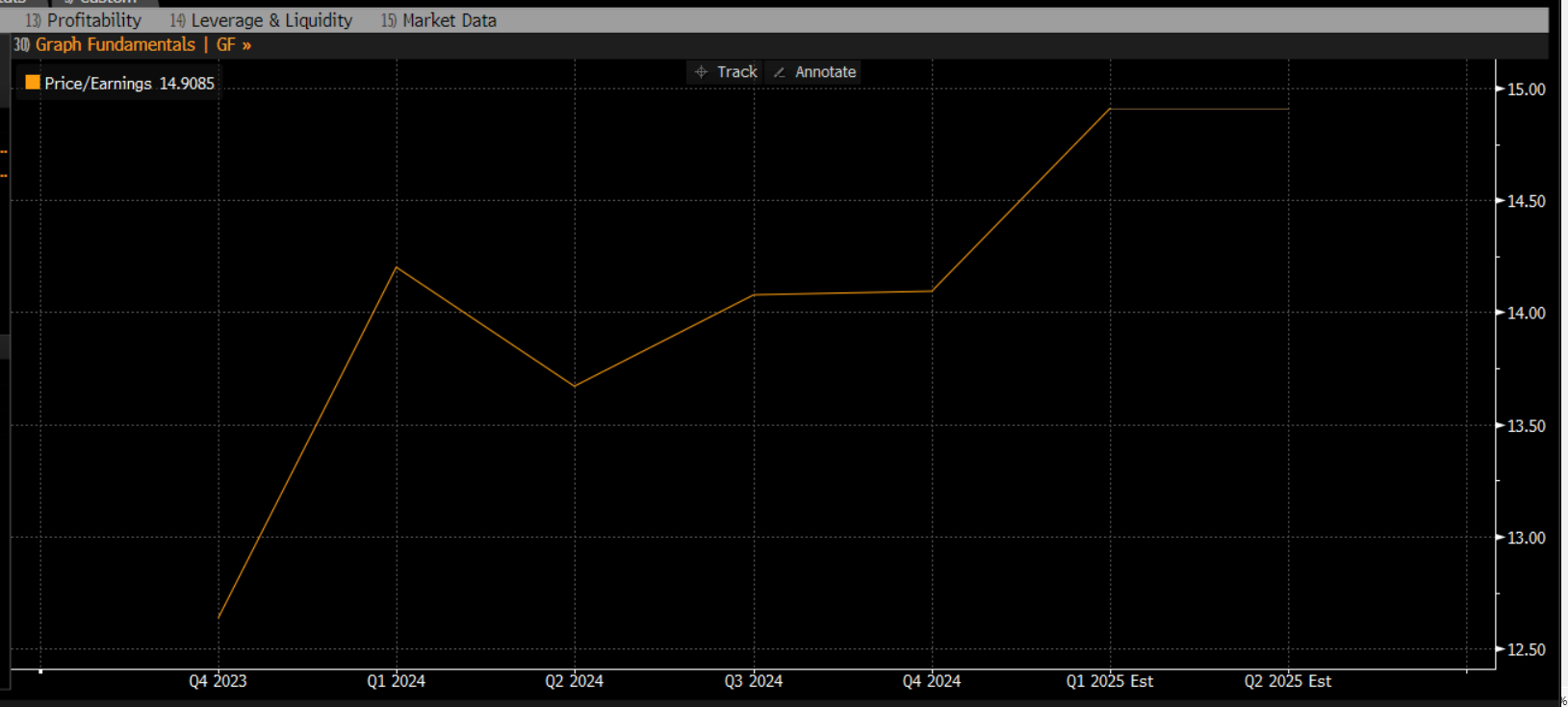
The rally in European shares has also pushed up their price/ earnings ratio. The average P/E ratio for the Eurostoxx 50 index was 14 at the end of 2024, this is now 15.4. Although this is lower than the P/E of 25 for the S&P 500, if European stocks continue to rally then they may start to look less attractive from a valuation perspective, especially if the top performing banking sector cannot repeat its earnings performance in Q1 2025.
Eurostoxx 50 P/E ratio
Source: XTB and Bloomberg
Author

Kathleen Brooks
XTB UK
Kathleen has nearly 15 years’ experience working with some of the leading retail trading and investment companies in the City of London.