This ratio doesn’t lie – Silver is ready to roar

The metals market is shifting.
But one certain metal is already miles ahead.
Silver is rewriting decades of price history, and most investors haven’t noticed.
Physical silver inventories are vanishing across global exchanges, hitting multi-year lows, yet paper markets still dominate headlines. When actual metal becomes scarce but paper claims persist, markets enter a tension that rarely ends quietly.
Every shortage of the past has preceded a dramatic repricing, often catching even the most experienced investors off guard.
Today, this imbalance is intensifying. Industrial buyers, investors, and sovereign holders are all competing for a finite supply.
When the tipping point comes, silver historically doesn’t creep higher.
It rockets.
Often faster than anyone anticipates.
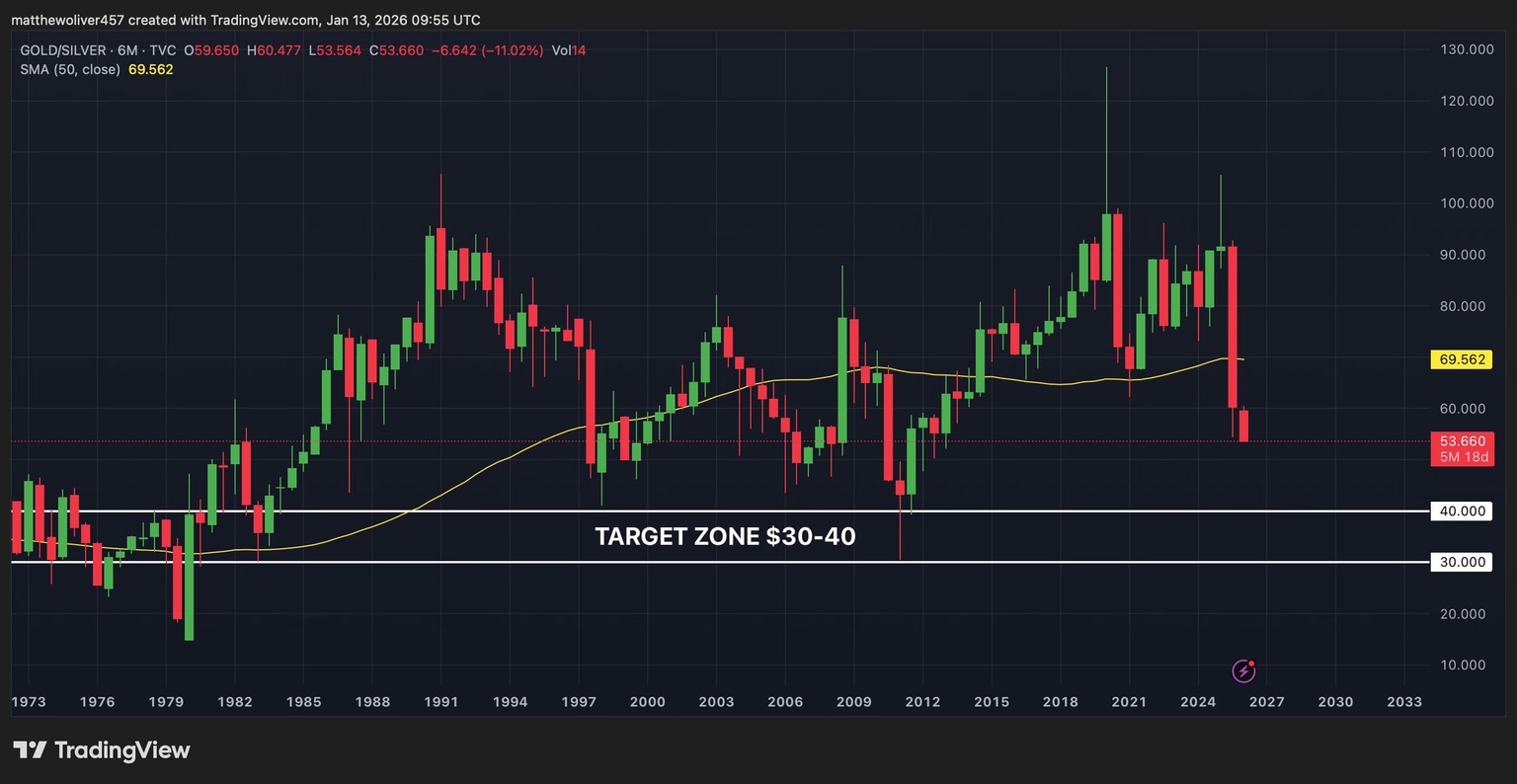
The Gold Silver ratio (GSR) has quietly rolled over
For the last 20 years, the ratio has hovered between 65:1 and 85:1 — a reflection of the market’s preference for gold’s stability over silver’s dual role as an industrial and monetary metal. But historically, when the ratio hits extremes, especially above 85:1, it signals the potential for explosive silver reversion.
And now, that reversion is underway.
Where could Silver go?
Let’s run the numbers using a conservative base-case: gold at $5,000/oz (Citigroup projection for 0–3 months).
- At 40:1 – Silver = $125/oz.
- At 30:1 – Silver = $167/oz.
- At 38:1 (2011-style reversion) – Silver = $132/oz.
- At 17:1 (1980 peak) – Silver = $294/oz.
If history rhymes, the upside could be shocking.
Silver’s story isn’t just technical. The fundamentals are tightening:
- Industrial demand from EVs, solar, energy storage, and defense is surging.
- Silver is in its fifth consecutive annual supply deficit.
- Above-ground inventories are shrinking globally.
- Institutional and sovereign holdings remain underweight.
- BRICS nations are accelerating non-dollar trade systems — silver may play a bigger role.
This isn’t just a commodity story. It’s part of a slow-motion global currency reset. And silver’s dual identity gives it a unique edge.
Silver always lags — Until it leads
Every precious metals bull market has a final chapter. And in that chapter, silver is always the star.
- 1980: Silver’s final surge came after gold had peaked.
- 2011: Silver stole the show during the parabolic leg.
- 2025?: The ratio compression and breakout suggest history may rhyme again.
Macro drivers you need to know
- BRICS accounts for 30% of global GDP and is building a commodity-backed trade unit.
- The U.S. will roll over $7T in debt this year, mostly at higher rates.
- ISO 20022-compliant digital asset rails are going live globally.
- GSR remains near 53:1 — far above the historical mean of 16:1.
- Physical silver inventories on COMEX are hitting multi-year lows.
- FedNow, ECB DLT pilots, and BIS mBridge quietly restructure global money settlementWhat’s happening is bigger than a single market move. It’s a structural shift.
Fiat systems weren’t designed to protect savers; they were designed to serve governments. Inflation, currency devaluation, and geopolitical tension are just symptoms.
The true opportunity lies in assets that straddle the line between industrial utility and monetary store-of-value… and silver is exactly that.
The gold-to-silver ratio doesn’t just measure relative pricing. It tracks emotional turning points: fear turning into confidence, hoarding turning into speculation. When it turns, silver often leads with surprising speed and scale.
This isn’t another leg of a cyclical commodity rally. It’s a generational moment. Multi-decade technical patterns are breaking, fundamentals are tightening, and a structural reallocation into real assets is underway.
Silver is not just cheap, it’s ready.
Author
Matt Oliver
Independent Analyst
Precious Metals Analyst managing proprietary trading accounts and a private investment portfolio. I use a blend of macroeconomics, fundamentals, value investing, technicals, and strict risk management.

















