There is a way to go before inflation can be said to have been whipped

Outlook: The dollar suffered yesterday from the “event risk” of the Powell testimony, even though he did not say anything new and in fact reiterated that we have a way to go before we can say inflation is whipped. And he is sticking to the 2% target come hell or high water. Everybody and his brother, including the WSJ, are piling on to poor Mr. Powell. The WSJ says we should focus on the economy because that’s what really matters for getting the direction right…. “the Fed’s fine-tuning misses the point.”
This is preposterous. Of course the Fed looks at the economy, and deeply. Disagreement is no justification for insults. And as the Atlanta Fed and various bits of data keep telling us, the economy is doing better than expected—housing starts, capital investment in factories, consumer spending, and that always neglected item, government spending on infrastructure, just ramping up. What the news outlets really mean is that the hawkish Powell is “sapping the spirits” in the stock market, not the currency market, where normally expectations of higher rates are favorable.
It's possible that the Powell testimony had nothing to do with yields or the dollar. As we like to point out, just because two things happen about the same time doesn’t mean they are cause-and-effect. This is glaringly obvious in the stock market and also oil, where newspaper headline writers are desperate to explain what is unexplainable most of the time. We notice that nobody is trying to explain why gold has fallen so far, to a 3-month low, when the usual suspect, inflation, is proving so sticky. At a guess, it might be investors choosing crypto over gold, something we have been seeing for over a year, but we don’t want to get caught in that same trap of phony correlations.
Besides, we still have the strange fact that the market doesn’t believe the Fed and its “higher for longer.” The probability of a second hike this year remains well below 15%. At least it’s up to 14.1% from 8.1% a few days ago. It’s doubtful that non-voter Atlanta Fed Pres Bostic had any effect—he would be comfortable with no more changes in the rate for the rest of the year, a really long pause. But in addition to being a non-voter, Bostic is also under scrutiny for stock trades just ahead of the last hike.
This is not to say fundamentals don’t count. They do, and of all the fundamentals, institutional (central banks) are at the top. It’s just that one number here from the economics pile and another number there should not get all the credit for shifting sentiment, which is impossibly complex.
One place we can see cause-and-effect is the Canadian dollar, which has a mountain of favorable indicators, both institutional and economic. Yesterday April retail sales leapt 1.1%, meaning expectations of a flat Q2 are likely to be revised. Canada’s GDP in Q1 was a high 3.1% annualized. We get May CPI next week and traders are starting to price in not just one but two more hikes.
And we do see cause-and-effect in the emerging markets. Today it was the central bank of Turkey raising rates by 650 bp to 15% when the market (and Bloomberg) had forecast 20%. The lira crashed.
Today we get jobless claims which some will try to make hay out of straw with another rise. We also get the current account, the Chicago Fed national activity index, and at least three more Fed speakers in addition to Powell’s second day of congressional testimony. None of these things are likely currency market movers unless traders are bored to tears and looking to foment a move. A curiosity: the CRB commodity price index is up a little today but as of 8 am, everything except copper is down.
In a nutshell, what is seemingly irrational price moves in more than one asset class. Hang on to your hat.
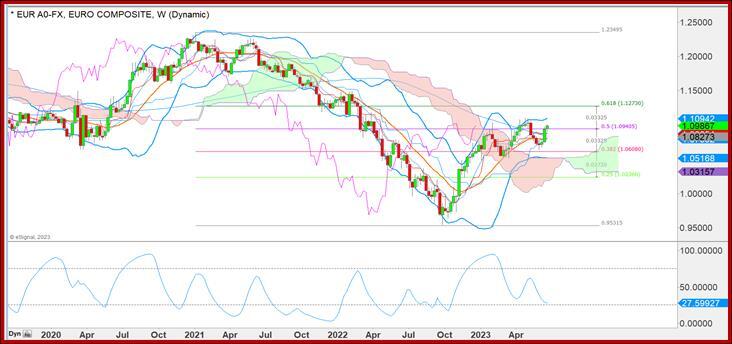
Forecast: It looks like the dollar correction was unnaturally small and short-lived. That means it’s not to be trusted as having ended for sure. We see the euro tending toward the previous high at 1.1094, but it seems silly to imagine that it can match-and-surpass that level given the current set of circumstances. Far more common would be another drawdown before that level which would deliver a head-and-shoulders, although that is perhaps too much imagination.
See the weekly chart. Granted, it’s not a tradable chart but maybe useful in that it shows the upward euro correction from the long slog downward at just over 50% and the 62% level at 1.1273. This doesn’t seem likely. More probable is stickiness right around where we are now for longer than anyone wants to see.
This is an excerpt from “The Rockefeller Morning Briefing,” which is far larger (about 10 pages). The Briefing has been published every day for over 25 years and represents experienced analysis and insight. The report offers deep background and is not intended to guide FX trading. Rockefeller produces other reports (in spot and futures) for trading purposes.
To get a two-week trial of the full reports plus traders advice for only $3.95. Click here!
This is an excerpt from “The Rockefeller Morning Briefing,” which is far larger (about 10 pages). The Briefing has been published every day for over 25 years and represents experienced analysis and insight. The report offers deep background and is not intended to guide FX trading. Rockefeller produces other reports (in spot and futures) for trading purposes.
To get a two-week trial of the full reports plus traders advice for only $3.95. Click here!
Author
Barbara Rockefeller
Rockefeller Treasury Services, Inc.
Experience Before founding Rockefeller Treasury, Barbara worked at Citibank and other banks as a risk manager, new product developer (Cititrend), FX trader, advisor and loan officer. Miss Rockefeller is engaged to perform FX-relat