There are short and long-term reasons for liking the current move


Outlook: Some traders are going mad before we get CPI tomorrow. It’s not so much the numbers per se, but rather what to expect from the Fed as a result. The easy answer is “nothing,” since the Fed doesn’t decide on this particular data, but that doesn’t stop the speculation. After several Fed govs said more hikes may be in store, Philadelphia Fed Harker said the Fed may now be able to halt rate increases. This is altogether too much noise.
Part of the noise is questioning whether deflation in China will affect the rest of the world. The answer is yes, a little, in terms of goods prices, but in most of G7, inflation comes from services, not goods. Still, there might be some deflationary effect leaking over to the rest of the world in Chinese exports. Looking at trade alone doesn’t satisfy and because China is a special case, nobody knows what other spillover effects there might be. Some say we should be alarmed. Yes, but because we don’t know the possible effects, not because we know they will be bad for us in some unspecified way. Deflation is not “contagious” like equity market developments. The Chinese property development problem is peculiar to China only. Nowhere else has there been such a flood of savings into zombie buildings and whole towns. Ten years ago the press wondered how this would end. We still don’t
know but we do know it’s bad in some still-undisclosed ways as well as deflation.
Ahead of tomorrow’s CPI, it’s important to note once again that the biggest component is really Bad Data. It’s “housing,” which accounts for 32.7% of the total. You could punish yourself by reading the BLS description but don’t bother.
Here’s the nub of it, from Forbes: “Specifically, the housing costs in CPI are covered by owners’ equivalent rent of residences (OER) and rent of primary residence (rent); these are calculated using a panel approach, where rental costs are sampled every six months across six different housing panels. This six-month sampling window creates a lag for CPI housing costs. The latest month’s data only changes housing data by a sixth in the current CPI report, with the remaining prices feeding in from panel data that is up to six months old.
As we complain every time, “owners’ equivalent rent” is a guess by homeowners of what their premises would go for if they were to rent them out instead of living in them. This is unbelievably dumb and not worth the paper it’s printed on. If you check out your own house at Zillow.com, for example, you will see an estimate of what rent you could get. Subtract your mortgage and gee, it looks like it would be worth moving into the cow shed to make that much money. But your own estimates and Zillow’s are wildly unrealistic.
And so are the BLS’ deductions about the cost of housing, and that’s not even considering that six “panels” doesn’t cover a country of the size and variability of the US. Many, many economists have proposed alternatives, but try telling that to the guv’mint. Even Mr. Powell would prefer to just exclude housing when considering inflation, and bravo to him.
About twenty other measures are available—you can check out the list at TradingEconomics.com. The House Price Index is up only 2.8% y/y in May after 3.10%
in April. See the chart. This is “The FHFA (Federal Housing Finance Agency) House Price Index measures month over month changes in average prices of single-family houses with mortgages guaranteed by Fannie Mae and Freddie Mac.” That seems acceptable. But let’s focus on that y/y number, which of course slides lower as the pandemic freak-out fades—the base effect. It was a mere 2.8% y/y in May.
House prices exclude rent, which accounts for about 35% of all households. You can see rents by city and state at https://www.rentcafe.com/average-rent-market-trends/us/ (eat your heart out, London). We couldn’t find a decent chart—we don’t like the ones at FRED—but even CNN reported “The US median rent in May fell from May 2022, the first annual rent decline in at least three years, according to a Realtor.com report released [in late June]. In May, the national median asking rent was $1,739, which was up a skosh ($3) from April but down 0.5% from May 2022. It’s the first decline since Realtor.com started tracking the year-over-year data in March 2020. Rents have gradually come down from July 2022’s peak of $1,777, but they remain nearly 25% higher than in 2019.”
Anyway, when CPI does come out, it will be inaccurate, and a multitude of analysts will come out in force to say so and propose their alternatives. After reading a slew of these stories in rapid succession, we guess the cost of housing is up about 3-3.3% year-over-year, and maybe less but not, probably more. Core is forecasts at the same 4.8%.
That brings us back to the 2% target, which has to add something to it in order for the Fed to avoid overshooting. Remember, the Fed doesn’t use CPI, anyway—it uses the PCE version. But the public and reporters use CPI and the Fed must take note. The point is that once the analysts get through adjusting CPI for a better housing component, CPI could well be a whole lot lower than the forecast. The wild card is likely food and maybe energy, considering electric bills are soaring even though the raw materials (oil and gas) are not.
Here is that good interactive chart from the BLS, which allows you to add components at will.
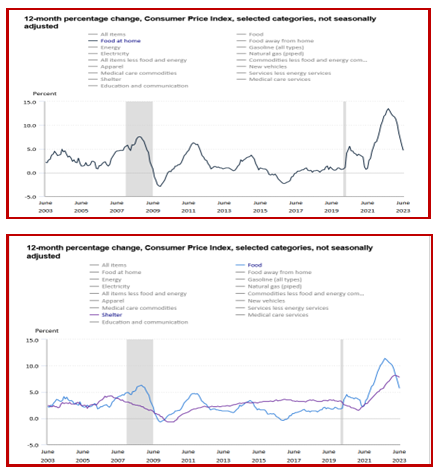
Bottom line—CPI may come in at 3%, the same as June, with core at 4.8%, also the same. But sensible folks know the true number is actually lower. Because there is so much publicity surrounding this release, the public will start believing the pandemic inflation is over and not too happy with a Fed that keeps raising rates. The Fed doesn’t care about publicity but does care about its public image, and not just among bond traders.
So, once digested, CPI will more likely offer a building block for jubilation—inflation is over! Inflation is over!--than a sad, limp return to the idea the Fed is not close to being done. Ironically, of course, the high inflation/more hikes version is probably more favorable to the dollar. Still to come—whether we get one more hike or not, we need to judge the expectation of a cut next year. The Fed keeps saying no, it might not be “higher for longer” but it will be “high for longer.” That’s unless disinflationary/deflationary forces appear out of the blue and scare the Fed.
Forecast: The 10-year bond yield at about 4% and over is telling us the dollar has a tailwind. In addition, China’s economic woes are raising uncertainty and risk aversion, favoring the dollar. Even the wobbly US stock market and gold imply, if weakly, that the dollar is a preferred place to be. So we have short-term and long-term reasons to like the current move. But tomorrow that pesky inflation data can be received well or badly and has the muscle to upset the apple cart.
This is an excerpt from “The Rockefeller Morning Briefing,” which is far larger (about 10 pages). The Briefing has been published every day for over 25 years and represents experienced analysis and insight. The report offers deep background and is not intended to guide FX trading. Rockefeller produces other reports (in spot and futures) for trading purposes.
To get a two-week trial of the full reports plus traders advice for only $3.95. Click here!
This is an excerpt from “The Rockefeller Morning Briefing,” which is far larger (about 10 pages). The Briefing has been published every day for over 25 years and represents experienced analysis and insight. The report offers deep background and is not intended to guide FX trading. Rockefeller produces other reports (in spot and futures) for trading purposes.
To get a two-week trial of the full reports plus traders advice for only $3.95. Click here!
Author
Barbara Rockefeller
Rockefeller Treasury Services, Inc.
Experience Before founding Rockefeller Treasury, Barbara worked at Citibank and other banks as a risk manager, new product developer (Cititrend), FX trader, advisor and loan officer. Miss Rockefeller is engaged to perform FX-relat

















