The US jobs surprise may be less inflationary than markets think

Why productivity, not Payrolls alone, may decide the Fed's next move
The US labour market has delivered a clear upside surprise, and markets have responded by raising the probability of another Federal Reserve rate increase. Yet the same set of official data contains a second signal that deserves equal attention: productivity accelerated while unit labour costs fell in the third quarter. The economy is creating more output without a comparable increase in hours worked.
That combination changes the policy debate. Strong employment still gives the Fed room to keep policy restrictive, especially while inflation remains above target. But payroll growth alone cannot establish that the economy is overheating. If productivity is genuinely improving, stronger growth and rising employment can coexist with less pressure on corporate costs than the headline jobs report suggests.
Why this topic matters now
This is the most timely market question after Friday's employment report and before the October US Consumer Price Index is released on Tuesday, 10 November. It forces markets to distinguish resilient demand from an improvement in the supply side of the economy. The new issue is whether investors are treating stronger activity as automatically inflationary while underestimating the economy's capacity to produce more output at a lower unit cost.
For FX and rates traders, the answer determines whether the dollar's payroll-driven rise can continue. For bond investors, it affects whether the front end should price a faster tightening path or whether lower cost pressure will eventually permit a less restrictive Fed. For equities, it helps distinguish a genuine improvement in productive capacity from a temporary earnings and employment rebound.
The evidence
The Bureau of Labor Statistics reported that nonfarm payroll employment increased by 165,000 in October, compared with a market forecast of roughly 65,000. The unemployment rate declined to 4.1% from 4.2%. August and September payroll growth was revised higher by a combined 84,000, taking the three-month average to approximately 137,000 jobs.
The detail was also stronger than the headline alone. Professional and business services added 70,000 jobs, including 33,000 in professional, scientific and technical services. Average hourly earnings rose 0.4% during October and 3.1% from a year earlier. The participation rate edged up to 61.9%.
There were, however, signs of slack beneath the surface. The number of people working part-time for economic reasons increased by 339,000 to 4.8 million, and the broad U-6 measure of underemployment rose to 7.9% from 7.6%. The report therefore described a resilient labour market, not an unambiguously overheating one.
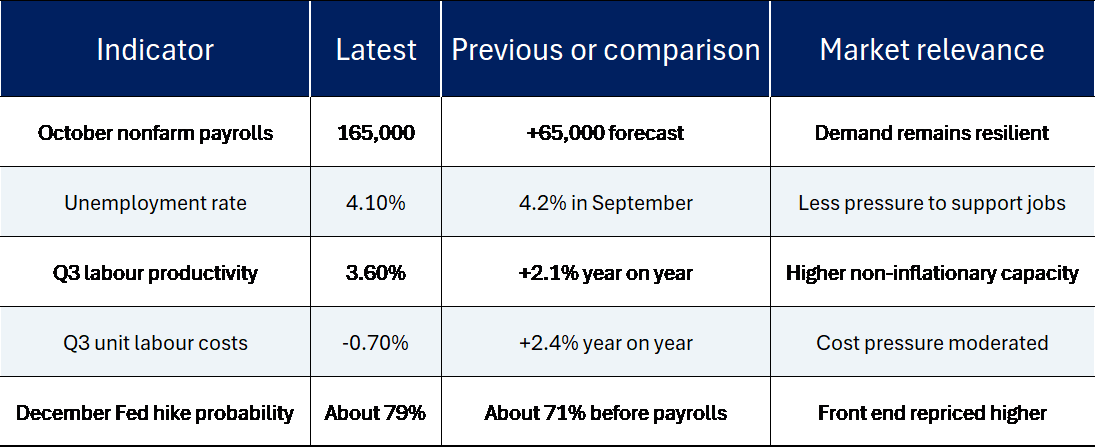
The productivity release provided the counterweight. Nonfarm business productivity increased at a 3.6% annualised rate in the third quarter as output rose 3.7% and hours worked increased only 0.1%. Unit labour costs fell at a 0.7% annualised rate because productivity grew faster than hourly compensation. Over the previous four quarters, productivity increased 2.1% and unit labour costs rose 2.4%.
Real hourly compensation rose 1.1% during the quarter at an annualised rate and 1.0% from a year earlier. The labour share of output fell to 53.0%, the lowest reading in the series that begins in 1947. That may support margins, but it also raises a longer-term question about how much of the productivity benefit is reaching household incomes and consumption.
The market reaction
Markets initially treated the employment report as hawkish. On Friday, the two-year Treasury yield rose to approximately 4.52% and the ten-year yield to 4.86%. The yield curve flattened, with the two-year to ten-year spread narrowing to about 34 basis points. The US Dollar Index gained around 0.7% to 102.2, while implied probability of a 25-basis-point Fed increase in December rose to roughly 78%-79% from about 70%-71% before the report.
The dollar held near its post-payroll gains on Monday. EUR/USD had touched approximately 1.1132 on Friday, its weakest level since May 2025, while AUD/USD fell to about 0.6855, its lowest since the end of March. These moves show that relative interest-rate expectations remain the first transmission channel from US data into FX.
Other markets offered a more complicated message. US equities recovered part of Thursday's sell-off, Asian technology shares rebounded sharply on Monday, and spot gold climbed above $4,120 in early European trading despite the increase in the expected Fed path. Gold's resilience suggests that demand for protection, lower oil prices and uncertainty about the durability of the risk-asset rebound are offsetting the normal headwind from higher US rate expectations.
The interpretation
My interpretation is that markets are right to treat the jobs report as reducing the probability of near-term easing, but they may be too quick to treat every upside employment surprise as proof that inflation must accelerate. Productivity determines how much output an economy can produce for a given amount of labour. When it rises, wages can increase without creating the same pressure on unit costs.
This does not mean the Fed can ignore inflation or stop tightening. The federal funds target range is 3.75%-4.00%, and September CPI increased 0.6% during the month and 3.7% from a year earlier. Core CPI rose 0.3% during the month and 2.6% year on year. Energy, shelter and other supply-sensitive components can keep headline inflation high even when labour costs improve. A single quarter of productivity data is also volatile and subject to revision.
The more balanced conclusion is that the Fed has gained time, not certainty. Resilient employment reduces the urgency to support activity, while stronger productivity reduces the urgency to assume that growth is inherently inflationary. Tuesday's CPI must therefore be interpreted together with labour costs, inflation expectations and demand indicators rather than as an isolated number.
There is another bond-market complication. Persistent productivity growth can lower cost pressure, but it can also raise the economy's potential growth rate and the equilibrium real interest rate. That would support higher real yields over time even if inflation moderates. Productivity is therefore not automatically bullish for duration. It may be positive for growth assets while keeping the long-run floor under interest rates higher than markets expect.
Currency implications
The Dollar retains a near-term advantage because the US data have widened the expected policy gap against economies with weaker growth or less capacity to tighten. The strongest confirmation would be a further rise in two-year Treasury yield differentials accompanied by a broader dollar advance. If the dollar rises while US front-end yields fall, the move would be more defensive than policy-driven and potentially less durable.
EUR/USD remains vulnerable if US CPI reinforces the December hike case, particularly because the euro area is already facing slower demand and tighter financial conditions. AUD/USD is exposed to both the US rate differential and global risk appetite, so it can remain weak even after an RBA rate increase. USD/JPY is more complex: higher US yields support the pair, but renewed equity stress can strengthen the yen through safe-haven demand. Traders should therefore separate the rate signal from the risk signal.
Interest-rate and bond implications
The front end of the Treasury curve is the cleanest expression of the CPI-Fed decision. A higher-than-expected core reading would probably push the two-year yield higher and flatten the curve as markets move closer to fully pricing a December increase. A benign core reading could reverse part of Friday's move and produce a bull steepening if the two-year yield falls faster than the ten-year yield.
Long maturities require a different analysis. Stronger productivity supports real growth and may keep the neutral rate elevated, while fiscal borrowing and term premium remain separate upward forces. Investors should not assume that softer inflation automatically returns the ten-year yield to the levels that prevailed before the recent supply shocks.
Equity implications
For equities, improving productivity is most valuable when it converts into operating leverage rather than simply financing more capital expenditure. Companies able to raise output without a proportionate increase in labour or financing costs should defend margins better. This favours profitable firms with visible cash generation over companies whose valuations depend on distant revenue and continuous external funding.
A lower labour share can support near-term profitability, but it is not an unconditional positive. If real income growth remains weak, consumer demand can eventually soften. The most durable equity outcome would combine productivity gains with rising real compensation, broader earnings growth and stable credit spreads.
Commodity implications
Gold is currently absorbing conflicting signals: higher Fed expectations and a firm dollar are negative, while geopolitical hedging, lower oil prices and volatile equities are supportive. A hot CPI would test whether the move above $4,100 is primarily a defensive allocation or an inflation hedge. Copper and other cyclical metals would benefit more directly from evidence that productivity is lifting real output, but a stronger dollar and tighter financial conditions remain important constraints.
A practical trading framework
The D.C.R.A.D.O.™ Principle suggests defining the decision before reacting to the data. The question is not whether payrolls were strong; that is already known. The question is whether stronger employment is producing persistent inflation after accounting for productivity, energy and financial conditions. Context should include the Fed's reaction function, current market pricing and the distinction between demand pressure and supply improvement.
Three scenarios deserve attention. First, core CPI moderates while productivity remains firm. December hike expectations fall, the dollar gives back part of its payroll gain, the Treasury curve bull-steepens and equity participation broadens. Second, core inflation remains hot despite lower unit labour costs. The Fed's inflation concern dominates, the two-year yield and dollar rise, the curve flattens and long-duration equities face renewed pressure. Third, productivity is revised lower while labour-market slack becomes more visible. That would weaken the soft-landing narrative, favour defensive currencies and high-quality bonds, and challenge cyclical equities and industrial commodities.
Confirmation should come from at least two markets. A hawkish interpretation needs higher two-year yields and a stronger dollar, ideally with higher short-dated inflation compensation. A constructive productivity interpretation needs stable or lower breakevens, broader equity performance and contained credit spreads. Invalidation occurs when the markets disagree with the assumed transmission mechanism—for example, when the dollar fails to respond to wider rate differentials or equities rise only because yields collapse on growth fears.
Conclusion
The October employment report has strengthened the case that the US economy remains resilient and has increased the probability of another Fed rate rise. But the productivity data warn against a mechanical conclusion that more jobs must mean more inflation. Output accelerated, hours barely increased and unit labour costs declined during the third quarter.
The next market move will depend on whether CPI confirms that the improvement in productive capacity is containing broader price pressure. Until then, the best approach is conditional rather than directional: watch the interaction between core inflation, two-year yields, the dollar and equity breadth. Payrolls have changed the probability of a December hike. Productivity may decide whether that hike becomes the beginning of a longer tightening sequence or the final insurance move of the cycle.
Author

Nikolaos Akkizidis
Independent Analyst
Nikolaos Akkizidis is an Independent Financial Writer, Economist, Author, and Speaker with more than two decades of experience in financial services, capital markets, investment advisory, portfolio management, trading, risk manage