|

The UK wage growth sets Bank of England for August rate hike

  • The UK labor market report for June came out largely in line with market expectations, setting the stage for the Bank of England to hike in August.
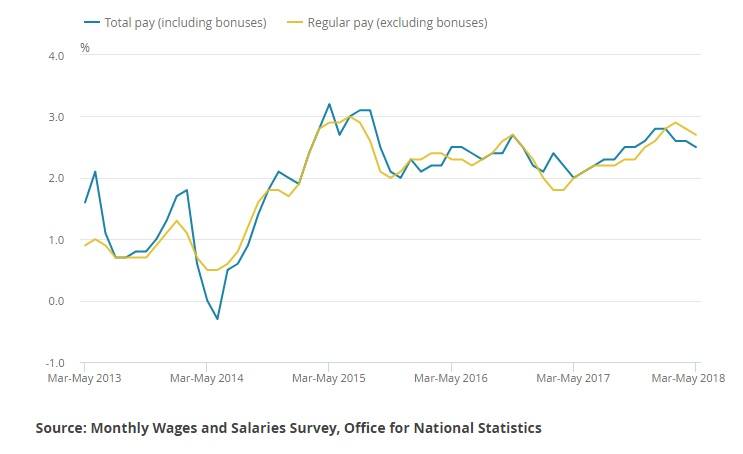
  • The UK wages for 2.5% y/y in three months ending in May including bonuses while rising 2.7% excluding bonuses at the same time.
  • The claimant count rose slightly, but the unemployment rate remained stagnant at four decades low of 4.2%.

The UK labor market report in June came out in line with the market expectations, especially with wages rising 2.5% over the year including bonuses while decelerating to 2.7% over the year in three months ending in May, the Office for National Statistics informed on Tuesday.

The number of unemployment benefit seekers in June increased by 7.8K in June after the revised drop of 3.0K in May, but the unemployment rate remained stagnant at four decades low of 4.2%.

The employment rate representing the proportion of people aged from 16 to 64 years who were in work rose to  75.7% in June, the highest since comparable records began in 1971.

With the UK labor market remaining strong in historical basis and the wages rising above the estimated inflation rate, the growth prospects are improving giving the Bank of England another reason to go ahead with the rate hike as early as August 2, this year together with the release of August Inflation Report that will be accompanied with the press conference of the Governor Mark Carney.

This is playing well into the Bank’sd strategy as the Bank of England turned hawkish in June voting 6-3 in favor of keeping the Bank rate steady, but the hawkish camp strengthened with the Bank of England chief economist Andy Haldane joining the camp of Ian McCafferty and Michael Sauders. 

UK wages
Author

Mario Blascak, PhD

Mario Blascak, PhD

Independent Analyst

Dr. Mário Blaščák worked in professional finance and banking for 15 years before moving to journalism. While working for Austrian and German banks, he specialized in covering markets and macroeconomics.


More from Mario Blascak, PhD
Share:

Editor's Picks

GBP/USD surges to multi-day peaks past 1.3250

GBP/USD leaves behind Friday’s small pullback and advances past 1.3250 level, or five-day highs, on Monday. Cable’s upside follows extra losses in the Greenback, while traders continue to assess the geopolitical front and upcoming key events.

EUR/USD pops to daily highs near 1.1430

EUR/USD starts the week on a positive note, climbing to as high as the 1.1430 zone, or daily tops, on Monday. The pair’s recovery comes in response to the broad-based US Dollar weakness, while investors continue to monitor developments from the Middle East ahead of the beginning of the ECB's annual forum.

Gold remains supported by $4,000

Gold remains under marked selling pressure, holding on just above the key $4,000 mark per troy ounce at the beginning of the week. The precious metal reverses two daily advances in a row as renewed effervescence in the Middle East revive inflation concerns and bolster Fed rate hike expectations.

Bitcoin four-year cycle: BTC risks 75% drawdown with four months of bear market still ahead

Bitcoin price continues to trend downward below the $60,000 support zone after losing over 50% of its value since the $126,199 high in October. Bitcoin’s four-year cycle, measured from cycle tops to bottoms, suggests that four months of a bear market are still ahead.

Just like Fed, is BoJ’s independence under threat?

When talking about central bank independence, most of the focus has been on Donald Trump’s pressure on the Federal Reserve. But a similar story, a quieter one for now, seems to be happening on the other side of the Pacific: Japan’s government may be testing the Bank of Japan’s independence.

Kevin Warsh isn't expected to say much in Sintra: That's exactly why markets will listen

Financial markets could find an important catalyst in the enchanting, fairytale-like landscape of Sintra this week. The ECB Forum will, as it does every year, gather the crème de la crème of central banks. The new boss at the Fed, who has clearly said that the Fed should stop explaining everything, will need to talk – and traders should listen.















