The tape is loud, but the bid is still there


The bid is still there
Seventeen trading days into the year, and it already feels like a full quarter has passed. Headlines spin the roulette wheel every session. Politics collides with policy. Threats collide with markets. And yet when you look up at the scoreboard, the S&P is quietly green, behaving as if none of it is terminal. When the headlines scream, and the index shrugs, that is the market telling you what actually matters.
At first glance, the price action invites the wrong conclusion. The dollar slips. Gold refuses to let go of the $5000 level. Silver trades like it has discovered jet fuel. Stop there, and it is easy to declare a Sell America trade, a rush for hard assets as Trump turns geopolitics into headline roulette. But markets do not vote with one asset. They vote with flows. You have to read the whole book, not the loudest page.
Equities are not acting defensively. They are rotating ( broadly speaking). While parts of the country are hunkering down or literally digging out from under Winter Storm Fern, US markets are doing the opposite. Tech and communication services led early, then handed the baton to energy, materials, staples, and industrials. This is not fear. This is a change of seats, not leaving the theatre. Markets that broaden rarely roll over quietly.
The mega cap story is being misread. This is not a valuation cliff. It is dispersion. Some names cool. Others reprice growth paths and capital spending. The premium remains elevated, but no longer extreme by recent standards. Earnings season will referee, but this is sorting, not sentencing.
Rates tell a similar story. Treasuries are bid, especially at the long end, but trapped in a narrow corridor. This is not a flight to safety ratther it is a market that believes the Federal Reserve will sit tight and keep the table stable. Rate cut expectations have nudged higher at the margin, not collapsed or exploded. The bond market is not calm because risk is gone. It is calm because policy is still predictable and the referee remains independent.
The dollar’s slide fits that framework. The damage occurred amid thin liquidity, fueled by talk of coordination with Japan as the yen snapped around like a loose cable. This is not de-dollarization, although it makes for great headlines.
Gold’s behaviour is the tell. It is not reacting to fear headlines. It is repricing global confidence. $5100 was not a ceiling, just as the $4900–$5000 zone is unlikely to become a trapdoor if the forces that have defined this multi-year ramp remain intact. It is a checkpoint. Options positioning is creating short-term gravity around these levels, but that is surface mechanics, not causality. The deeper driver is institutional. Central banks and long-horizon allocators are not abandoning the dollar system overnight. They are quietly hedging its edges, one allocation at a time, treating gold less as a trade and more as balance sheet insurance.
Volatility adds another layer. Index skew shows no clean bullish or bearish lean. The VIX sits in the mid-teens even as single-name volatility flares. This is a short-dated vol seller regime again. The guardrails are up, but thin. Zero-day options have pinned the index and compressed realized volatility, masking fragility underneath. The market is quiet because it is being held, not because it is relaxed.
Commodities tell their own uneven story. Crude limps lower with yields, caught between macro caution and structural oversupply. Bitcoin shakes off a rough weekend and stabilizes intraday, still trading like a leveraged liquidity proxy rather than a sanctuary. Precious metals steal the spotlight, but even there the drama hides complexity. Not every spike is a signal. Some are just stress fractures.
Silver’s surge has been spectacular, blasting through levels that force old ratios to break. The collapse in the gold-silver ratio has technicians calling exhaustion. Yet positioning fails to confirm a classic blowoff. ETFs have seen outflows. Hedge funds have trimmed longs as CME margin requirements bite. The usual fast money is not chasing. When the price runs without the tourists, you have to ask who paid for their tickets to get them stamped.
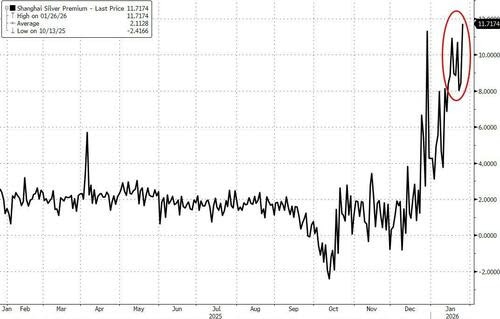
The answer likely lies in Asia. None of this is happening in a vacuum. As pre–Chinese New Year demand sweeps across the region, precious metals demand is moving through Asia like a seasonal fever. Retail buying, which never shows up in Western flow data, is doing the heavy lifting. Physical premiums, especially in China, have blown out. Corporations scrambling to secure supply amid shortage fears are adding another layer of urgency. That kind of demand can carry prices a long way, but it rarely guarantees a smooth landing once the season turns.
The Shanghai premium over London has risen dramatically. Thanks to one of Dark Side of the Boom traders, Op @slrt, for pointing that out over the weekend!
As for the broader US stock market and maybe global markets as a whole, positioning is where the big risk hides. Last year, caution was the invisible tailwind as investors waited for dips that never came. This year, that cushion is thinner. Cash is lighter. Exposure is higher. The market has leaned in. Crowded trades do not fail because they are wrong. They fail because they run out of real money buyers.
The yen sits beneath it all like a metronome, but keep an eye on AUDJPY, the true risk beta in FX land. Every violent fifty-point move is a reminder that FX is not a free lunch. Trends are negotiated daily, not guaranteed. When it swings, carry trades adjust, and risk is recalibrated across assets. Ignore FX, and you are trading with one eye closed.
The structural supports remain intact. Monetary policy is accommodative in posture even if the Fed calendar lags. Fiscal impulse is alive. Regulatory pressure has eased. The AI value unlock is still being treated as an earnings bridge, not a narrative crutch. Layered on top are the familiar engines. Buybacks. Retail dip buying. M&A quietly absorbing equity supply. The machinery is noisy, but it is still running hot.
The economic scaffolding justifies the market’s behaviour. Employment is firm. Growth is stable. Inflation is normalizing. Rates are lower than last year even if cuts arrive slower than hoped. The data is not the problem. Sometimes it is simply the interpretation that fails.
Politics and markets are no longer adjacent. They are fused. Every headline carries optionality. Every comment is leverage. The real skill now is not forecasting the news, but deciding how long it matters. Greenland rhetoric. Japan fiscal tremors. Tariff threats. Domestic political theatre. The danger is not the headline. It is mispricing its half-life.
Last week was the case study. Tone deteriorated fast. Then it stopped mattering. By the end of the week, yields stabilized and focus snapped back to earnings and Fed themes. That is not complacency. That is adaptation.
The US growth narrative continues to surprise. Talk of consecutive quarters above 5% GDP would have sounded absurd not long ago. Now it circulates freely. Service activity is accelerating. Jobless claims remain healthy. The economy is running hot, and policy is tolerating it. Markets rarely top when growth is still being revised upward.
Bonds remain the quiet smoke signal. Yields have started to grind higher again. Foreign policy tone. Defence spending. Tariff noise. Supply questions. Buyer questions. The equity rally has been supported by stable long rates. If that anchor drifts, sentiment will follow faster than fundamentals.
Put it all together, and this does not feel like an ending. It feels like a transition within a bullish stock market regime. Loud headlines. Quiet resilience. Leadership rotating rather than collapsing. Heavy positioning that can amplify moves in either direction. And currencies flashing reminders that the US Treasury Police still matter.
The tape is clear. As long as liquidity is tolerated and earnings hold, the path higher remains open. Not because the world is calm, but because capital has decided instability is tradable. The road is still there. It is just rougher than most are willing to admit.
Through it all, the tide remains in. That does not mean it will stay that way forever. But for now, liquidity is tolerated, capital is active, and everyone is still swimming. Signal saturation is not a warning sign. It is the admission price for this market.
Author
Stephen Innes
SPI Asset Management
With more than 25 years of experience, Stephen has a deep-seated knowledge of G10 and Asian currency markets as well as precious metal and oil markets.