The September curse strikes again


If you have déjà vu, it is no surprise. A month ago, a sell off happened, and it looks like the same thing is happening this month. A mixture of fears about global growth, a commodity market sell off, shifting monetary policy cycles and seasonality, with stock markets typically doing badly in September, has been given a helping hand by the Department of Justice in the US, who has subpoenaed Nvidia as it seeks evidence that the AI giant broke anti-trust laws. Nvidia, still the top performing stock on the S&P 500 so far this year, toppled nearly 10% on Tuesday, and the semiconductor sector in the US was the second worst performer of the day. There were few safe harbours in the latest financial market storm. Tech was the most impacted, and the Nasdaq dropped more than 3%. However, even the Dow Jones Industrial Index lost 1.5%, with defensive sectors like healthcare and consumer staples just about managing to eke out a gain.
Commodity market concerns remain
The FTSE 100 may not be tech heavy, but this rout is not just about tech, it is also a reflection of growth concerns. The commodity market sell off began in earnest last week and has filtered through to stocks as we progress through this week. The Brent crude price has fallen more than 6% in the last 5 days, gasoline has fallen by 12% and iron ore is down more than 8%. While we continue to think that the decline in commodities is due to fears of oversupply, there is no denying that there is a commodity-equity link in the market right now, which is weighing on the broader market as tech leads this sell off.
There could be further pain on Wednesday. We get a flurry of key US economy, such as job openings and factory orders. There was further weakness in Chinese data overnight, the Caixin service sector PMI report dropped from 52.1 to 51.6. The good news is that the service sector index is still in expansionary territory. Added to this, the US ISM Manufacturing index also remained mired in contraction territory for August at 47.2. The new orders component fell, and prices paid rose along with the employment sub index. As we said yesterday, the market is reactionary and volatility remains elevated, so expect further sell offs if we get weak economic data later this week.
Is the market overestimating recession risks?
However, it is worth noting that the market has reacted strongly to summer data, which is usually when things slow down in the manufacturing sector, thus the ISM manufacturing surveys may not be giving us a recession signal for the US. It is worth noting that yesterday’s Atlanta Fed GDPNow estimate for Q3 GDP, came in at a very respectable 2%, even if it is down from the 2.5% level estimated last week.
The main event this week remains the payrolls report, however, economic data on Wednesday is also worth watching. In the US, factory orders and Jolts job openings are the highlight, in Europe and the UK, the focus will be on service sector PMIs for August. The market expects these to remain in expansion territory, but an upside surprise could calm market fears.
Where will stocks go next?
European markets are set to open lower, after a sharp sell off for Asian shares, the Nikkei is lower by more than 4%. However, it is worth noting that commodity prices did not sell off as much as stocks on Tuesday, and Brent crude is finding support above $73.00, after falling to its lowest level of 2024. If commodities can stage a recovery from here, then stocks may follow.
Gold, not acting like a safe haven for now
Also worth noting is the performance of gold. It has also fallen this week and did not rally like a traditional safe haven on Tuesday. While it has outperformed every other commodity this week, it is still lower by 0.5% in the past 5 days, which suggests that the market is not in panic mode right now. Added to this, there were large inflows into government bonds, the US 10-year yield is lower by more than 10 basis points, which suggests that investors still believe that the Fed has the market’s back. There is now just over 100 bps of rate cuts priced into the Fed Funds market, so investors are still banking on sweeping interest rate cuts for the rest of this year.
The AI theme takes another pause
The legal woes facing Nvidia is giving investors time to rethink the investment case for AI, after its terrific run this year. The DOJ case against Nvidia may also erode support for AI in the long term and due to this it could be harder for Nvidia to bounce back than other sectors of the market. The sweet spot for the broader market would be a decent payrolls number and the continued prospect of interest rate cuts from the Federal Reserve. This is why payrolls will continue to be key for market sentiment. Until then stocks may struggle to rally, and S&P 500 futures are pointing to another leg lower for US stocks later today.
Chart one: S&P 500 and equal weighted S&P 500, the broader market index ex tech is not playing catch up during this sell off
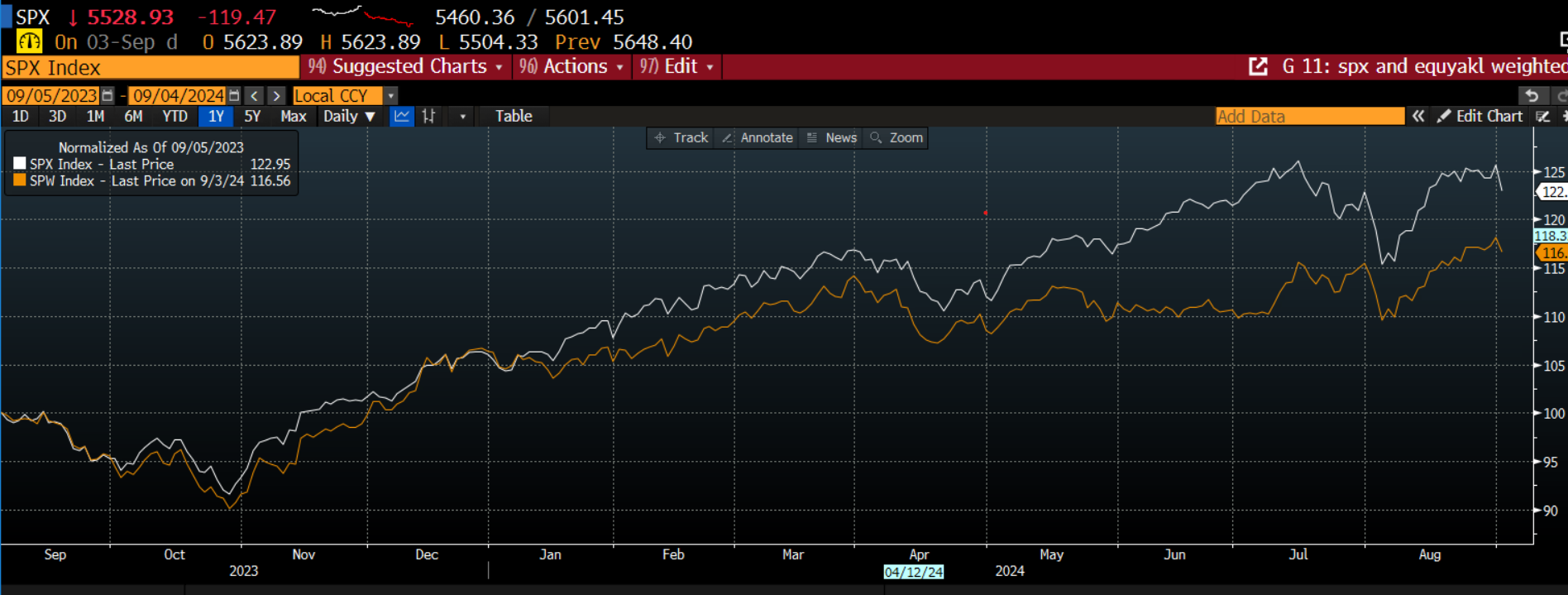
Source: Bloomberg and XTB
Author
Kathleen Brooks
XTB UK
Kathleen has nearly 15 years’ experience working with some of the leading retail trading and investment companies in the City of London.

















