|

The power of Elliott Wave blue boxes: GBP/USD’s perfect bounce

In this technical blog, we will look at the past performance of the 1-hour Elliott Wave Charts of GBPUSD. In which, the rally from 13 January 2025 low is unfolding as an impulse sequence & showed a higher high sequence therefore, called for an extension higher to take place. We knew that the structure in GBPUSD should remain supported & extend higher. So, we advised members not to sell the pair & buy the dips in 3, 7, or 11 swings at the blue box areas. We will explain the structure & forecast below:

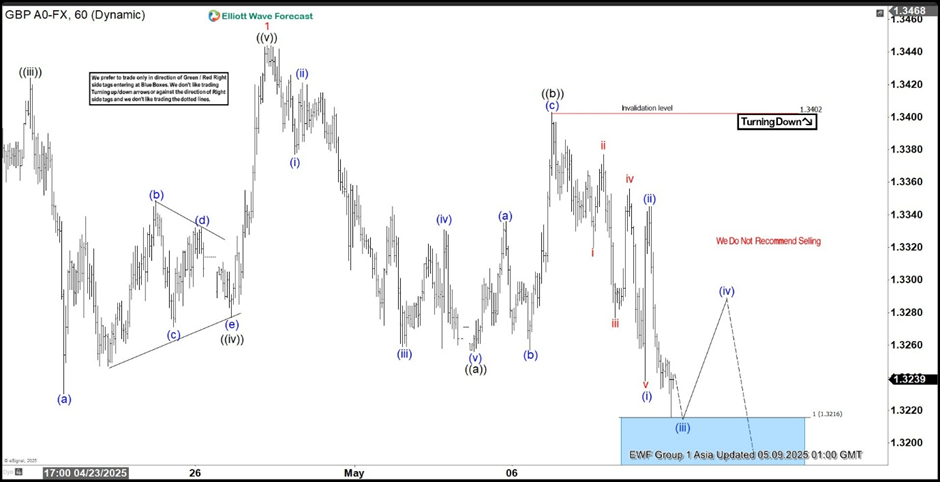
GBP/USD one-hour Elliott Wave chart from 5.08.2025
Chart

Here’s the 1-hour Elliott wave Chart from the 5.09.2025 Asia update. In which, the rally to $1.3443 high completed wave 1 & made a pullback in wave 2. The internals of that pullback unfolded as Elliott wave zigzag correction where wave ((a)) ended at $1.3257 low. Then a bounce to $1.3403 high-ended wave ((b)) & started the next leg lower in wave ((c)) towards $1.3216- $1.3100 blue box area. From there, buyers were expected to appear looking for new highs ideally or for a 3-wave bounce minimum.

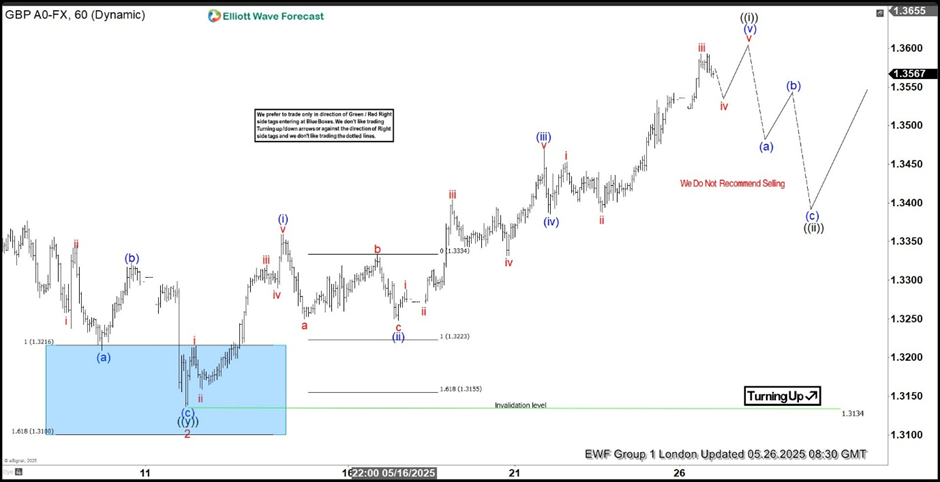
GBP/USD latest one-hour Elliott Wave chart from 5.26.2025
Chart

This is the latest 1-hour Elliott wave Chart from the 5.26.2025 London update. In which the pair is showing a strong reaction higher taking place, right after ending the correction within the blue box area. Allowed members to create a risk-free position shortly after taking the long position at the blue box area. Since then, the pair has already made a new high above $1.3443 high confirming the next extension higher targeting $1.3819- $1.4044 area higher.

Author

Elliott Wave Forecast Team

Elliott Wave Forecast Team

ElliottWave-Forecast.com

More from Elliott Wave Forecast Team
Share:

Editor's Picks

GBP/USD flirts with weekly highs in the Fed's aftermath

GBP/USD reversed early losses following the Federal Reserve decision to keep rates on hold and neared the 1.3360 level before shedding some ground. Focus shifts to Governor Kevin Warsh's speech, while the Bank of England will announce its monetary policy decision on Thursday.

EUR/USD extends rally pass 1.1450 on Fed's Warsh

EUR/USD trades at fresh weekly highs above 1.1450, following the Federal Reserve monetary policy decision to keep interest rates on hold. The statement showed policymakers remain confident in economic progress while blaming inflation on energy prices. The divided vote among officials put in doubt a September hike, leading to sharp US Dollar losses.

Gold faces rejection near $4,100 amid emergence of USD dip-buying

Gold struggles to build on a modest intraday uptick beyond $4,100 during the Asian session on Thursday as the US Dollar attracts some dip-buyers following the previous day's post-FOMC slide to a one-week low. Escalating US-Iran tensions support oil prices, fueling inflation fears and bolstering bets for at least one Fed rate hike in 2026. This, in turn, underpins the Greenback and acts as a headwind for the non-yielding bullion.

Bitcoin trails US Dollar as Fed holds rate steady
The Federal Reserve (Fed) kept its benchmark interest rate unchanged at 3.50% to 3.75% at its July meeting on Wednesday, in line with market expectations. Minutes from the meeting showed that economic activity has been expanding at a solid pace despite elevated uncertainty. The central bank also noted that job gains have "kept pace with the workforce."
No soft target: Warsh vows to return inflation to 2%
The Fed left interest rates unchanged at 3.50%-3.75%, but the decision carried a distinctly hawkish edge as three officials voted for an immediate 25-basis-point increase. Chair Kevin Warsh reinforced that message, insisting there was no tolerance for a softer inflation target and warning that the Fed would not hesitate to act.
US Dollar mid-year outlook: Exceptional currency, exceptional risks?
The US Dollar enters the second half of 2026 in a markedly different position from a year ago. The King currency has recovered, reflecting persistent US inflation, changing expectations for Fed policy, geopolitical tensions and renewed demand for defensive assets.
















