The New China and Gold

China has developed tremendously in recent years. But what's next? Is the country entering the growth recession? And how it will affect the world and the gold market?
A New Chapter in China
We have not analyzed the publications of the World Gold Council for a while. Let's make it up, starting with the newest edition of Gold Investor. The report is about China and its remarkable transformation in the context of the gold market.
Indeed, at the turn of this century, China was a minor player in this market. While today it is both the world's largest consumer and producer of gold, accounting for 23% of total gold demand and 13% of total gold supply. However, there are still opportunities for further development, as the investor base is too narrow, while the market infrastructure and regulations need to improve.
According to the publication, Chinese investors should optimally allocate to gold about 6 percent of their portfolios. Such an allocation would reduce the volatility of the portfolio, increase the Sharpe ratio from 0.46 to 0.54 and still keep the target return of 5% The reasons for holding gold are widely known, but let's mention them: it's a portfolio diversifier (it has low or negative correlations with other asset classes), it's an alternative currency, and it has no credit risk. Moreover, gold market is deep and liquid.
There are many concerns about the future growth of China's economy. In particular, people worry about the country's debt to GDP ratio is around 250 percent, clearly too high for an emerging market. Zhou Hao, Associate Dean at Tsinghua University PBC School of Finance, interviewed in the publication, dismisses these fears, pointing out that China is still growing at around 6% a year, so that ratio may be more sustainable than people think. Also, he argues that the central government has enormous foreign exchange reserves, while households are not highly leveraged.
We are more skeptical than Hao. True, the economy is still growing, but that growth is partially possible exactly thanks to incurring more debt. Life on credit is not stable.
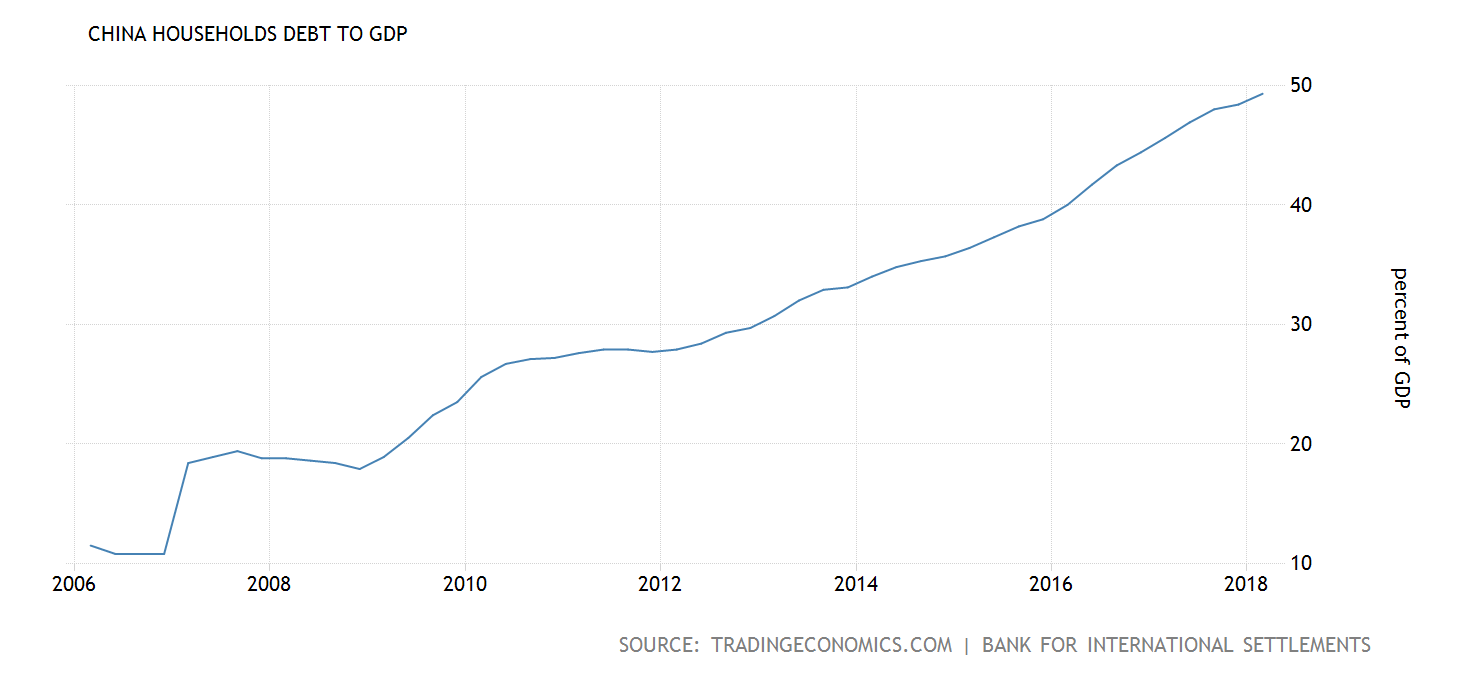
Especially that, contrary to Hao's words, Chinese consumers have accumulated a lot of debt recently. Just look at the chart below. As one can see, China's household debt-to-GDP ratio jumped from almost 40 percent in 2016 to almost 50 percent in the first quarter of 2018, reaching a record high.
Chart 1: China's household debt-to-GDP ratio from 2006 to Q1 2018.
Gold Demand Trends and Investment Update
The WGC also published a new edition of its quarterly report on gold demand. The highlights are that both retail investors and central banks took advantage of the price dip and increased their purchases (so they are price-takers, not price-setters). The demand for gold bars and coins jumped 28 percent in Q3 2018, while central bank reserves grew 22 percent year-onyear. In the December edition of the Market Overview, we will analyze whether the central banks' purchases create a floor for gold prices.
However, gold ETFs saw a 116t decline when compared with inflows of 13.2t in Q3'17. It does not look encouraging – but the trend reversed in October, which indicates an improved sentiment towards gold compared to the third quarter of 2018.
Last but not least, let's analyze shortly the recent WGC's Investment Update. It's a short publications which points out the gold's role as a safe haven asset in the context of the recent stock market turmoil. Initially, the yellow metal did not response to the US stock market selloff. But as it became more systemic globally, gold began to rally.
Implications for Gold
To sum up, we provided you with an update on the recent WGC's publications. The most important report concerns China. Actually, it is one of the most important questions in our times. So far, the Chinese authorities have postponed the inevitable slowdown. But it will arrive one day. Given the economy's massive leverage, the growth recession is likely to cause a financial crisis, which would hit the whole world. Gold should shine, then. The problem is that nobody knows when it will happen. So be prepared, but also remember that it may take a while, so you can lose money passively waiting for the day of reckoning. Stay tuned!
Want free follow-ups to the above article and details not available to 99%+ investors? Sign up to our free newsletter today!
Author
Paul Rejczak
Sunshine Profits
Paul Rejczak is a stock market strategist who has been known for the quality of his technical and fundamental analysis since the late nineties.