The market is finally moving... But has anything really changed?
Over the past 24 hours, we've finally seen some movement across the markets.
The good news? Several of the scenarios we've been discussing started to play out exactly as expected. The bad news? Most charts are still sitting between major support and resistance levels, meaning the bigger technical picture hasn't changed just yet. Until those key barriers are broken, patience remains just as important as prediction.
Dollar (DX.F)
Yesterday we wrote:
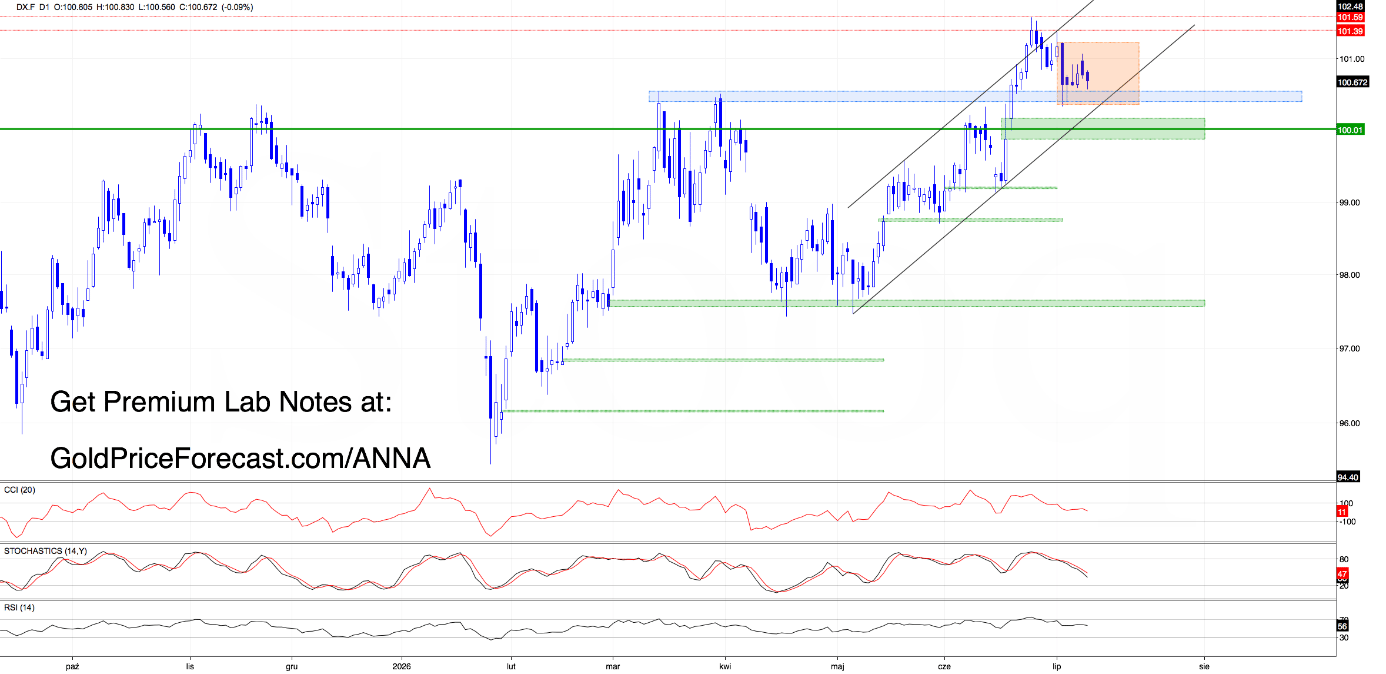
(…) “If today's session closes below 100.77, today's bullish gap would likely become nothing more than another failed recovery attempt, increasing the odds of a re-test of the support zone built around the previously broken March highs (100.36-100.53).”(…)
Well... That's exactly what happened.
The Dollar Index finished the session at 100.76, officially triggering yesterday's bearish scenario and pushing the price closer to the support zone built around the previous March highs.
Does that automatically mean a larger decline has started?
Not yet.
The dollar is still trading inside its consolidation, and neither buyers nor sellers have won the bigger battle.
What should traders watch now?
On the upside, 101.21 remains the first key resistance. Only a breakout above that level would put buyers back in control and reopen the path toward the next upside target we discussed on June 25:
“(…) buyers (…) still have a chance to attack the next upside target around 101.74-101.81, where the 138.2% Fibonacci extension and the May 2025 intraday high come into play.(…)”
On the downside, the focus stays on 100.36-100.53, along with 100.32, the lower boundary of the orange consolidation. A daily close below that entire area would significantly strengthen the bearish case and shift attention toward the next downside cluster around 99.86-100.15, about which we wrote at the beginning of the month.
Takeaway
- Watch 100.36-100.53 support together with 100.32.
- Daily close below 100.32 -> opens the door toward 99.86-100.15.
- Break above 101.21 -> buyers regain control and keep the short-term uptrend alive.
Palladium (PA.F)
Palladium continues to be one of the strongest metals on our watchlist.
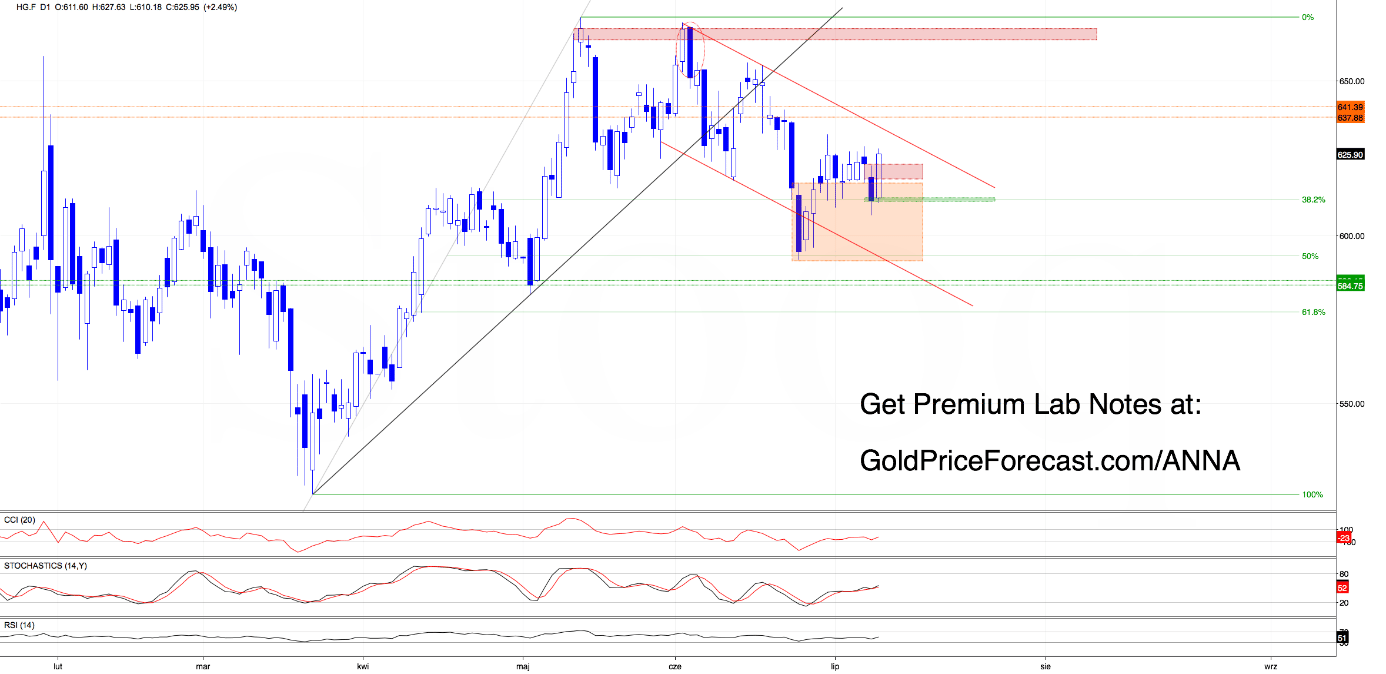
Buyers successfully pushed the price back above the previously broken upper boundary of the consolidation (1248).
That's encouraging. However, one important obstacle still stands in the way - yesterday's bearish gap (1269-1281).
Closing that gap would reactivate the bullish roadmap from the beginning of the month, targeting 1324-1363, with the measured move pointing toward roughly 1347, followed by a potential test of the upper boundary of the red descending channel.
If buyers fail?
The focus shifts back toward 1206, then 1180, and potentially 1156.
Takeaway
- Watch 1269-1281 resistance gap.
- Close the gap -> buyers target 1324-1363.
- Failure there -> 1206, 1180 and 1156 become the next downside levels.
Copper (HG.F)
After yesterday's disappointment, copper immediately answered back.
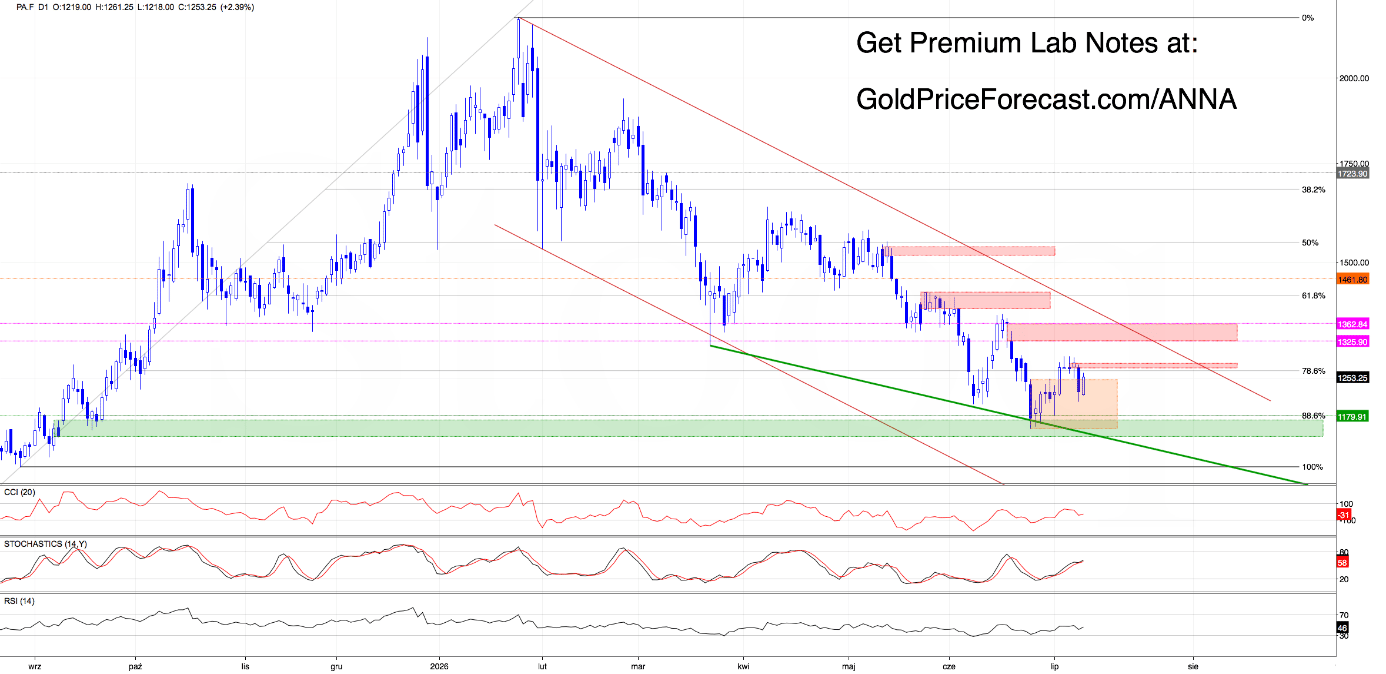
Today's Asian session opened with a small bullish gap (610.75-611.60), and buyers quickly reclaimed the orange consolidation while also closing yesterday's bearish gap (617.75-622.60).
Momentum has clearly improved.
Now attention shifts toward the upper boundary of the red descending channel, currently sitting near 634.78. That level is likely to determine whether this recovery has enough fuel to continue.
Takeaway
- Watch 634.78 resistance.
- Break above -> recovery gains momentum.
- Failure there may trigger another pullback toward the reclaimed consolidation.
Final thoughts
Over the past two sessions, we've seen something important: the market has started moving, but the biggest technical decisions still haven't been made.
Several bearish scenarios were triggered exactly as expected, while today's session showed buyers are beginning to fight back across some instruments.
For now, neither side has delivered a decisive victory.
Want free follow-ups to the above article and details not available to 99%+ investors? Sign up to our free newsletter today!
Author

Anna Radomska
Gold Price Forecast
Anna's passion for drawing evolved into a fascination with colorful lines and shapes, which later inspired her interest in the stock market.